
How to Find Recently Released Hillsborough Inmates
The Hillsborough County Sheriff's Office does not publish a public "released inmates" list as its own page. Release information is pulled out of the same tool used for current bookings: the HCSO Arrest Inquiry. The portal is built around a single form. To look for someone who is no longer in jail, the trick is to leave the "Current Inmates Only" box unchecked and to use the Release Date field as a filter. People who have been let out stay listed on the public site for 90 days after release. After that window closes, the public view drops them unless the requester is an authorized member from law enforcement, the bond industry, accredited media, or a state bar.
Live arrest records refresh every 30 minutes. There is one delay to know about. A new arrest will not appear in the general browse list for the first 24 hours. During that gap, the record can still be pulled up if the searcher types the full first and last name. Once 24 hours pass, the record joins the broader queue. If a person was booked and then released the same day, the Release Date filter is the fastest way to confirm it. Booking number, booking date, race, sex, and date of birth all narrow results when several people share a common name.
When the online tool does not match what is expected, calling the jail is the next step. HCSO Inmate Records can be reached at 813-247-8400, and the main jail line is 813-247-8300. Records staff can verify whether a person has been released, transferred to state custody, or moved between the Orient Road Jail and Falkenburg Road Jail. Authorized users with bail-bond, attorney, or media credentials can request fuller access by emailing publicaffairs@teamhcso.com from an official email account.
Note: Released-inmate listings drop off public view 90 days after release unless the searcher qualifies as an HCSO authorized member.
Setting Up VINELink Release Notifications
For victims, family, and concerned community members, the simplest way to stay on top of a release is a notification service. VINELink is the public side of the VINE (Victim Information and Notification Everyday) system. It plugs into county jail data feeds and state prison systems across the country. A VINELink alert can fire by phone, by email, or by text when the registered offender is booked, transferred, released, or moved to supervision. Registration is free and confidential.
A screenshot of the VINELink custody-status notification site shows the entry point used to start a watch on a Hillsborough County inmate.
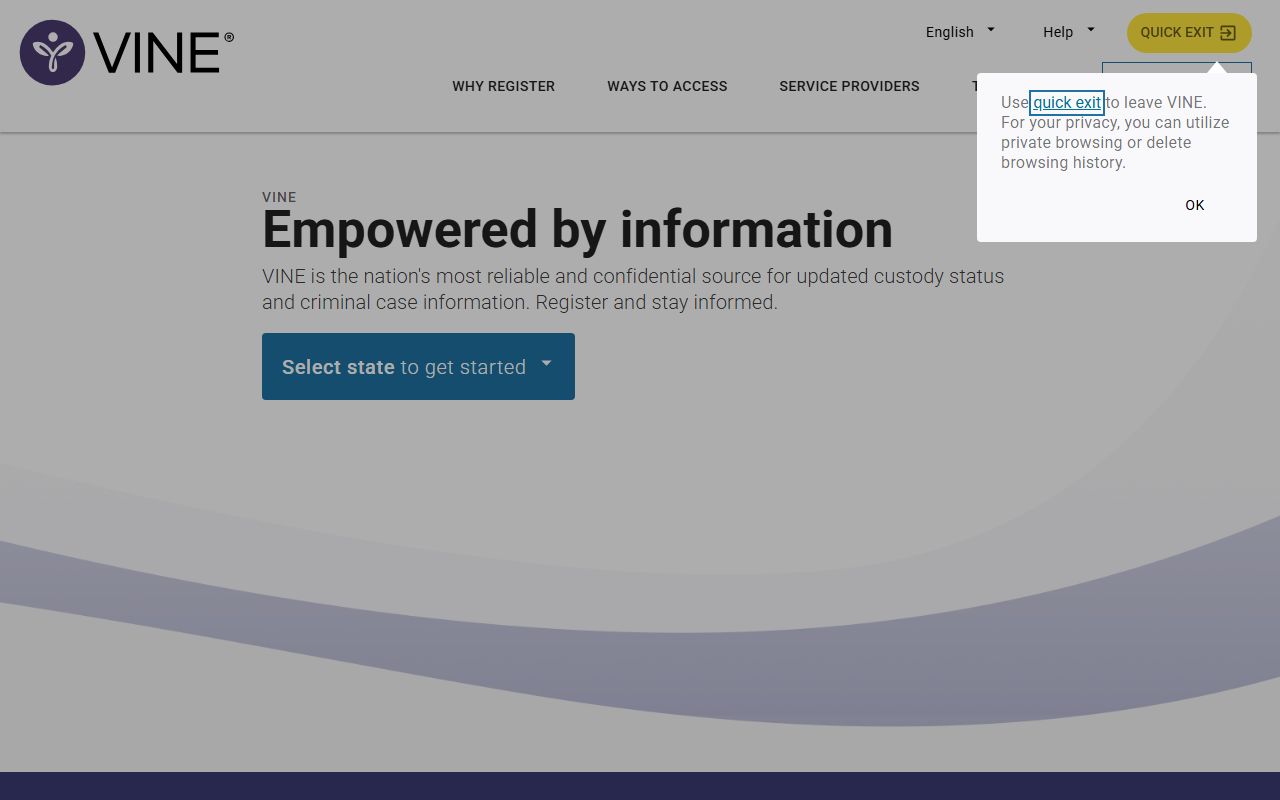
The VINELink home screen leads to a state selector, a name and ID search, and a registration workflow that links a contact method to the offender of interest. Anyone tracking a Hillsborough case should pick Florida, look up the person, then choose how the alert reaches them.
- Visit the VINELink site and choose Florida from the state selector.
- Search by offender name or by jail/state ID number, then pick the matching record from the result list.
- Register a phone number, email, or text destination, set a PIN for phone alerts, and confirm the notification preferences.
Florida also has a parallel state-run victim-notification service through the Department of Corrections. The FDC Victim Notification Request form covers offenders held in the state prison system rather than the county jail. A short look at that form is worth doing for anyone whose offender of interest has already moved out of Hillsborough custody into state prison.
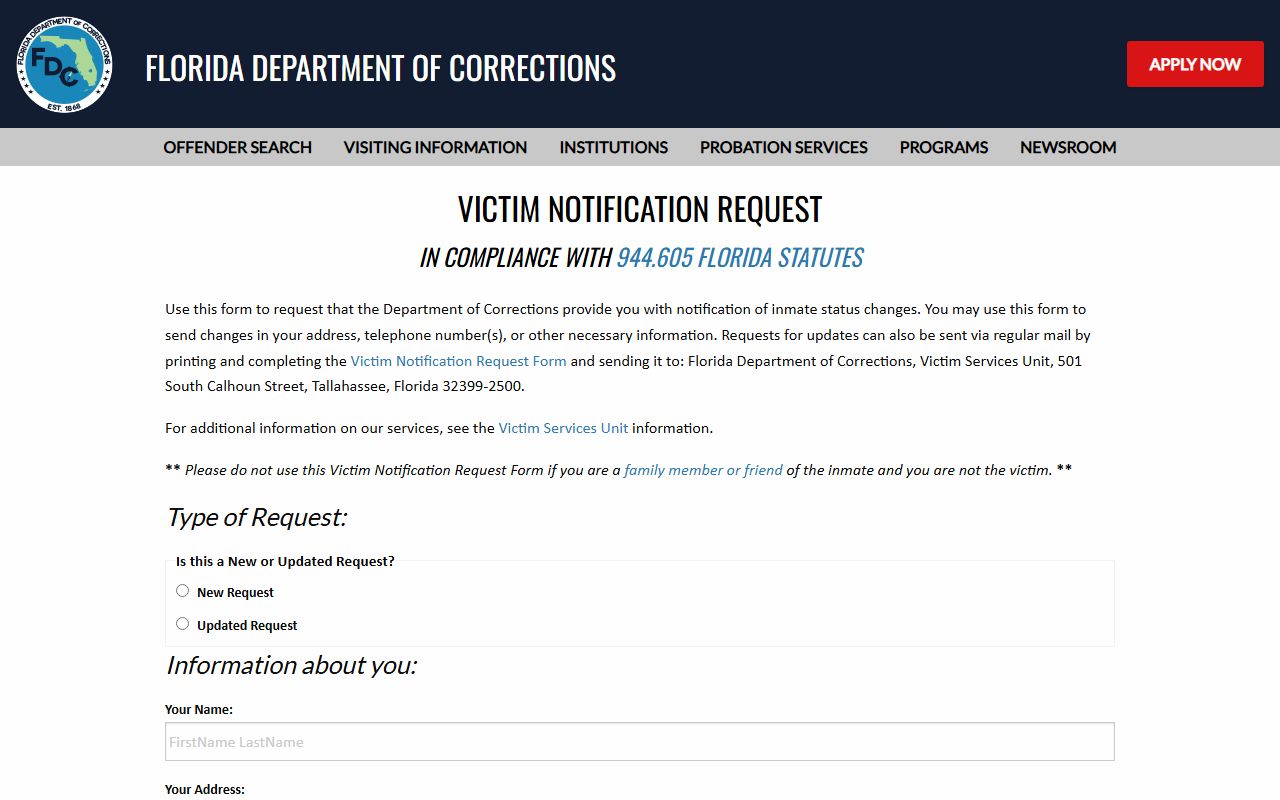
The FDC form lets a requester submit identifying details on both the victim and the inmate, including DC number, date of birth, crime, county, and case number. Filing both a VINELink registration and the FDC form gives the most complete custody-status coverage when a case may move between local and state systems.
Searching Florida State (FDC) Released Inmates
Once a person finishes a county sentence and is moved into the state prison system, they leave HCSO custody and become a Florida Department of Corrections case. The FDC public site hosts inmate search tools, the reentry resource directory, victim assistance, and supervision data. FDC reports that the state prison system holds more than 80,000 inmates and watches more than 146,000 offenders in the community on probation, parole, and other supervised release.
FDC's inmate locator accepts names and DC numbers and returns custody status, location, projected release date, and offense summary. The search-field structure looks like the table below, drawn from the FDC public locator and victim-assistance tools.
| Field Label | Type | Required | Notes |
|---|---|---|---|
| Last Name | Text | No | Use with first name or DC number for best matches. |
| First Name | Text | No | Helps narrow common surnames. |
| DC Number | Text | No | Florida Department of Corrections inmate number. Exact match. |
| Race | Dropdown | No | FDC race codes. |
| Sex | Dropdown | No | Male or female. |
| Date of Birth | Date | No | MM/DD/YYYY filter to break ties. |
| Status | Dropdown | No | Active inmate, released, supervised population. |
| Search | Button | n/a | Runs the locator query. |
A typical FDC profile result returns more than just custody status. The field inventory below shows what the locator usually displays for a released or active state inmate.
- DC number and full legal name.
- Race, sex, hair color, eye color, height, weight.
- Date of birth and current age.
- Custody status (active, released, supervised).
- Current facility or supervising office.
- Initial receipt date and current release date.
- Offense list with county and case number.
- Sentence length per count.
The released-inmate side of FDC is searched the same way as the current inmate side. Status simply flips from active to released, and the release date and last facility appear in the profile. For Hillsborough cases that were sentenced in the Thirteenth Judicial Circuit, the county field in FDC results will read Hillsborough.
Searching Federal (BOP) Released Inmates
Federal cases out of the Middle District of Florida send people to the Federal Bureau of Prisons rather than to a Hillsborough jail or to FDC. The BOP Inmate Locator is the official tool for current and former federal inmates. It covers anyone in BOP custody from 1982 forward. A released federal inmate will still appear in the locator with a release date listed.
A look at the BOP locator search form shows the simple two-mode setup: search by number, or search by name plus filters.
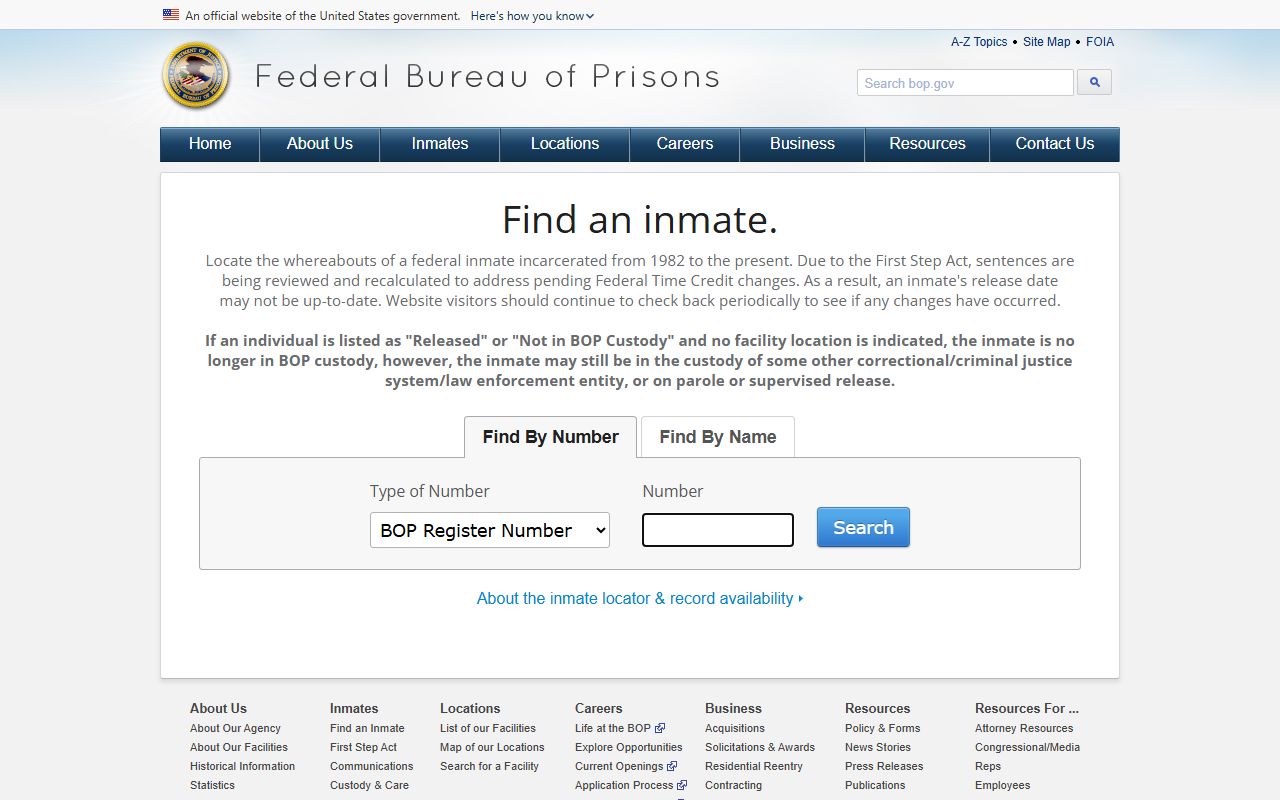
The locator accepts a BOP register number, a DCDC number, an FBI number, or an INS number on the number side. The name side supports first, middle, and last name with race, age, and sex filters. The field structure is shown below.
| Field Label | Type | Required | Notes |
|---|---|---|---|
| Find by Number | Text | No | BOP Register Number, DCDC Number, FBI Number, or INS Number. |
| First Name | Text | No | Name-search mode. |
| Middle Name | Text | No | Optional middle name. |
| Last Name | Text | No | Required when using name search. |
| Race | Dropdown | No | BOP race options. |
| Age | Text/Number | No | Filter to break common-name ties. |
| Sex | Dropdown | No | Male or female. |
| Search | Button | n/a | Runs the locator query. |
| Clear Form | Button | n/a | Resets the form. |
For Hillsborough-area federal cases, the locator will often show the person was held at FCC Coleman or a federal detention center within or near the Middle District of Florida. Released federal inmates keep showing in the BOP database with the release date and final facility, which makes the locator the right starting point for any federal release check.
Verifying Release in Person or By Phone
Some questions cannot be settled by the public web tools. A common case is a release that happened in the past few hours. Booking data updates every 30 minutes in the HCSO system, but a transfer to state custody or a release on bond may take a little longer to reflect. The fastest way to confirm a current status is a phone call to the jail. The HCSO main jail line is 813-247-8300, and the Inmate Records desk is 813-247-8400. Staff can confirm a release, a transfer to FDC, or a move between the two main jail facilities.
In-person verification is also possible. The Orient Road Jail at 1201 Orient Road, Tampa, FL 33619, is the cash-bond and purge payment site. People posting bond there learn release timing once paperwork clears. Visitors should bring the inmate's full legal name with correct spelling, the date of birth, and a valid government ID. The Falkenburg Road Jail at 520 N. Falkenburg Road, Tampa, FL 33619, is the second main facility. Both jails route their phone traffic through 813-247-8300.
Note: HCSO accepts cash bonds and purge payments only at Orient Road Jail; credit and debit cards are not accepted for bond.
Florida Sexual Offender and Predator Registry
People released after a qualifying sex offense in Florida must register and stay registered. The public-facing tool is the FDLE Sexual Offender and Predator Registry. The registry is run by the Florida Department of Law Enforcement under section 943.0435, Florida Statutes. It shows registered offenders and predators living, working, or attending school in Florida, including those who have been released from Hillsborough County jail, FDC custody, or another state's system.
FDLE warns that the registry helps with risk assessment but that positive identification still requires fingerprints. The registry is searchable in several ways. The simplified search-field structure used by the public registry is captured below.
| Field Label | Type | Required | Notes |
|---|---|---|---|
| Last Name | Text | No | Partial last-name search supported. |
| First Name | Text | No | Often combined with last name. |
| City | Text | No | City filter, includes Tampa, Brandon, Plant City. |
| County | Dropdown | No | Pick Hillsborough for local results. |
| ZIP Code / Radius | Text | No | Address-radius search for nearby registrants. |
| Offender Type | Dropdown | No | Sexual offender or sexual predator. |
| Search | Button | n/a | Runs the registry query. |
A typical registry profile shows the legal name, aliases, photo, date of birth, race, sex, height and weight, scars and tattoos, address, vehicle, employment site, school of attendance, offense list with conviction dates, and re-registration cycle. Hillsborough County hosts a sizable registrant population because of the population scale around Tampa, Brandon, and Plant City. HCSO operates a dedicated Offender Registration Unit out of the Re-Entry Center at 1201 Orient Road, Tampa, FL 33619, reachable at 813-247-8460, for in-person registration and address updates.
Parole and Probation Information
Florida ended traditional discretionary parole for most offenses committed after October 1, 1983. Today, people released from state prison are usually on a form of post-prison supervision: conditional release, control release, conditional medical release, or addiction recovery supervision. Older cases may still be on parole under the rules that applied at sentencing. The Florida Commission on Offender Review is the state board that handles those release decisions and parole revocations.
Day-to-day supervision is run by the Florida Department of Corrections through probation and community-corrections officers. FDC supervises more than 146,000 offenders in the community across the state. For Hillsborough County, supervision officers work out of local probation offices and report violations back to the Thirteenth Judicial Circuit court that imposed the sentence. Violations can lead to a warrant and a return to custody. Reports of new offenses or violations can be made to the supervising officer or to HCSO at the main non-emergency line.
Florida Commission on Offender Review
4070 Esplanade Way
Tallahassee, FL 32399
850-488-4071
Hillsborough Re-Entry Center / Offender Registration Unit
1201 Orient Road
Tampa, FL 33619
813-247-8460
People who think they may be on an old Florida parole case can write or call the Commission to confirm status. People who think they are on FDC supervision can confirm through their assigned officer or through the FDC public locator, which marks supervised cases.
FDC Reentry Resource Directory
Returning to the community after time in jail or prison is a process. Housing, ID, jobs, behavioral-health care, substance-use treatment, transportation, and probation compliance are the common pressure points. Florida has a state-built directory that maps service providers by service type and by location. The FDC Re-Entry Resource Directory is searchable by keyword, service category, county, city, judicial circuit, and ZIP code. Hillsborough County falls in the Thirteenth Judicial Circuit, so circuit and county filters both work for local results.
A look at the FDC reentry resource directory search shows the multi-filter form people use to find local providers.
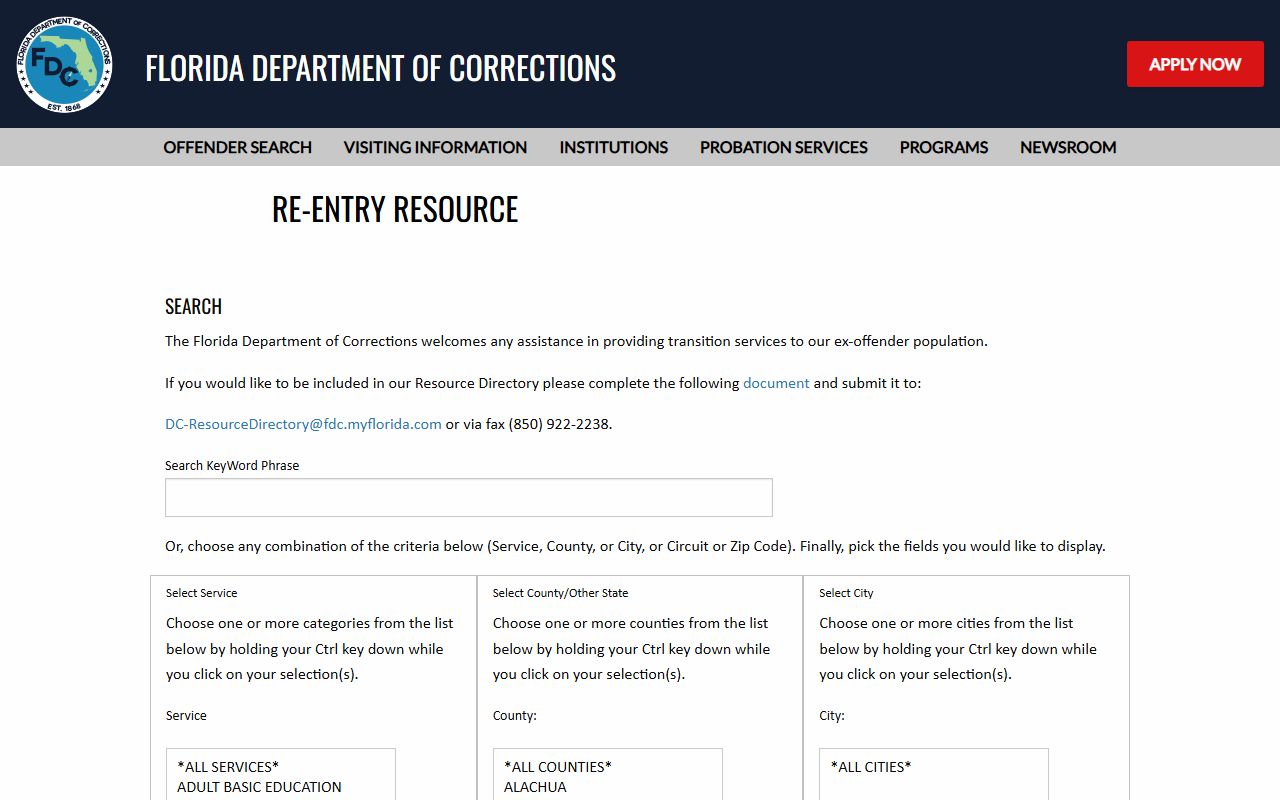
The directory returns provider name, address, phone, fax, website, email, and a notes field that often lists hours, intake rules, and the people the agency serves. The result list pulls in the contact fields the user has checked on the form. Filtering by Hillsborough County or by Circuit 13 gives a starting set for Tampa-area reentry needs.
Beyond the directory, HCSO runs a Re-Entry Center and Offender Registration Unit at the Orient Road Jail address. The unit handles offender registration, address updates, and intake referrals. The county's Veterans Treatment Court works with a wide partner list to help justice-involved veterans rebuild after release, with partners that include Agency for Community Treatment Services, Crisis Center of Tampa Bay, DACCO, Goodwill Industries, Gracepoint, North Tampa Behavioral Health, Phoenix House, Riverside Recovery, Steps to Recovery, Tampa Crossroads, The Vet Center, and WestCare. Many of those same providers serve non-veterans in their general intake.
- DACCO and Phoenix House for residential and outpatient substance-use treatment.
- Gracepoint and North Tampa Behavioral Health for behavioral-health care.
- Goodwill Industries and Tampa Crossroads for job placement and reentry case management.
- The Vet Center for veteran-specific reintegration help.
- Crisis Center of Tampa Bay for the 211 line, suicide prevention, and victim services.
Civil Rights Restoration After Release
A Florida felony conviction takes away certain civil rights, including the right to vote, the right to serve on a jury, and the right to hold public office. Restoration is handled through the state clemency process. The Florida Commission on Offender Review provides intake support for the Board of Executive Clemency, which is made up of the Governor and the Cabinet. The Florida Clemency Board sets the rules, decides cases, and grants relief.
Voting rights for many people convicted of felonies in Florida were addressed by Amendment 4, passed by voters in 2018. Implementation has continued to shift through state legislation and court rulings, so anyone trying to register after a felony should confirm current eligibility with the Supervisor of Elections and the Commission on Offender Review before registering. Firearm rights are restored only through a separate clemency process that is more selective. Employment rights vary by industry, with state-licensed jobs often requiring a disclosure of a criminal record and sometimes a waiver from the licensing board.
Sealing and expunction of a Hillsborough County criminal record is a separate remedy from rights restoration. Petitioners usually start with the FDLE seal-and-expunge eligibility process, then file in the Thirteenth Judicial Circuit court that handled the case. The Hillsborough Clerk's fee schedule lists a $42 fee for sealing any court file or expunction of any record. A sealed record is hidden from most public view but remains accessible to specified agencies. An expunged record is destroyed or restricted further. For more on those remedies, see the discussion under Hillsborough County criminal records.
Note: Voting eligibility after a Florida felony conviction depends on offense type, sentence completion, and outstanding financial obligations; confirm current status before registering.