How to Search Hillsborough County Court Records
Court files for the Thirteenth Judicial Circuit are searched through HOVER, short for Hillsborough Online Viewing of Electronic Records. The portal is run by the elected Clerk of the Circuit Court and Comptroller. HOVER returns case indexes, progress dockets, and many filed document images. The Florida Supreme Court authorized the Clerk to host this service under the state Standards for Access to Electronic Court Records and the Access Security Matrix. Access depends on whether the user is anonymous, registered, an attorney of record, or a self-represented party. Anonymous users see less than attorneys.
Before opening the portal, gather what is known about the case. A case number is best. A Uniform Case Number works too. A full party name, a date range, a court type, or a citation number can all narrow results. Some case types carry tighter image rules. Family, divorce, probate, guardianship, mental health, juvenile, and domestic violence dockets often hide images from the public view. A "Case Not Found" message can mean the file is sealed or the number was typed wrong.
The official Clerk hub for records sits one click from the portal. A look at the Clerk Records and Reports page shows the same gateway that lawyers and pro se parties use, with links to HOVER, Official Records, eCertify, and public-data files.
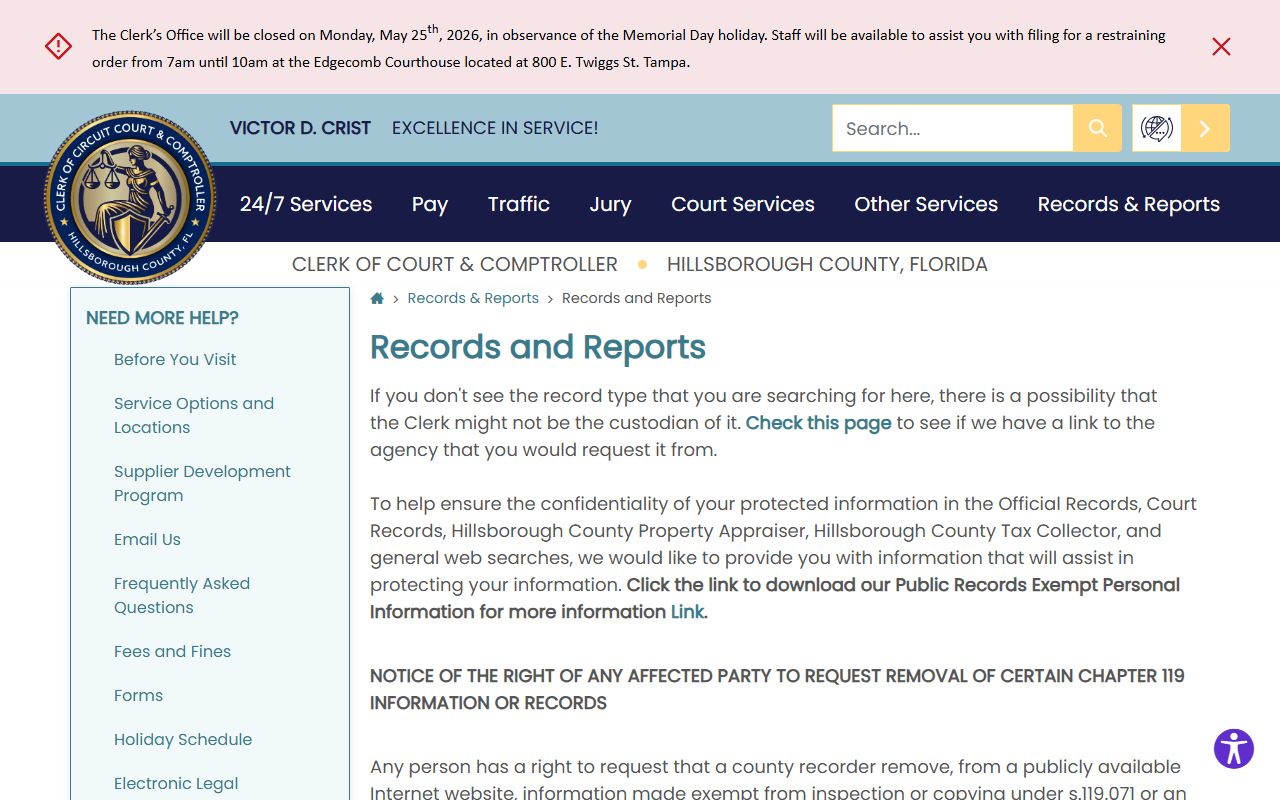
The hub also warns that some online images cannot be shown because Florida statutes restrict them. That is the same notice users see when they request older Official Records images that include death certificates or family case files.
- Open HOVER at hover.hillsclerk.com and pick a search mode.
- Use Case Number or Uniform Case Number when the number is known. Use Citation Number for traffic. Use Party or Business Name when only a name is known.
- Narrow a broad search by Date Range, Court Type, and Case Type. The Court Hearing Lookup mode finds a court date.
- Open the case detail. Look at the parties, the filing date, the judge, and the docket events.
- Review the progress docket for filings, hearings, orders, and the disposition.
- If a document is viewable and a stamped copy is needed, use Purchase Certified Copies through eCertify. The Clerk sends secure download links by email after payment clears.
- If images are missing, the file may be sealed, restricted by case type, or require an in-person visit at the Clerk's office.
HOVER has minimum browser rules. The Clerk lists Chrome 97 or newer, Firefox 96 or newer, and Microsoft Edge 97 or newer, with Java enabled. Sessions log out after 30 minutes of no use. For help with a HOVER account, the Clerk lists 813-307-7180.
The Hillsborough County Judicial System
Florida runs a four-level court system. The Supreme Court of Florida sits at the top. The District Courts of Appeal sit below it as the intermediate appellate level. Hillsborough County is in the Second District Court of Appeal. Below the appellate level are the trial courts. Circuit courts handle the bigger or more serious matters. County courts handle the smaller ones. Hillsborough County is the whole Thirteenth Judicial Circuit, which makes the circuit identity and the county identity nearly the same.
The case-flow diagram is short. A felony or large civil suit starts in Circuit Court. A misdemeanor, a traffic ticket, or a small claim starts in County Court. An appeal from either trial level normally moves up to the Second District Court of Appeal. From there, a narrow set of cases can reach the Florida Supreme Court. Public docket lookups for trial-level cases all route through the same Clerk portal.
Case flow: County Court › Circuit Court › Second District Court of Appeal › Florida Supreme Court
The current trial bench has divisions for criminal, civil, family, probate, juvenile, and mental health work. A look at the Thirteenth Judicial Circuit directory lists current judges, division assignments, and chambers.
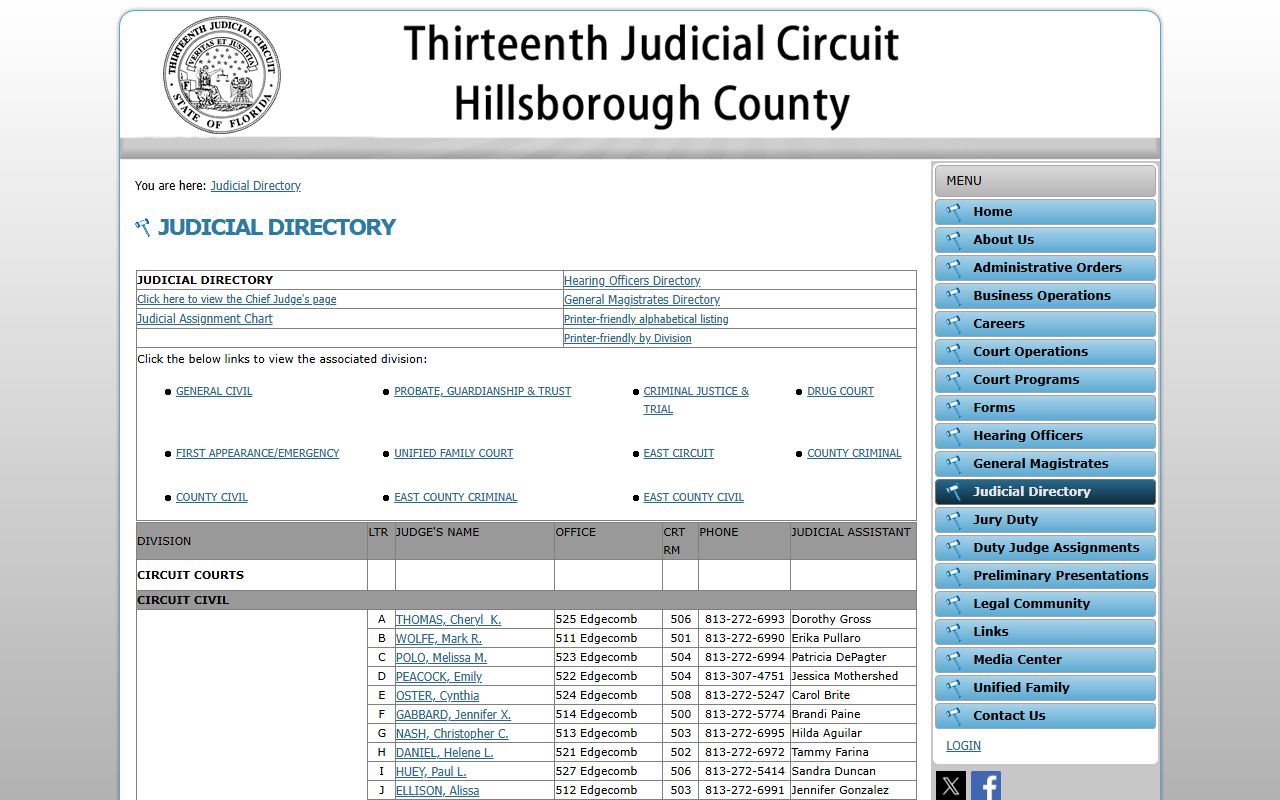
That directory is the place to confirm which judge holds a current case before a hearing or a filing.
| Court | Jurisdiction | Case Types |
|---|---|---|
| Circuit Court (Thirteenth Judicial Circuit) | General jurisdiction, statewide circuit | Felony, family, probate, guardianship, juvenile, civil over $50,000, injunctions |
| County Court | Limited jurisdiction | Misdemeanor, traffic, small claims, eviction, civil up to $50,000 |
| Second District Court of Appeal | Intermediate appeals | Appeals from Hillsborough trial courts |
| Supreme Court of Florida | Final state review | Discretionary review and mandatory categories under state law |
Note: The same Clerk maintains both Circuit Court and County Court records, so a docket search uses the same portal for either level.
Hillsborough County Courthouses
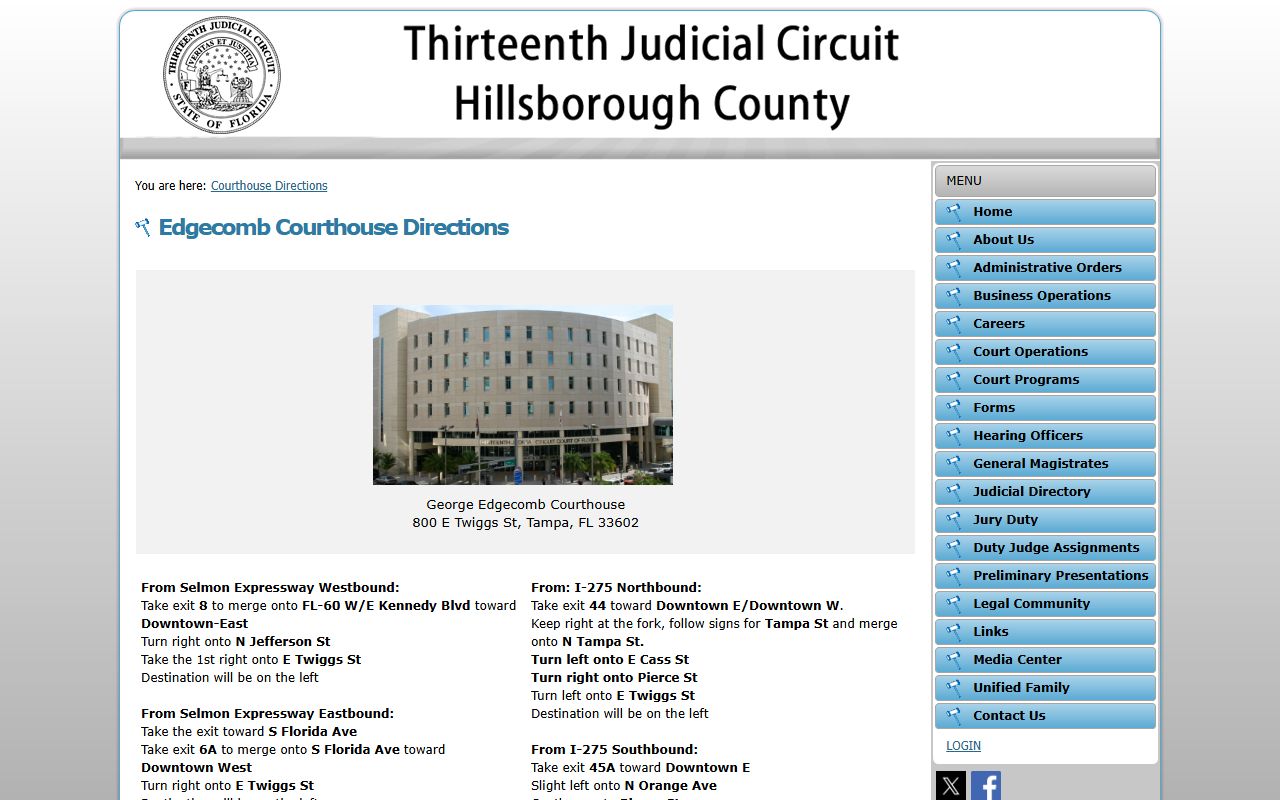
Hillsborough's court campus sits in downtown Tampa with one east-county outpost in Plant City. The main civil and family courthouse is the George Edgecomb Courthouse. Felony cases and first appearance hearings run from the Criminal Courthouse Annex a few blocks away. Civil Traffic Court has its own building on Pierce Street. The Plant City Courthouse covers east-county services. A look at the Thirteenth Judicial Circuit locations page shows photos and addresses for every site.
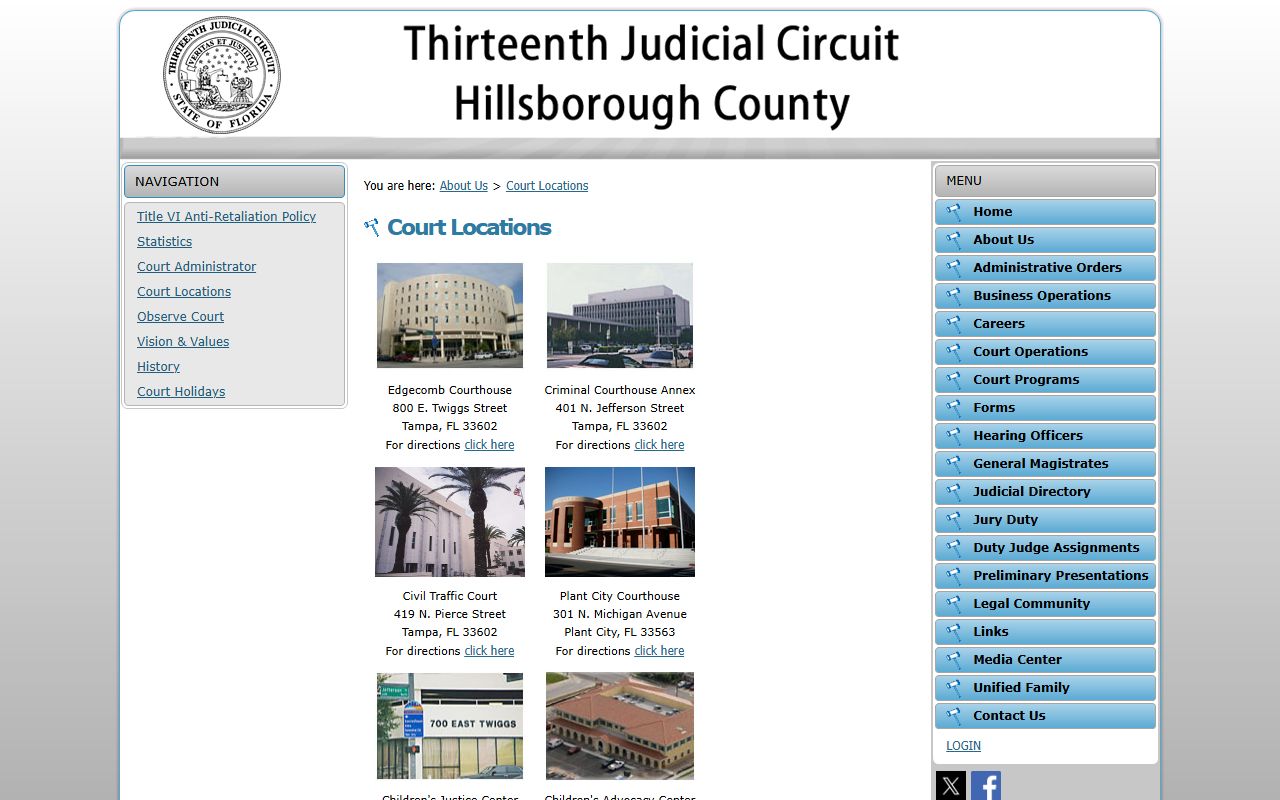
Selecting the right building matters because a wrong stop can mean a long walk in the heat. Family and civil cases head to Edgecomb. Felony arraignments head to the Annex.
George Edgecomb Courthouse
800 E. Twiggs Street
Tampa, FL 33602
Family and civil divisions
Criminal Courthouse Annex
401 N. Jefferson Street
Tampa, FL 33602
Felony and first appearance
Civil Traffic Court
419 N. Pierce Street
Tampa, FL 33602
Traffic and related clerk service
The Children's Justice Center and Juvenile Diversion sit at 700 E. Twiggs Street, a short walk from Edgecomb. The Children's Advocacy Center at Mary Lee's House is across town at 2806 South Armenia Avenue.
Types of Court Records Available in Hillsborough County
Hillsborough Court records cover a wide range of case types because one Clerk maintains files for both trial tiers. The Clerk also keeps Official Records, which include recorded deeds, plats, marriage licenses, and judgments. About 25 million Official Records have been recorded since 1846, and the Clerk says roughly 2,000 new documents come in each day. Court files live in HOVER. Recorded documents live in the Official Records index.
Many case categories sit inside the broader bucket of Hillsborough County court records. Each category has its own access rules.
- Criminal records include felony files in Circuit Court and misdemeanor or traffic-criminal files in County Court.
- Civil records cover lawsuits, foreclosures, evictions, debt, contract, replevin, and injunction matters.
- Family and divorce records live in Circuit Court. Many images are restricted to attorneys of record, pro se parties, and registered users.
- Probate records live in the Probate Division of the Circuit Court and include estates, guardianships, and trusts.
- Traffic records are searchable by citation number through the same Clerk portal.
- Juvenile records are restricted under state law and need authorized access for most images.
- Marriage records are Official Records, not court records, and date back to 1831.
For day-by-day court schedules, the Hillsborough County court dockets page lays out how to read a progress docket and how to use the Court Hearing Lookup mode. For general agency records that fall outside court files, the public records page covers the request process under Florida's open-records law.
What Hillsborough County Court Records Show
A court file from the Clerk usually includes a case number, the parties, the filing date, the assigned judge, the docket events, and the final disposition. Criminal files add the arrest document, the charging information, bond paperwork, plea forms, and sentence orders. Civil files add the complaint, the answer, motions, hearing notices, and the judgment. Probate files add petitions, letters, inventories, accountings, and the order of discharge. Many of these fields appear directly in HOVER search results. Some show only inside the case detail.
The table below mirrors the field set a public user sees on a typical case page. The Clerk follows the state Access Security Matrix when deciding what each user role can see.
| Field | What It Shows |
|---|---|
| Case Number or UCN | Unique file identifier used to pull the docket and any viewable images. |
| Filing Date | Date the Clerk accepted the first pleading. |
| Court and Division | Circuit or County tier, plus the division such as Criminal, Family, or Probate. |
| Parties | Plaintiff and defendant, or petitioner and respondent, or the State and the defendant. |
| Judge | Assigned judge and current courtroom. |
| Charges or Cause | Charged offenses or the cause of action. |
| Docket Entries | Chronological list of every filing, hearing, and order. |
| Disposition | How the case ended, including plea, verdict, dismissal, or judgment. |
| Documents | Filed images that are not sealed or restricted, often available for eCertify. |
Public Access Laws for Hillsborough County Court Records
Florida starts from a strong presumption of open government. Chapter 119 of the Florida Statutes is the state public-records law. It applies to most executive and local agency records. Court files have their own rule overlay under the Florida Rules of General Practice and Judicial Administration. Rule 2.420 governs access to judicial branch records. Clerks wear two hats. When the Clerk holds court files, the rule controls. When the Clerk holds Official Records or county records, the statute controls. The Clerk's records page cites both authorities.
The fee structure also flows from statute. Section 28.24 of the Florida Statutes lets the Clerk charge for copies, certifications, record searches, and many filings. The Hillsborough fee schedule reads directly off that section, plus county ordinances and administrative orders. Online image limits track section 28.2221, which blocks the public display of death certificates, military discharges, and many family, juvenile, and probate court images.
Key Statutes:
Florida Statutes § 119.01 - States Florida's policy that government records are open to the public unless a specific exemption applies.
Florida Statutes § 119.07 - Sets out the right to inspect and copy public records and authorizes custodian fees.
Florida Statutes § 119.071 - Lists general exemptions covering personal information, security data, and protected-class material.
Florida Statutes § 28.24 - Authorizes the Clerk service charges that drive the local fee schedule.
Florida Rule of Judicial Administration 2.420 - The judicial-branch rule that governs access to court records, sealed filings, and confidential matters.
For records that fall outside the court file, residents can submit a request through the Clerk's public-records portal. The Clerk's custodian page also lists which records are not kept locally, such as accident reports from the investigating police agency and statewide criminal-history reports from the Florida Department of Law Enforcement.
Records That Are Restricted or Confidential
Not every court record is open. Sealed or expunged criminal records are governed by sections 943.0585 and 943.059 of the Florida Statutes. A sealed record is hidden from the public but still reachable by certain agencies. An expunged record is destroyed or made unavailable except as the law permits. Hillsborough's Clerk fee schedule lists a $42 charge for sealing a court file or expungement of any record, plus copy and certification costs. The seal-and-expunge process usually begins with eligibility review at the state criminal records agency.
Juvenile delinquency and dependency files are restricted under section 985.04. Adoption records are confidential under section 63.162 and need a court order to inspect. Mental health clinical records sit behind section 394.4615. Domestic violence injunctions under section 741.30 can hide victim addresses and contact details. Social Security numbers, financial accounts, and protected-class identifiers are redacted under section 119.071. The Clerk's online image notice warns that family, juvenile, and probate court-file images often cannot be shown over the public internet because of section 28.2221. Sexual-abuse case images may also need an in-person visit to view.
Anyone whose own records contain exempt personal information can ask the Clerk to remove that data from online images. The request needs a notarized statement listing the statute that authorizes removal and confirming eligibility. The Clerk warns that grantor, grantee, and party names cannot be removed from the Official Records index.
Specialty Courts in Hillsborough County
The Thirteenth Judicial Circuit runs several problem-solving courts. The most documented is the Veterans Treatment Court. The court serves veterans who served or were honorably discharged from military service and who suffer from service-related mental illness, traumatic brain injury, substance-use disorder, PTSD, or military sexual trauma. The first session took place in October 2013. The program started as a misdemeanor track and added a felony track in 2015. It uses a treatment-team model, individualized care plans, and a five-phase advancement process that is not automatic. Volunteer veteran mentors support each participant.
Eligible veterans may join the Misdemeanor Intervention Program or the Felony Pretrial Intervention Program under section 948.16(2) of the Florida Statutes. Successful completion can lead to dismissal of the charge. Some veterans with prior convictions may qualify for a post-adjudication track. Treatment partners include Agency for Community Treatment Services, the Crisis Center of Tampa Bay, DACCO, Gracepoint, Phoenix House, Riverside Recovery, Tampa Crossroads, The Vet Center, and WestCare. The program has grown to more than 200 participants and over 60 mentors.
Beyond the trial bench, the county jail also runs treatment programs. The Sheriff's Office operates the only state-certified jail drug treatment program in Florida and runs a mental health unit at the Falkenburg Road Jail. A new Mental Health Stabilization Unit opened at Falkenburg in 2026. Both Falkenburg and Orient Road Jail were the first correctional facilities in the nation to earn three NCCHC accreditations for jail health, mental health, and opioid treatment.
Hillsborough County Sheriff and Jail
The Hillsborough County Sheriff's Office is led by Sheriff Chad Chronister. HCSO is both the countywide law-enforcement agency and the jail operator. Two main jail campuses hold pretrial and sentenced inmates: Orient Road Jail at 1201 Orient Road and Falkenburg Road Jail at 520 N. Falkenburg Road, both in Tampa. The main HCSO jail phone is 813-247-8300. Inmate Records is 813-247-8400. The Sheriff's Operations Center sits at 2008 E. 8th Avenue, with main line 813-247-8000.
The agency runs a free public lookup at the HCSO Arrest Inquiry. A look at the HCSO Arrest Inquiry portal shows the public search form used to find a person in jail.
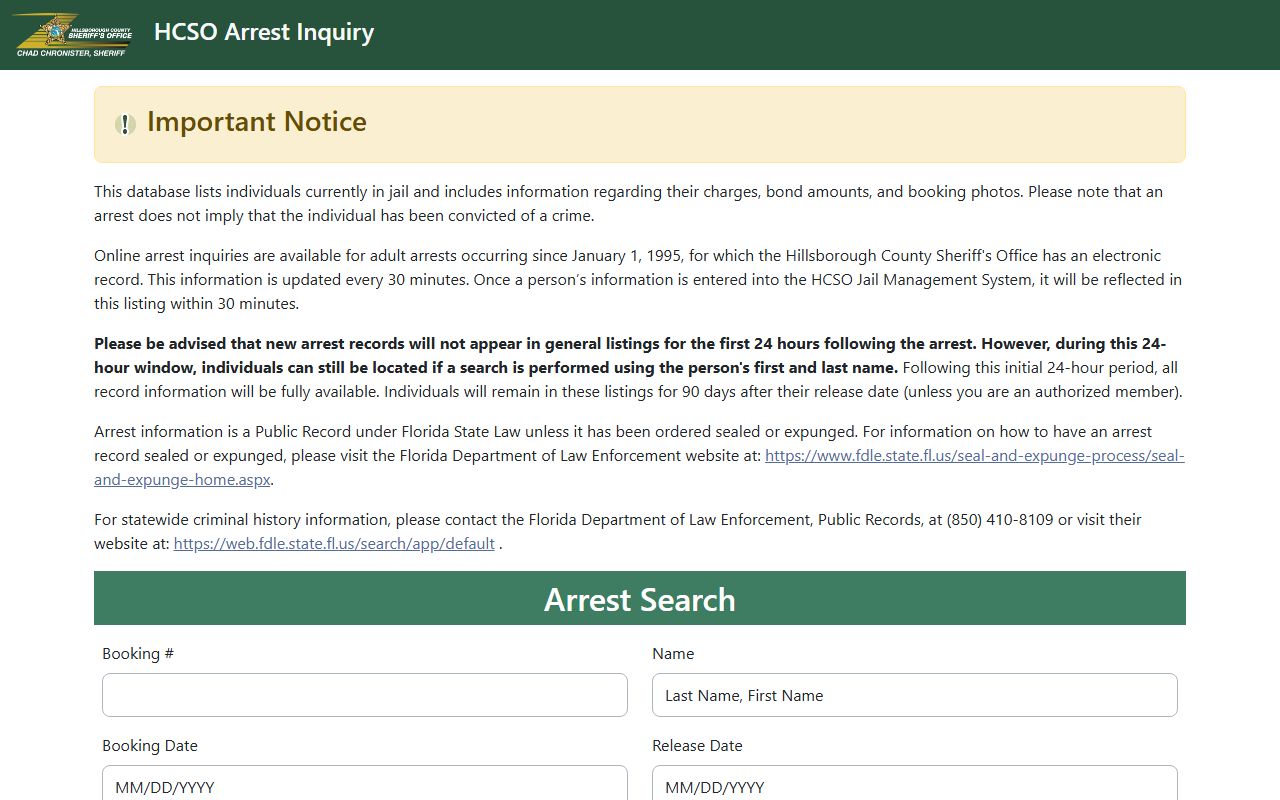
The database lists current inmates with charges, bond amounts, and booking photos. Records date back to January 1, 1995 for adult arrests with an electronic record. The portal updates every 30 minutes. New arrests do not appear in general listings for the first 24 hours, but a name search can still pull them up. Released persons stay in public listings for 90 days after release.
For roster details and the field guide to a booking record, the Hillsborough County inmate records page covers the full search form and the field set. Active warrants are tracked through a separate HCSO portal. The warrant records page covers the warrant lookup and what to do if a person has an open capias. The released inmates page and the jail population data page handle the post-release and operational sides of the system.
HCSO has warned residents about warrant and jury-summons scams in recent years. Real warrant resolution never requires payment by cryptocurrency, gift card, or wire transfer. A look at the HCSO Warrant Inquiry portal confirms the official channel for warrant lookups.
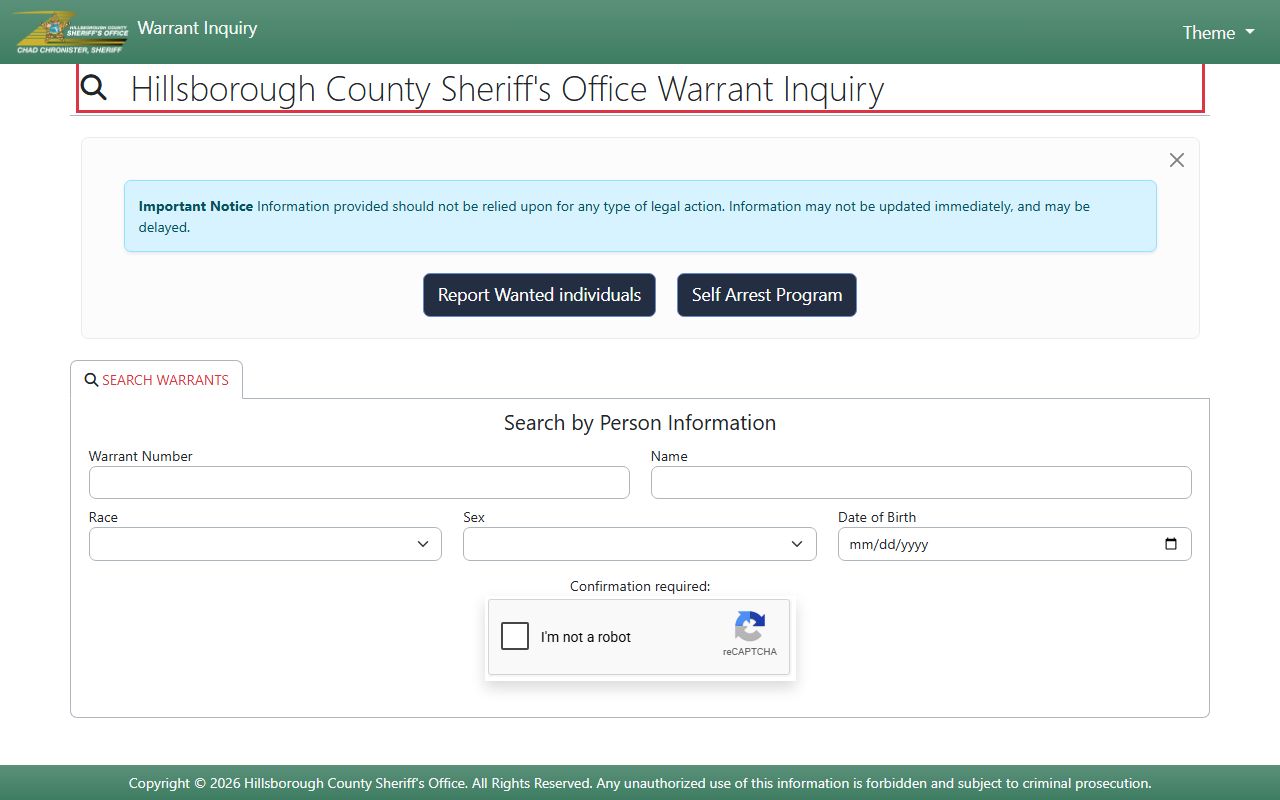
The lookup itself sits behind an interactive page, so confirm any warrant by calling HCSO before going to a jail to surrender.
Marriage, Divorce, and Probate Records
Marriage and divorce records sit in different buckets in Florida. Marriage records are Official Records held by the Clerk and date from 1831 to the present. Divorce records are court records in the family division of the Circuit Court and must be searched through HOVER. The same Clerk handles both, but the storage and the access rules are not the same. The Clerk issues marriage licenses as a state agent under Chapter 741 and also performs ceremonies in Tampa, Brandon, and Plant City. The base license fee is $86 and includes one certified copy. Florida residents who complete a qualified premarital course pay $61.
Probate cases live in the Probate Division of the Circuit Court. The same Clerk keeps the file. Estates can run as summary administration or formal administration depending on size. The Clerk lists $235 for summary administration of an estate under $1,000, $345 for summary administration of estates of $1,000 or more, and $400 for formal administration. Guardianship cases also live in the probate division and carry tighter access rules online. For full coverage, see the marriage and divorce records and probate records pages.
- Testator
- The person who made the will.
- Executor
- The person named in the will to administer the estate, called personal representative in Florida practice.
- Intestate
- A person who died without a valid will. State law sets who inherits.
- Guardianship
- A court appointment to manage the person or property of a minor or an adult who cannot manage on their own.
- Conservator
- A guardian appointed over property in many state systems. Florida uses guardian of the property for similar work.
- Letters
- A court order that names the personal representative and gives that person legal authority.
Hillsborough Court Records Fees
Clerk fees are set by Florida statute, county ordinance, and administrative order. The table below covers common record charges. eCertify, the Clerk's online certified-copy service, adds a $6 vendor fee per document, plus the Clerk fee, plus a 3.5% credit-card processor fee. Multi-page event documents must be bought in full through eCertify, so single-page selection requires an in-person or mail request.
| Item | Amount |
|---|---|
| Photocopy up to 8.5 x 14 inches | $1.00 per page |
| Larger photocopy | $5.00 per page |
| Certified copy of an instrument in Public Records | $2.00 |
| Exemplified certificate | $7.00 |
| Sealing a court file or expungement of any record | $42.00 plus copy and certification costs |
| Marriage license including one certified copy | $86.00 |
| Marriage ceremony | $30.00 |
| Eviction of tenant | $185.00 |
The Clerk's homepage also routes residents to other service categories, from BOCC records to comptroller reports. A look at the Hillsborough Clerk of the Circuit Court and Comptroller homepage shows the main navigation hub.
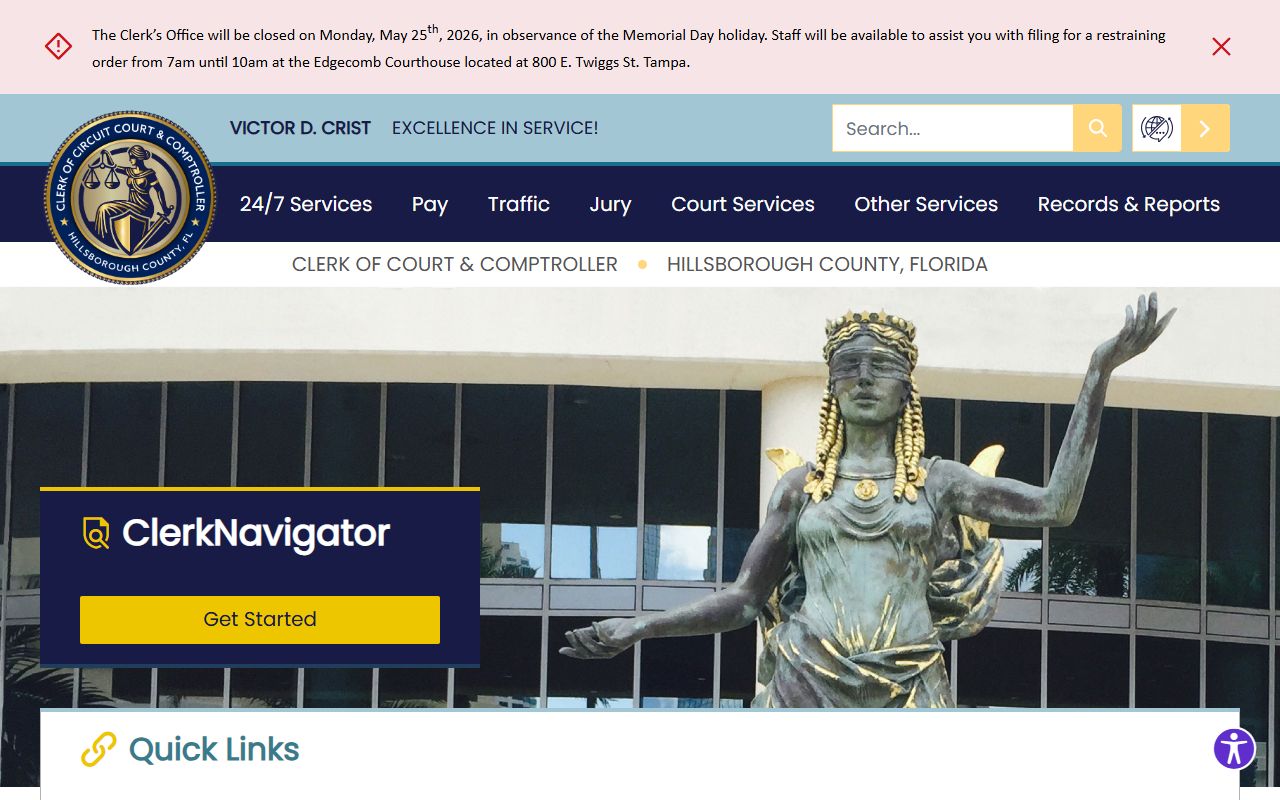
The same page links to the public-records request system used when a record is not posted online.
How to Interpret Court Records
Court files use a short list of common terms. A plaintiff brings a civil case. A defendant defends one or faces criminal charges. A petitioner files in family, probate, or injunction matters. A respondent answers a petition. A complaint starts a civil case. An information is the prosecutor's charging document. An indictment comes from a grand jury. An arraignment is the first hearing where the charge is read and a plea is entered.
A docket is the chronological log of filings and events. A motion asks the court to do something. An order is the judge's written answer. A judgment is the final or enforceable decision. A disposition is the outcome of the case. Charges are not the same as convictions. An arrest does not prove guilt. The Sheriff's Office repeats that warning on the Arrest Inquiry page. Always check the court docket for the actual disposition before drawing a conclusion about a person.
Florida criminal practice also uses two distinct relief paths. Sealing limits public access but does not destroy the file. Expunction physically destroys or makes the record unavailable except in narrow situations. Both need eligibility review at the state level before a petition is filed in the trial court that handled the case.
Accuracy and Record Limitations
Online records can lag the paper file. HOVER says a filed document is usually viewable in a reasonable time after the Clerk accepts it. Some sensitive case-type images never appear online and require an in-person visit. The Sheriff's Office updates Arrest Inquiry every 30 minutes after a record enters the Jail Management System, but a new booking can take up to 24 hours to show in general listings. A name search can still find that person during the gap.
Note: Confirm any sensitive court or jail detail with the originating Clerk office or HCSO unit before relying on it for a legal, employment, or housing decision.
For information not held by the Clerk, the custodian agency is the right contact. Crash and accident reports come from the investigating law-enforcement agency. Fire and arson reports come from the fire agency. Medical examiner files come from the county medical examiner. Birth and death certificates come from the Florida Department of Health. Statewide criminal-history checks come from the Florida Department of Law Enforcement.
History of Hillsborough Courts
Hillsborough County's earliest courthouse was a log cabin that burned at the start of the Second Seminole Indian Wars. When the first Commissioners met in 1846, the agenda included taxes, transportation, a new courthouse and jail, and downtown growth. In 1847, the Commissioners accepted Captain James McKay's bid to build a two-story courthouse for $1,358. An 1855 courthouse cost $5,000, mixed Grecian, Ionic, and Corinthian architectural orders, and used a picket fence to keep animals out of the yard.
In August 1892, an ornate red-brick courthouse with a silver dome filled a downtown square block. Architect J.A. Wood, who also designed the Tampa Bay Hotel, was responsible for the design. A replica of that silver dome sits today at Joe Chillura Courthouse Square Park, and the original 1892 doors were restored on the Judicial Conference Room at the George Edgecomb Courthouse. A 1952 courthouse occupied two city blocks with segregated facilities. The Courthouse Annex followed about a decade later. The North Annex was built in 1984. The 1999 Courthouse Facilities Project led to the 2004 construction of the six-story Family and Civil Court Building that residents now know as the Edgecomb Courthouse, with more than 268,000 gross square feet of court space.
Legal Help and Self-Help Resources
Defendants who cannot afford a lawyer in criminal court can request a public defender through the trial court. The Public Defender for the Thirteenth Judicial Circuit is Lisa B. McLean. The office is at 700 E. Twiggs Street, 5th Floor, Tampa, FL 33602, with main line 813-272-5980. The office staffs more than 220 employees, including over 120 attorneys, investigators, and support staff. A look at the Public Defender homepage lists current contact options and service areas.
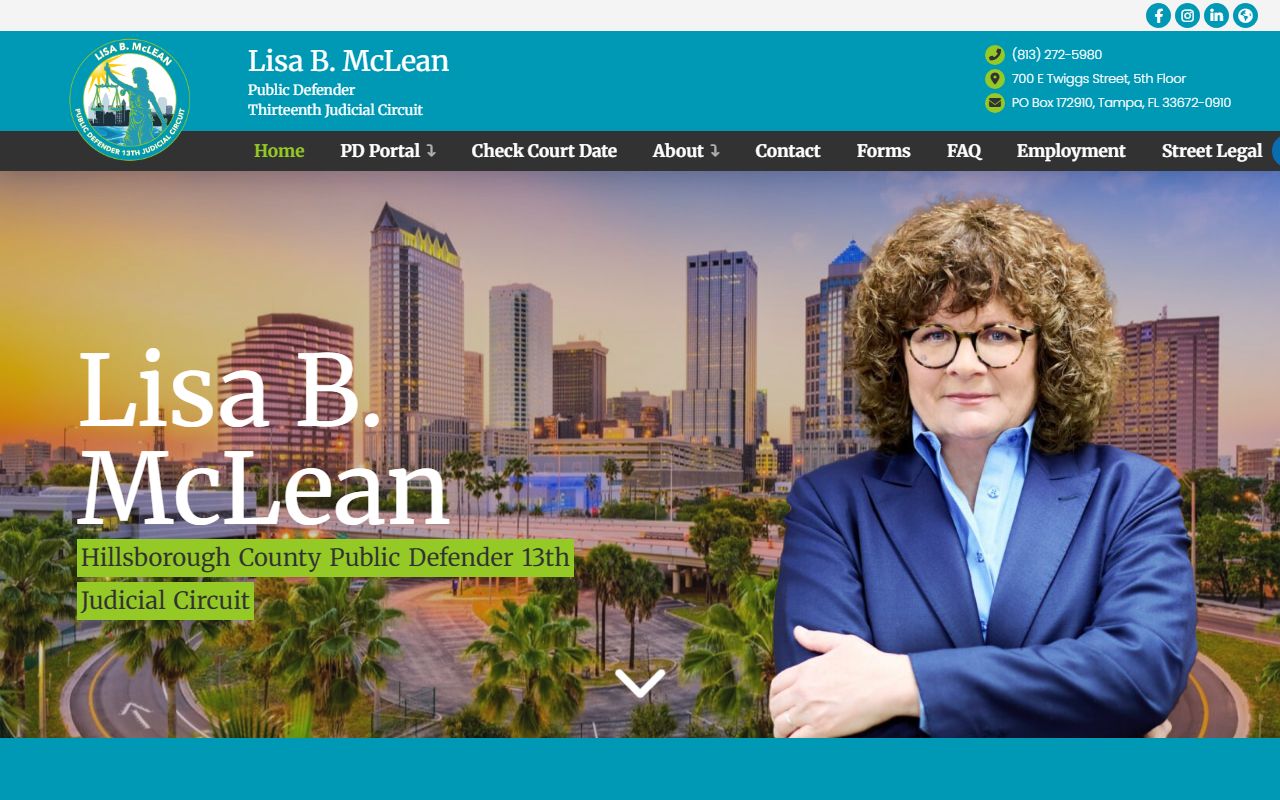
Indigent defense intake includes a financial affidavit and a court order of appointment.
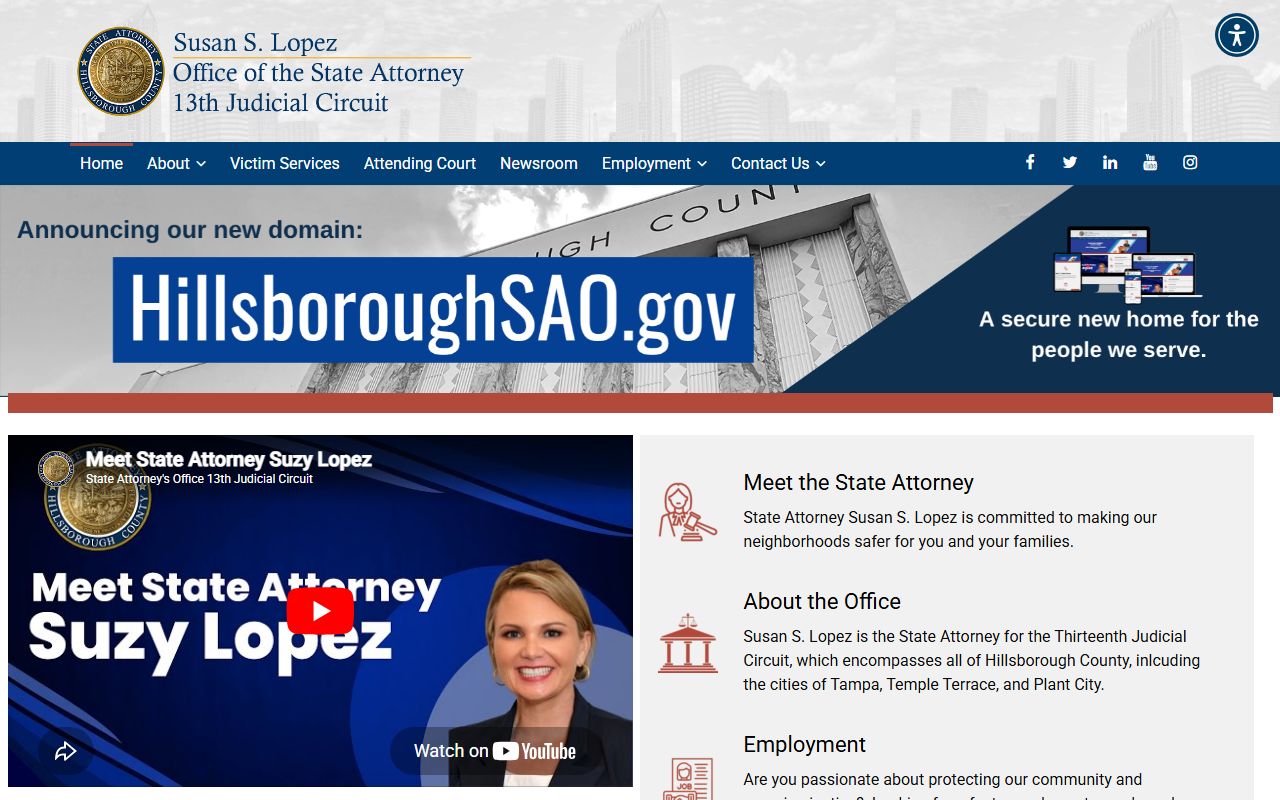
Prosecution is handled by the State Attorney for the Thirteenth Judicial Circuit. Suzy Lopez serves as the State Attorney. The office covers all of Hillsborough County, including Tampa, Temple Terrace, and Plant City, and runs the victim-services unit for local crime victims. A look at the State Attorney homepage confirms the office's role.
Civil legal aid in the Tampa Bay area runs through Bay Area Legal Services and the Bay Area Volunteer Lawyers Program. The Florida Bar Lawyer Referral Service connects residents to private attorneys when legal aid is not a fit. For directions, court forms, and history, the Circuit Court page and the County Court page collect the local rules, forms, and links in one place. The Clerk of the Circuit Court page covers fees, eCertify, and Official Records in depth.
Frequently Asked Questions
What is HOVER?
HOVER is Hillsborough Online Viewing of Electronic Records, the Clerk's free court record portal. It offers case indexes, progress dockets, and many filed document images that are not sealed or made confidential by rule or statute. The site supports searches by case number, citation, party or business name, date range with court and case type, and a court hearing lookup. Access depth depends on the user category, with attorneys of record and pro se parties seeing more than anonymous users.
How do I find someone in the Hillsborough jail?
Use the HCSO Arrest Inquiry. Search by booking number, name, booking date, release date, race, sex, or date of birth. The portal lists current inmates with charges, bond amounts, and booking photos. Use "Current Inmates Only" for active custody. The system refreshes every 30 minutes after a record reaches the Jail Management System. New arrests may not show in general listings for the first 24 hours, but a first and last name search can still locate them. The inmate records page covers the full process.
Are divorce records part of Official Records?
No. Marriage records are Official Records and date from 1831 to today. Divorce records are court records, not Official Records, and are searched through HOVER as family-court cases. Many divorce-case images are restricted to attorneys of record, pro se parties, or registered users. The clerk distinguishes between recorded instruments and court files, and only the recorded side carries the Official Records label.
How much does a marriage license cost?
The nonrefundable Hillsborough marriage license fee is $86, which includes one certified copy. Florida residents who complete a qualified premarital preparation course pay a reduced fee of $61. A Clerk-officiated marriage ceremony costs $30. Additional certified copies are $3 each. Both parties must appear together with valid government ID, read the Florida Family Law Handbook, and provide Social Security or alien-registration information as applicable.
How do I clear or expunge an arrest record?
Florida treats sealing and expunction as separate remedies. The process usually begins with eligibility review at the state criminal records agency. The petitioner then files a court petition in the trial court that handled the original case. The Hillsborough Clerk lists a $42 fee for sealing a court file or expungement, plus the cost of copies and certifications. A granted petition is then processed by the Clerk, the arresting agency, and state criminal-justice repositories.
What is the difference between Circuit Court and County Court?
Circuit Court is the general jurisdiction trial court. It handles felonies, family law, probate, guardianship, juvenile cases, injunctions, and circuit civil suits over $50,000. County Court is the limited jurisdiction court. It handles misdemeanors, traffic, small claims, evictions, and county civil matters up to $50,000. The same Hillsborough Clerk maintains records for both tiers and routes them through the same online portal.
Where do I find federal court records for Tampa cases?
Federal cases that arise in Tampa go to the U.S. District Court for the Middle District of Florida. Federal docket access runs through PACER. Bankruptcy cases use the U.S. Bankruptcy Court for the Middle District of Florida. Federal appeals go to the U.S. Court of Appeals for the Eleventh Circuit. Federal inmate custody is searched through the federal Bureau of Prisons inmate locator, not through the Hillsborough Sheriff portal.
More on the Hillsborough County Court Records FAQ page.