
Hillsborough County Marriage License Requirements
The Hillsborough County Clerk of the Circuit Court issues marriage licenses as an agent for the State of Florida under Chapter 741 of the Florida Statutes. The full service runs out of the Clerk's Marriage License Department, with offices and ceremony rooms in Tampa, Brandon, and Plant City. Both people who want to marry must come in together. Walk-ins are welcome. Appointments are also offered, and online issuance by Zoom is available for people who cannot come in person.
The age rule is firm. Both parties must be at least 18 years old. Each person has to show a valid government photo ID such as a driver's license, state ID, or passport. U.S. citizens provide a Social Security number, but the card itself is not needed. Non-citizens may provide either a Social Security number or an alien registration number. If either person has been married before, the Clerk asks for the start and end dates of those marriages and how they ended. Both parties must read the Florida Family Law Handbook before applying, and both must jointly fill out the application. A short premarital preparation course is optional, but it cuts the fee for Florida residents.
The Clerk's marriage license FAQ spells out the in-person process, payment rules, and what happens after the ceremony. A quick read before walking in helps couples avoid surprises at the counter.
The Clerk's marriage page is the front door for license issuance, ceremony booking, and the Zoom option, so most couples start there before picking a date.
Hillsborough County Clerk Marriage License Department
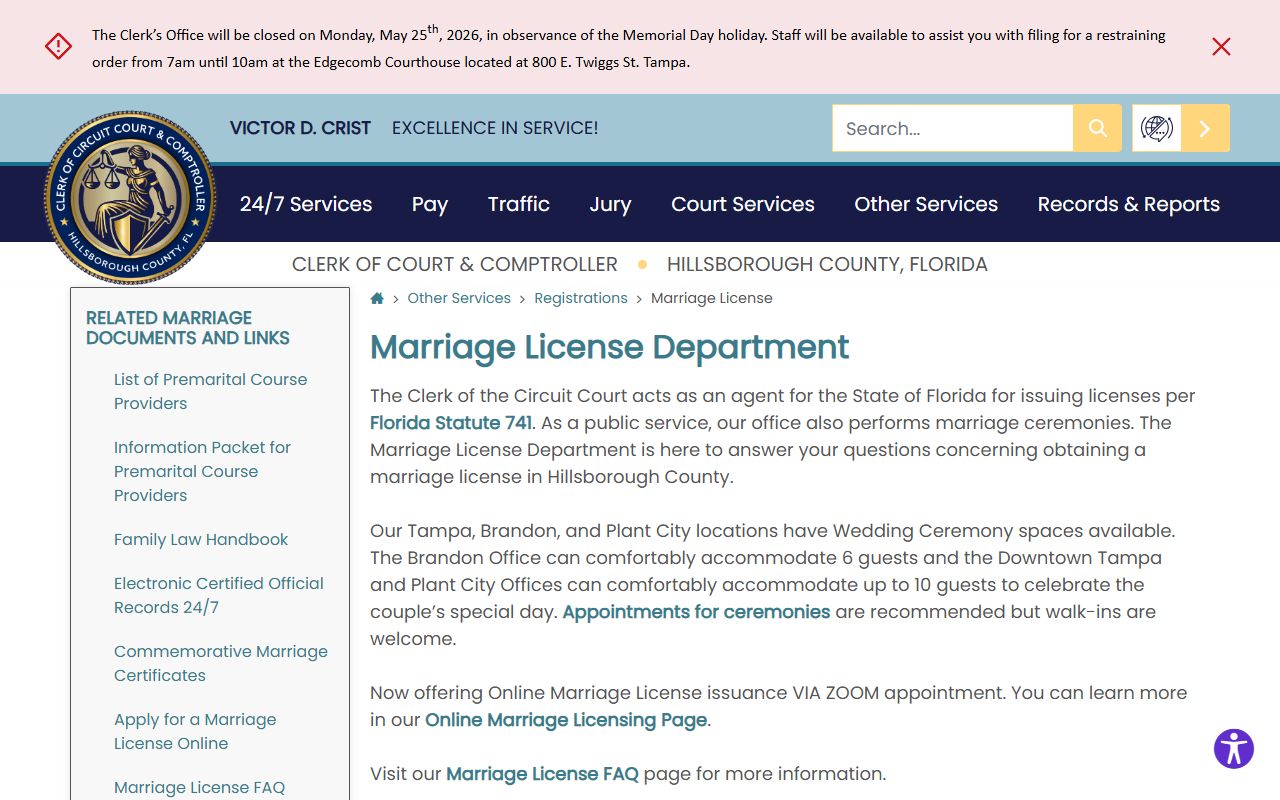
The page lists ceremony locations, the Zoom option, and the steps to set up an appointment, which speeds up the in-person visit.
Hillsborough County Marriage License Fees and Premarital Discount
Fees are set by the Clerk and posted on the Clerk fees and fines page. The base license fee is nonrefundable. A discount is offered to Florida residents who finish a state-approved premarital preparation course. Cost differences for amended, duplicate, and partial licenses also matter for couples who later need to fix or replace a record.
| Item | Amount |
|---|---|
| Marriage license, including certified copy | $86.00 |
| Florida resident with premarital preparation course | $61.00 |
| Marriage ceremony at the Clerk | $30.00 |
| Certified copy of marriage license | $3.00 |
| Duplicate marriage license | $32.00 |
| Amended marriage license | $42.50 |
| Partial marriage license | $96.50 |
| Commemorative marriage certificate | $15.00 |
The premarital discount is real money. A couple who takes the course pays $25 less and skips the standard waiting rule that applies to people who do not take it. Online applications must be paid by credit card. In-person payments can be cash, money order, traveler's check, credit card, or a personal check that has an imprinted name and current address along with photo ID.
Note: The first certified copy is included in the $86 license fee, but extra certified copies cost $3 each at the Clerk counter.
How to Apply for a Marriage License in Hillsborough County
The Clerk gives couples a clean path. The steps below match the in-person flow and also work for the Zoom online option. Couples who plan ahead, read the handbook, and bring the right ID often finish in under an hour.
- Read the Florida Family Law Handbook. Both parties must do this before filing the application.
- Decide on a path. Pick the in-person walk-in, schedule an appointment at Tampa, Brandon, or Plant City, or use the online Zoom marriage license option through the Clerk.
- Fill out the application together. Both parties complete the joint application and confirm the handbook acknowledgment.
- Show valid ID. Each person brings a driver's license, state ID, or passport. U.S. citizens give a Social Security number; non-citizens may give an SSN or alien registration number.
- Report prior marriages if any. Provide the start and end dates and how each one ended.
- Take the premarital course if it fits. Florida residents who finish a qualified course pay the $61 fee and skip the 3-day waiting rule.
- Pay the fee. Online applications need a credit card; in-person payments accept cash, money order, traveler's check, credit card, or a qualified personal check.
- Hold the ceremony within the legal Florida timeframe. Use an authorized officiant or the Clerk's ceremony service.
- Have the officiant complete the Certificate of Marriage section of the license and return the signed license to the issuing Clerk within 10 calendar days.
The Zoom path is good for couples who live out of state, have mobility issues, or simply cannot get to a Clerk office during business hours. The basic checklist stays the same; the difference is that ID verification and the joint application happen over video.
Hillsborough County Marriage License Application Fields
The application asks for the same core information from both parties. Pulled from the Clerk's marriage FAQ, the inventory below shows what each person should be ready to provide before sitting down to sign. Some fields are conditional and only apply to non-citizens or to people who were married before.
| Field Label | Type | Required | Notes |
|---|---|---|---|
| Party 1 identity | text / ID | Yes | Valid driver license, state ID, or passport. |
| Party 2 identity | text / ID | Yes | Same ID rules as Party 1. |
| Age / Date of Birth | date | Yes | Both parties must be 18 or older. |
| Social Security number | text | Yes for U.S. citizens | SSN card itself is not required. |
| Alien registration number | text | Conditional | Non-citizens may give SSN or alien registration number. |
| Prior marriage dates | date / text | Conditional | Start and end dates plus how each marriage ended. |
| Family Law Handbook acknowledgment | acknowledgment | Yes | Both parties must read the handbook before applying. |
| Premarital course certificate | checkbox / certificate | Optional | Earns the $61 discounted fee for Florida residents. |
Couples who walk in without the right ID or without the handbook acknowledgment will be turned away. The Clerk's marriage FAQ stresses that both parties must appear together; one party cannot pick up a license alone.
The Clerk's marriage license FAQ page walks through these fields and the payment rules in plain English.
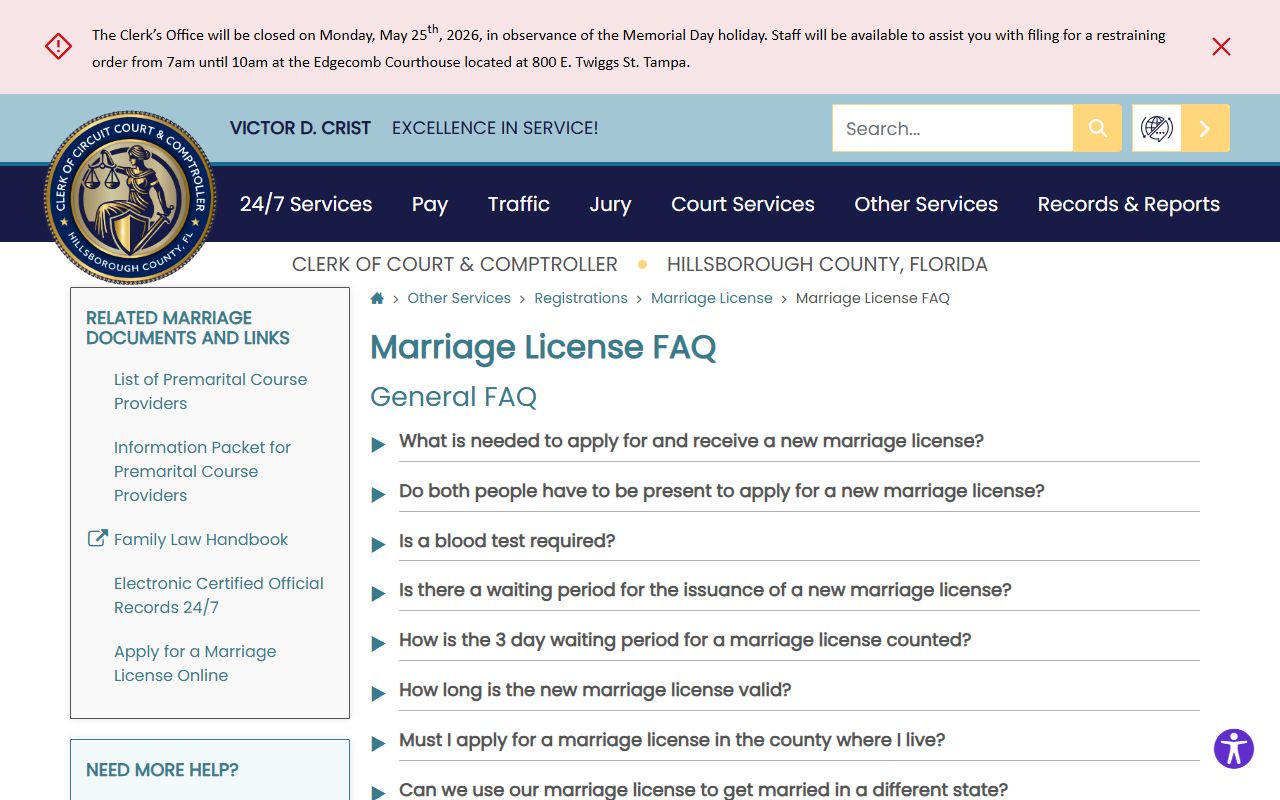
The FAQ is the cleanest single source for ID rules, fee details, payment options, and the post-ceremony return process.
Ceremony, Officiant, and Recording the License
The Clerk offers ceremonies at Tampa, Brandon, and Plant City. Brandon holds about 6 guests. Downtown Tampa and Plant City each hold about 10. The ceremony fee is $30. Couples can also use any authorized officiant in Florida.
After the ceremony, the officiant must complete the Certificate of Marriage portion of the license and return the signed license to the Clerk that issued it within 10 calendar days. If the Clerk officiated and the license was issued by Hillsborough, the office records the license in house. If another county issued the license, the Clerk forwards it to that county for recording. Once the license is recorded as an Official Record of Hillsborough County, a certified copy is mailed to the couple within about 7 business days.
The first certified copy of a Hillsborough-recorded marriage record is included with the license fee. Additional certified copies are $3 each. Couples who want a souvenir piece can buy the $15 commemorative marriage certificate, which is decorative and not a legal record.
How to Look Up Hillsborough County Marriage Records
Hillsborough marriage records run from 1831 to present. They are Clerk records and they are part of the Official Records of Hillsborough County. The free public index covers Official Records from 1965 forward. Archived marriage licenses from 1846 to 1972 are in the Clerk's archived records collection, and certified copies of older archived records can be requested by emailing recordslibrary@hillsclerk.com.
The Clerk's marriage and divorce records page is the central guide. It explains where to find a marriage license, how to fix a record, and how to order a duplicate. The same page also points users toward the divorce side, which lives in the court file system rather than Official Records.
Hillsborough Clerk marriage and divorce records guidance
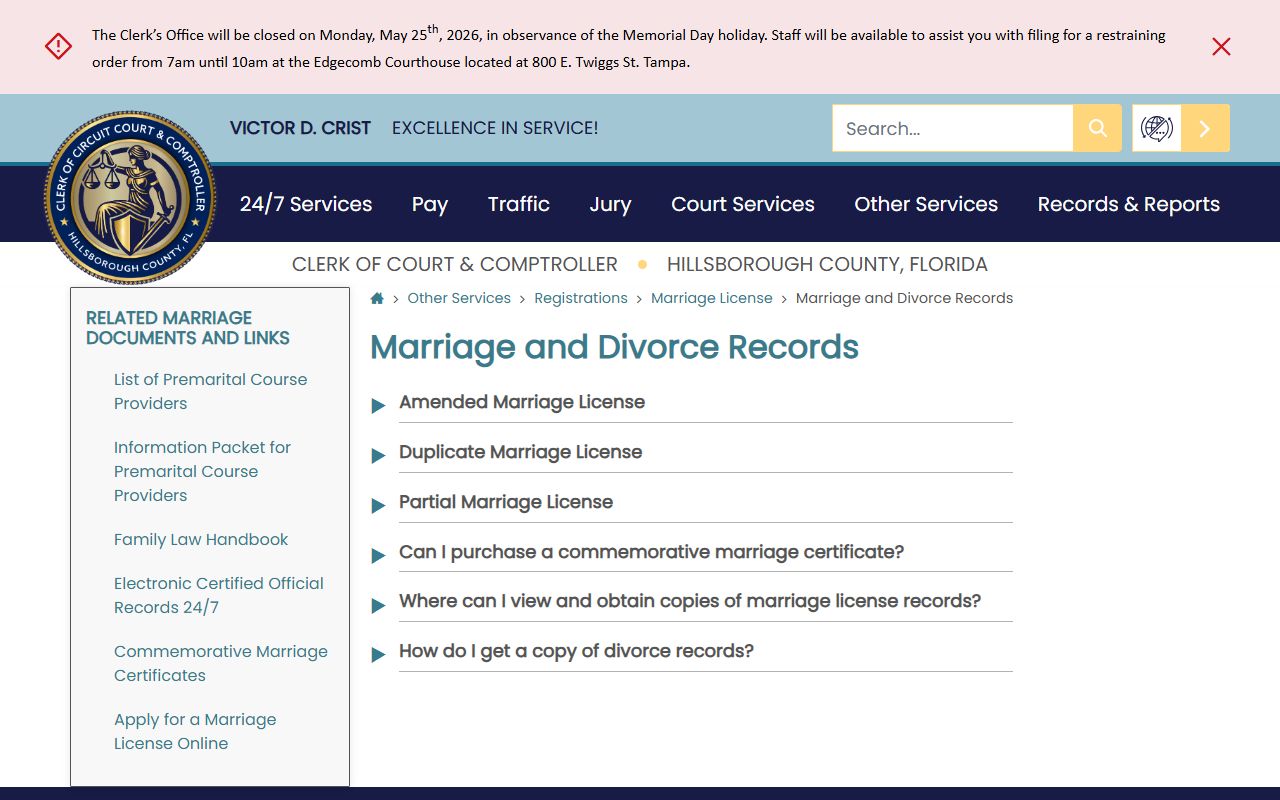
The page is the simplest place to confirm which type of record applies and where to search next.
To search the live Official Records index for a marriage record, head to the Clerk's Official Records service page and open the public search. Free results are non-certified. For a certified electronic copy, use the Clerk's eCertify service after the record is located.
Note: The Clerk's Official Records side handles marriage records, but divorce records are not stored there and will not show up in an Official Records name search.
Certified Copies and eCertify
Certified copies are needed for legal uses such as a name change, a passport application, an immigration filing, or proof of marriage in another state. A plain print from the public index will not be accepted as proof. The Clerk sells certified marriage copies for $3 each at the counter or by mail, and electronic certified copies through the Clerk's eCertify service.
eCertify works in a few clicks once the record is found in the Official Records index. The user clicks the Certify icon, drops the document into the Clerk eCertify shopping cart, reviews the price, and pays online. A confirmation email arrives, then a second email with secure download links. Fees include a $6 vendor charge per certified document, $2 per Clerk document plus $1 per page, and a 3.5% processor fee. All pages of a multi-page event must be ordered together through eCertify; single-page pulls require a counter or mail order.
Anyone with a fee-exempt status, such as a law-enforcement agency or a qualified state agency, should skip eCertify and contact recording@hillsclerk.com directly.
Amended, Duplicate, and Partial Marriage Licenses
Mistakes happen. The Clerk has a process for each one. The fees were listed earlier in the fee table, and the rules below explain when each option applies.
An amended marriage license fixes errors on the original record such as a misspelled name, a wrong date of birth, or a bad Social Security number. The Clerk requires proof of the correct information, usually a certified birth certificate or a valid U.S. driver's license with a gold-star Real ID. Both parties must apply together in person, even if they have since divorced. If one party is deceased, the surviving party must bring an original or certified death certificate. A legal name change after the marriage is different. That requires a certified court order directing the Clerk to change the marriage record.
A duplicate marriage license is a full replacement for a lost license. The fee is $32. A partial marriage license is used when the original was never returned to the Clerk by the officiant within the 10-day window and the record needs to be recreated from the parts the Clerk still has. The partial license fee is $96.50, which is higher because of the extra work involved.
Hillsborough County Divorce Records in HOVER
Divorce records are court records, not Official Records. Hillsborough divorce cases are filed in the family division of the Thirteenth Judicial Circuit and stored in the court case management system. The free public search is the Clerk's HOVER portal, short for Hillsborough Online Viewing of Electronic Records. HOVER carries case indexes, progress dockets, and many non-confidential document images.
Searchers can pull a name search or case-number search on HOVER. Family division case numbers in Hillsborough start with a year and a division code such as DR for dissolution of marriage. The case header shows filing date, parties, attorneys of record, and a progress docket of every event. Many divorce documents are remote-access restricted, though, so a public user may see an index entry but a closed lock icon on the document image. Full divorce file viewing often needs attorney-of-record, pro se, or registered-user status.
For a deeper walkthrough of the court record portal, the steps, the case types, and what is hidden by rule, see the dedicated Hillsborough County court records guide and the Thirteenth Judicial Circuit page.
Note: Family law and divorce images are not categorically sealed, but the Clerk limits remote internet display to protect minors, victims, and other parties that statute and court rules cover.
Domestic Violence Injunctions and Section 741.30
Domestic violence injunctions are a separate court track from divorce, but they often overlap in family disputes. The petition asks the court to bar contact and to set protective conditions. The governing statute is Florida Statutes section 741.30, which sets the rules for filing, hearings, and service of process.
Filings are public to a point. The Clerk records page notes that a respondent's identity may be added to a public website after a final injunction judgment that involves a minor under sections 741.30, 784.046, or 784.0485, unless the respondent is also a minor. Victim addresses, phone numbers, and other safety-sensitive details are generally redacted under Chapter 119 exemptions.
Florida Statutes section 741.30, Domestic violence injunctions
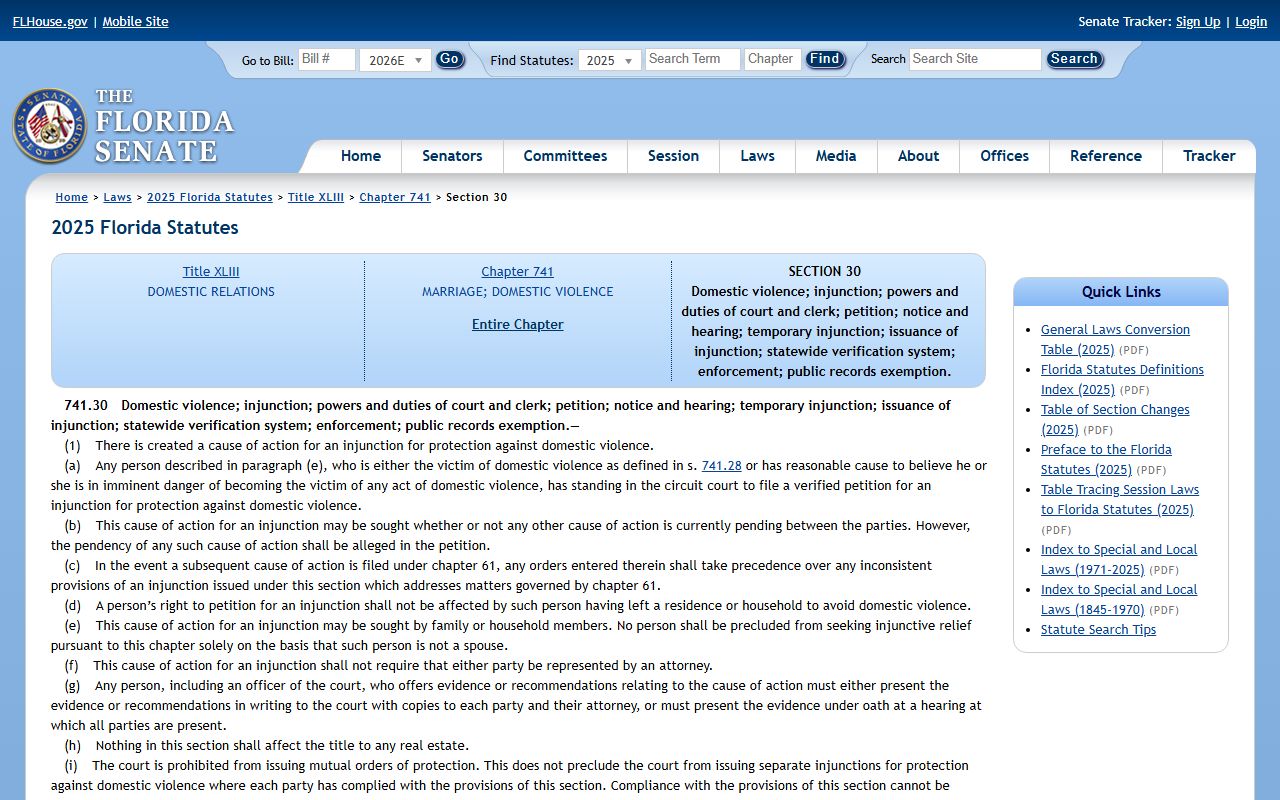
The statute is the legal anchor for injunction petitions, hearing timelines, and the rules that judges follow when deciding whether to grant or extend a protective order.
Family Record Restrictions Under Rule 2.420
Court access in Florida starts open. The exceptions are written into Florida Rule of General Practice and Judicial Administration 2.420. The rule defines court records, sets the duty to redact confidential information at the time of filing, and lists categories that are kept from public view by default.
For family files, that means several types of details get pulled before the public can see them. Social Security numbers, bank account information, victim identifying data, and addresses for protected persons are common redactions. Adoption records, juvenile dependency files, and many guardianship records are confidential by separate statute. The Clerk applies these rules to both paper and electronic files, so a record that exists in a paper folder may still show up online as a sealed entry.
Couples and family members who want a full copy of a sealed or restricted family file generally need a court order or have to fit a statutory exception. The judge in the case is the one who decides on access.