
Florida Uses Circuit Courts
Florida runs a two-tier trial system. The Circuit Court is the court of general jurisdiction, and the County Court is the lower trial court of limited jurisdiction. Each county sits inside one of the state's judicial circuits, and Hillsborough County is the entire Thirteenth Judicial Circuit. There is no separate probate court, no separate family court, and no separate juvenile court in Florida. Each of those dockets is a division of the Circuit Court, staffed by circuit judges and supported by the same Clerk's office that keeps every other court file.
Circuit judges hear all felony criminal cases, divorces and other family law petitions, probate and guardianship estates, trust disputes, juvenile dependency and delinquency, real-property title fights, injunctions, and any civil action above the County Court cap. They also review appeals taken from County Court, handle writs such as mandamus and certiorari, and step in when local administrative orders are challenged. The Florida Supreme Court sets statewide judicial-branch policy and the rules of procedure that circuit judges follow.
The word circuit is not just bureaucratic. Early Florida judges rode a literal circuit on horseback or by stagecoach, hearing cases in one county and then moving on to the next. Hillsborough's first courthouse was a log cabin that burned at the start of the Second Seminole Indian Wars, and the circuit court continued to meet wherever it could. The structure today still groups counties into circuits, even though the Thirteenth covers only Hillsborough.
Thirteenth Judicial Circuit
The Thirteenth Judicial Circuit is unusual because it contains a single county. That keeps the circuit identity and the Hillsborough County identity tightly aligned. The chief judge and circuit judges all sit in Hillsborough courthouses, hear Hillsborough cases, and answer to Hillsborough voters in nonpartisan judicial elections. The circuit's official site at fljud13.org publishes the judicial directory, division assignments, administrative orders, and forms.
To see who is assigned to which division, use the judicial directory. The directory lists each judge by division, current assignment, courtroom, and judicial assistant. That matters when filing a motion, preparing a hearing notice, or checking which judge signed a recent order. Administrative orders posted by the circuit also explain how dockets are split, which judges hear which case types, and how specialty programs run.
The circuit publishes a brief history of Hillsborough's courthouses going back to 1846. View it at the official circuit history page. The history page has photographs of the early courthouses and notes on the architects, designs, and major rebuilds.
The Thirteenth Judicial Circuit's history page documents how Hillsborough courthouses evolved from a frontier log cabin to the modern Edgecomb building.
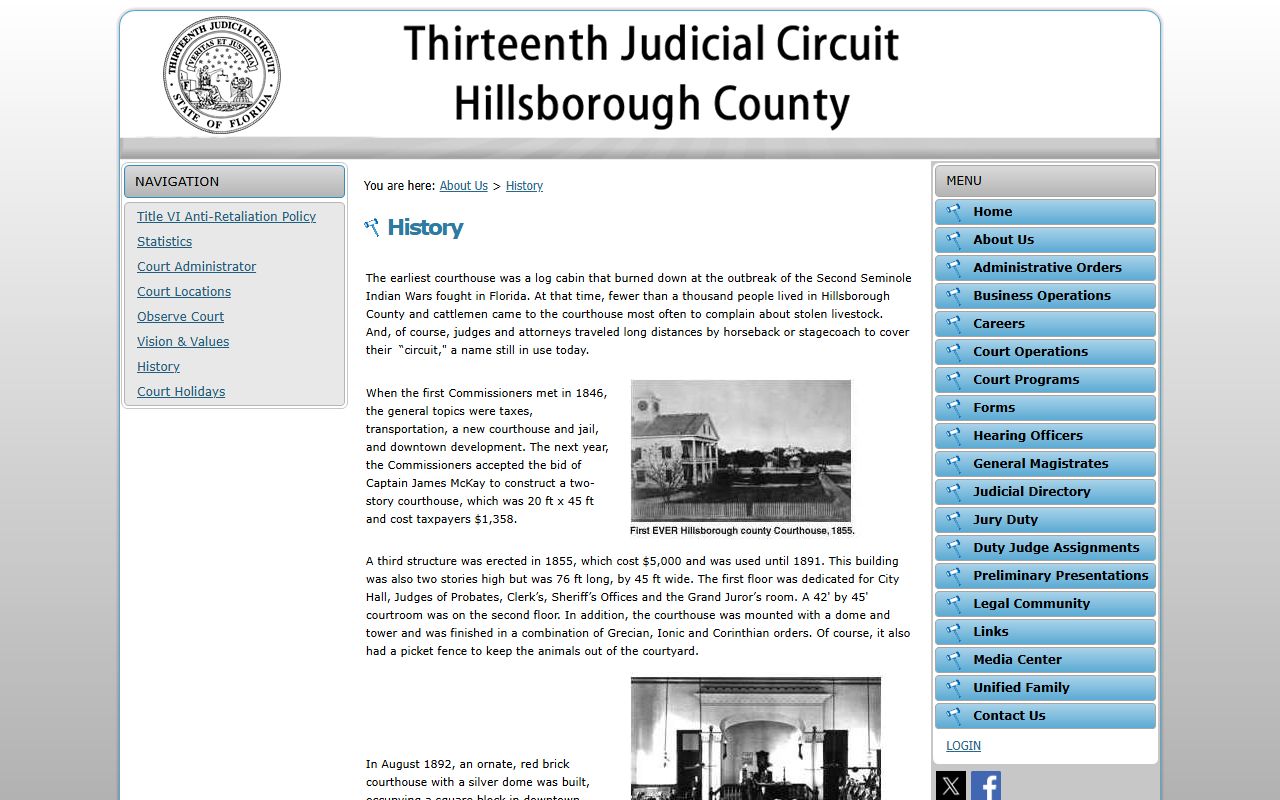
The page anchors the modern circuit to a long civic record and helps explain why some original 1892 courthouse fixtures still appear inside today's Edgecomb Courthouse.
County Court as Lower Trial Court
The County Court sits below the Circuit Court and handles the cases the Circuit Court does not. That means misdemeanors, traffic citations, small claims, evictions, county civil claims up to fifty thousand dollars, and local ordinance cases. The same elected Clerk maintains files for both courts, so a searcher does not need to know in advance whether a case is County or Circuit. A full overview of those lower-court dockets sits on the Hillsborough County Court page.
County Court appeals go up to the Circuit Court rather than to the District Court of Appeal. That gives the Circuit Court an appellate role on top of its trial work. A landlord-tenant ruling, a traffic infraction verdict, or a misdemeanor disposition from County Court can be reviewed by a circuit judge sitting in the appellate capacity, with briefs and a record on appeal rather than a full new trial.
Some matters can move between the two courts. A misdemeanor charge can be refiled as a felony if facts change. A County Court civil case that exceeds the jurisdictional cap can be transferred to Circuit Civil. Eviction cases stay in County Court even when the property value is high. Each of these splits ties back to the same Clerk's records system, which is why the court records search uses one portal for both levels.
Second District Court of Appeal
Appeals from the Hillsborough County Circuit Court generally go to the Second District Court of Appeal. The Second DCA hears appeals from circuit-court trials, reviews final judgments, and weighs petitions for extraordinary writs. The court is not a trial court. It does not take evidence, hear new witnesses, or hold jury proceedings. Instead, panels of appellate judges review the trial record, briefs, and oral argument before issuing written opinions.
Above the DCA sits the Florida Supreme Court, the state's highest court. The Supreme Court takes a small number of appeals on its own discretion, reviews questions of great public importance, and handles cases involving the death penalty and bond validations. Most Hillsborough cases stop at the DCA level, with the Supreme Court reserved for unsettled questions of state law.
Federal appeals are different. A Hillsborough case heard in the U.S. District Court for the Middle District of Florida goes up to the Eleventh Circuit, not to a Florida state appellate court. State and federal appellate tracks do not cross.
The Eleventh Circuit hears federal appeals from the Middle District of Florida, which sits in Tampa.
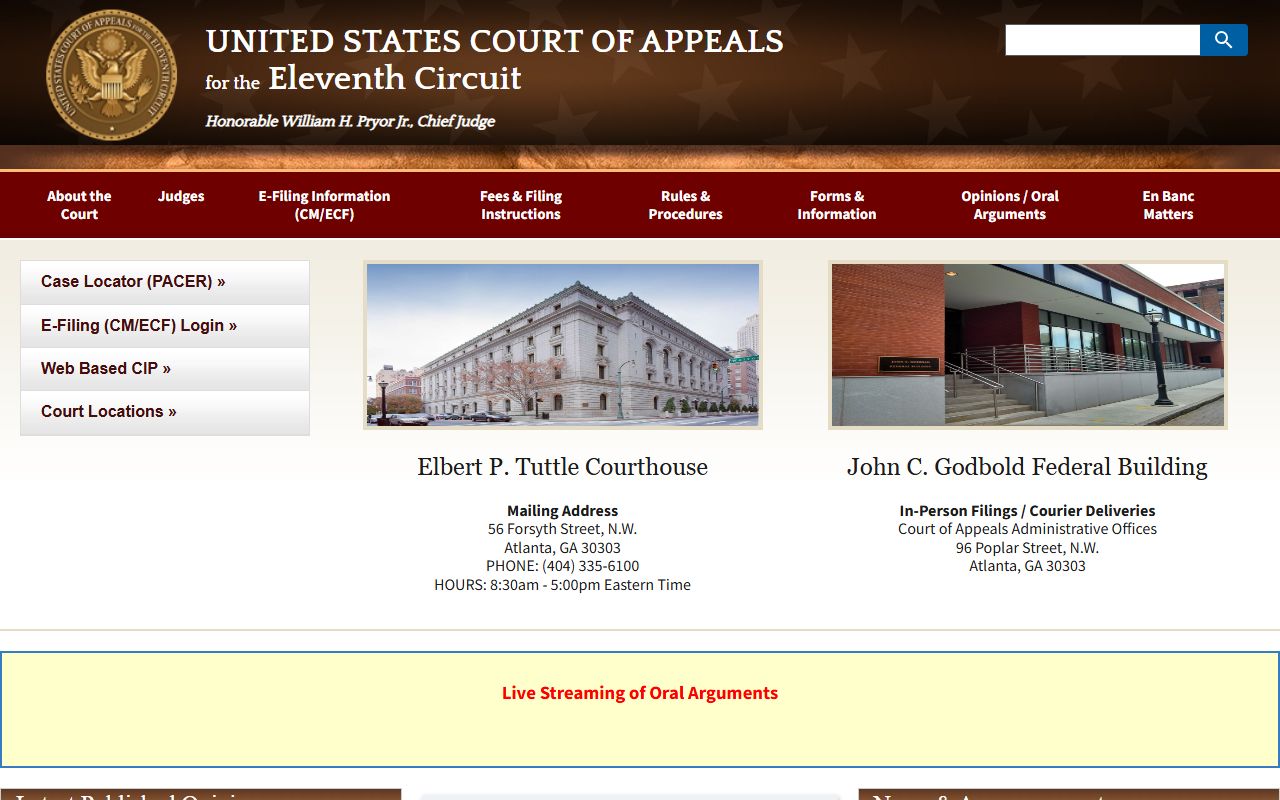
That federal track runs on PACER and operates fully apart from the state Circuit Court and Second DCA system.
Hillsborough Courthouse Locations
Hillsborough's Circuit Court is centralized in downtown Tampa but not housed in a single building. Civil, family, and probate work goes to one courthouse. Felony criminal work goes to another. Civil traffic gets its own building. Plant City has a courthouse for east county service. The Thirteenth Judicial Circuit posts a full list at the court locations page, with photos and addresses for each site.
| Courthouse | Address | Phone | What It Handles |
|---|---|---|---|
| George Edgecomb Courthouse | 800 E. Twiggs Street, Tampa, FL 33602 | HOVER support 813-307-7180 | Family, circuit civil, probate, guardianship, and many circuit divisions. |
| Criminal Courthouse Annex | 401 N. Jefferson Street, Tampa, FL 33602 | Phone not published in official locations list | Felony courts and first appearance hearings. |
| Civil Traffic Court | 419 N. Pierce Street, Tampa, FL 33602 | Phone not published in official locations list | Civil traffic infractions and related Clerk services. |
| Plant City Courthouse | 301 N. Michigan Avenue, Plant City, FL 33563 | Phone not published in official locations list | East county trial court services for both Circuit and County matters. |
| Children's Justice Center | 700 E. Twiggs Street, Tampa, FL 33602 | Phone not published in official locations list | Juvenile diversion, supervised visitation, and children's services. |
Drive routes from I-275 and the Selmon Expressway are spelled out on the official courthouse directions page. Parking is mostly downtown garages and metered street spaces. Plan extra time for security screening at any building.
The map embed below shows George Edgecomb Courthouse in downtown Tampa.

The map is the quickest way to plot a route from the Selmon Expressway exits or from northbound I-275 toward the downtown court campus.
Circuit Court Divisions
Hillsborough's Circuit Court is broken into divisions, and each division has its own set of judges, courtrooms, and rules. The Clerk routes filings into the right division based on case type. Knowing which division a case sits in helps a searcher find the correct docket and the correct hearing room.
- Circuit Civil: lawsuits above fifty thousand dollars, real property and foreclosure, business disputes, injunctions, and writs.
- Circuit Criminal: felony prosecutions, from first appearance through trial and sentencing.
- Family: divorce, paternity, custody, child support, modifications, and domestic violence injunctions.
- Probate, Guardianship, and Trust: decedent estates, summary and formal administration, guardianships, and trust matters.
- Juvenile: delinquency and dependency cases, with confidentiality limits set by Florida statute.
Family division work in Hillsborough leans heavily on standardized forms. The state publishes them through the Florida Courts Office of Family Courts, and circuit judges expect parties to use the approved versions. The Florida family law forms library is the official source. The Thirteenth Judicial Circuit also keeps a local forms page with locally approved templates.
The state family law forms library is the master set for divorce, paternity, custody, and support filings.
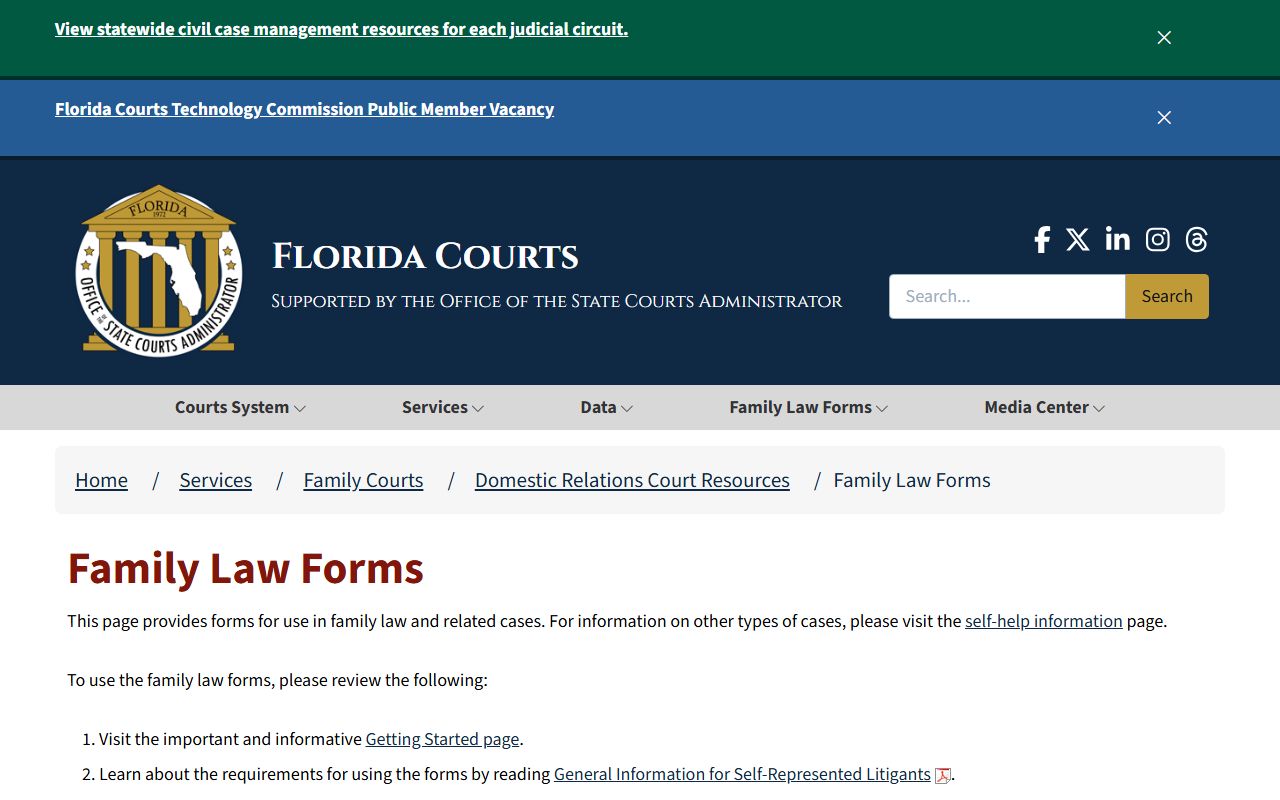
Self-represented parties in the family division should pull forms from this page first, then check the local circuit forms page for any Hillsborough-specific addendum.
The Thirteenth Judicial Circuit also posts general civil, probate, and criminal forms locally.
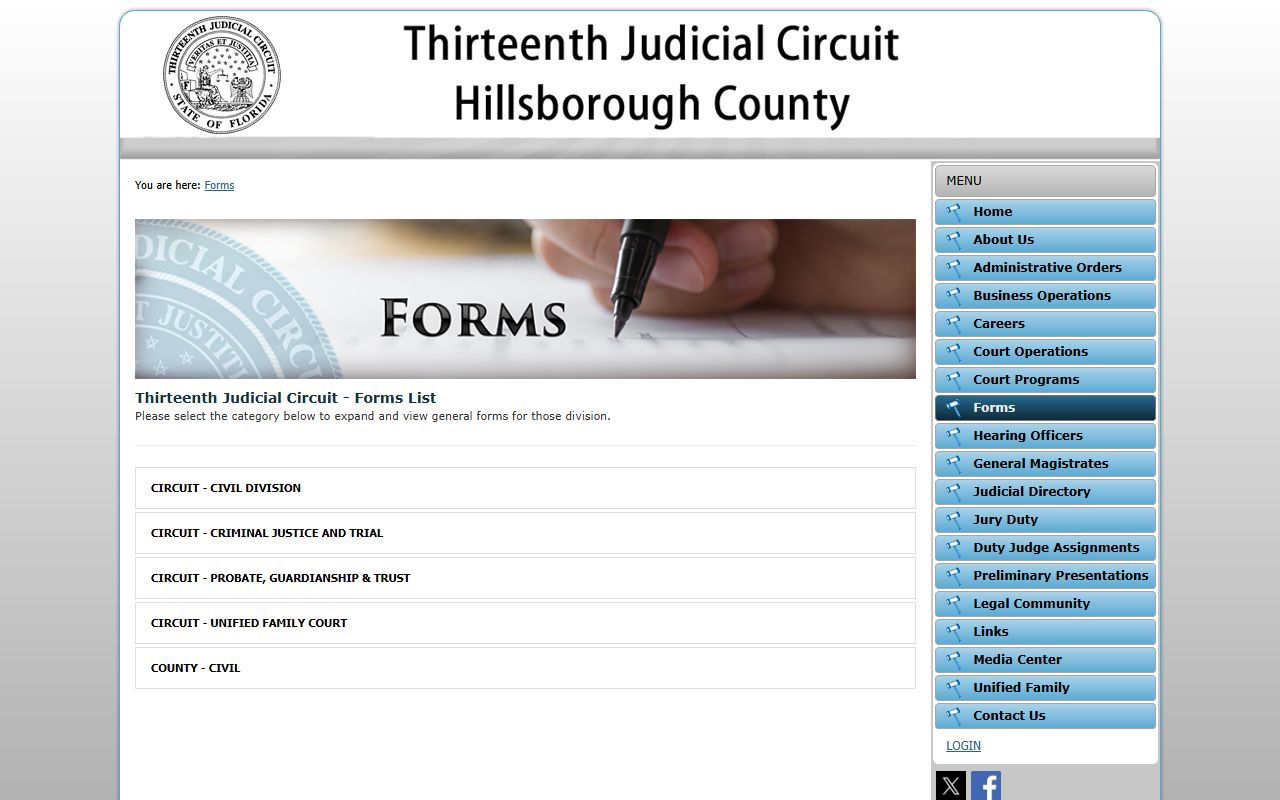
Pairing the local forms page with the statewide Office of Family Courts library covers most filings in the circuit's divisions.
Circuit Court vs County Court vs Second DCA
Each level of the Florida court system does something different. The comparison block below lines up the three a Hillsborough searcher is most likely to deal with. Circuit Court handles trials of major matters. County Court handles trials of smaller matters. The Second District Court of Appeal handles appeals from the Circuit Court.
| Circuit Court | County Court | Second DCA | |
|---|---|---|---|
| Role | General-jurisdiction trial court | Limited-jurisdiction trial court | Intermediate appellate court |
| Civil Limit | Above $50,000 | Up to $50,000 | Appellate; no civil cap |
| Criminal Jurisdiction | Felonies | Misdemeanors and ordinance cases | Reviews trial-court rulings |
| Family Cases | Yes, in Family Division | No | On appeal only |
| Probate / Guardianship | Yes, in Probate Division | No | On appeal only |
| Appeals From | Hears appeals from County Court | Trial court of first instance | Hears appeals from Circuit Court |
| Filing Fee | $400 for circuit civil above $50,000 | Varies by claim band, $55 to $400 | $300 to file an appeal |
Filing fees are set by the Hillsborough Clerk under Florida Statutes section 28.24. A Circuit Civil action above fifty thousand dollars costs four hundred dollars to file. A Second DCA filing fee is three hundred dollars. The County Court range starts at fifty-five dollars for very small claims and climbs with the amount in dispute.
How a Case Moves Through the System
A case rarely stays in one court for its entire life. It can start in County Court, move up to Circuit Court if facts change, and then move on to the Second DCA on appeal. The flow is different for criminal and civil cases, but the basic path runs in one direction.
Vertical flow: County Court › Circuit Court › Second District Court of Appeal › Florida Supreme Court
- Most misdemeanor and small civil cases begin and end in County Court without ever touching the Circuit Court.
- Felonies, divorces, probate, and larger civil suits start in the Circuit Court and stay there through trial.
- A losing party in County Court appeals up to the Circuit Court for appellate review.
- A losing party in Circuit Court appeals up to the Second District Court of Appeal in Lakeland.
- A small number of Second DCA cases go on to the Florida Supreme Court when the issue is one of statewide importance.
Inside Circuit Court itself, the criminal flow runs from arrest to first appearance, to charging document or indictment, to arraignment, pretrial motions, trial, sentencing, and appeal. The civil flow runs from petition or complaint to answer, discovery, mediation, trial, judgment, and appeal. Family law cases follow the civil pattern but often include temporary relief hearings, parenting plans, and mandatory parent education before any final judgment.
Note: Case progress and hearing dates can be checked in the Clerk's HOVER system, which posts dockets for both Circuit and County matters.
Specialty Courts
The Thirteenth Judicial Circuit runs several problem-solving courts that sit inside the Circuit Court structure. These are not separate courts. They are dockets staffed by circuit judges working with treatment teams, prosecutors, defense counsel, probation, and community partners. The goal is treatment-based resolution rather than straight punishment.
The Veterans Treatment Court is the most fully documented. It serves veterans who are in or about to enter the criminal justice system and who suffer from service-related mental illness, traumatic brain injury, PTSD, substance use disorder, or military sexual trauma. The program has five phases, an individualized treatment plan built by VA or court-approved providers, and a mentor program with active veteran volunteers. Eligible participants may enter through the VTC Misdemeanor Intervention Program or the VTC Felony Pretrial Intervention Program under section 948.16(2), and some veterans with prior convictions may qualify for a post-adjudication track.
The Veterans Treatment Court's official program page describes the eligibility, phases, and partners.
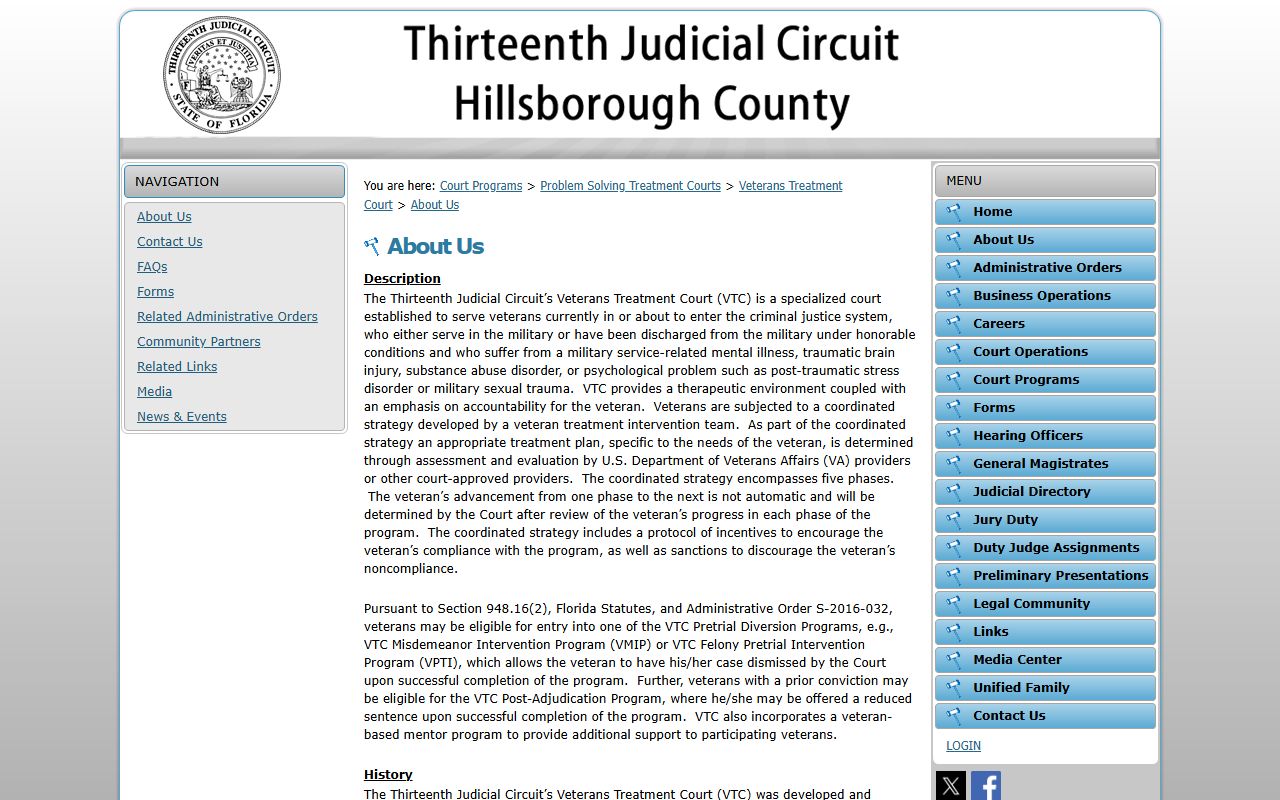
The program started in October 2013, expanded to felonies in 2015, and now lists more than 200 participants and over 60 volunteer mentors working with the court's treatment team.
Hillsborough also runs Adult Drug Court and a Mental Health Court docket inside the Circuit Court framework. The Sheriff's Office operates a jail-based mental health stabilization program and the only state-certified drug treatment program inside a Florida jail. These jail-side programs connect into the circuit's problem-solving court dockets when a defendant is released to community supervision or treatment.
Judicial Directory and Court Officers
Hillsborough circuit judges are elected to six-year terms in nonpartisan elections and serve in the divisions assigned by the chief judge. The current roster, courtroom assignments, judicial assistants, and division splits sit in the official judicial directory. Anyone preparing a motion, scheduling a hearing, or checking who signed an order should pull the directory first.
The Clerk of the Circuit Court and Comptroller, Victor D. Crist, is the elected officer who keeps the case files, processes filings, runs the cashier, records Official Records, and supports the courtroom workflow. More on the Clerk role is on the Clerk of the Circuit Court page. Prosecution is handled by the Office of the State Attorney for the Thirteenth Judicial Circuit, led by Suzy Lopez. Indigent defendants are represented by the Law Offices of Lisa B. McLean, the Public Defender for the Thirteenth Judicial Circuit, at 700 E. Twiggs Street, 5th Floor, Tampa.
The Sheriff is Chad Chronister. Sheriff's deputies provide courtroom security, serve civil process, and run the county jail system that feeds defendants into circuit criminal first appearance and arraignment.
Court History
Hillsborough's earliest courthouse was a log cabin destroyed by fire at the outbreak of the Second Seminole Indian Wars. In 1847, the first Commissioners accepted Captain James McKay's bid to build a two-story wooden courthouse, twenty by forty-five feet, for $1,358. A larger 1855 building added a forty-two by forty-five foot courtroom on the second floor and mixed Grecian, Ionic, and Corinthian architectural orders. A picket fence kept livestock out of the courthouse yard.
In August 1892, an ornate red-brick courthouse with a silver dome took up a full downtown block. The architect was J.A. Wood, who also designed the Tampa Bay Hotel. The dome no longer stands, but a replica sits at Joe Chillura Courthouse Square Park, and the original 1892 courthouse doors were restored and reinstalled at the Judicial Conference Room inside the modern George Edgecomb Courthouse. The 1952 courthouse occupied two city blocks and originally had segregated restrooms and drinking fountains, a fact the circuit's history page records honestly. The Courthouse Annex followed about a decade later, the North Annex came in 1984, and the 1999 Courthouse Facilities Project produced the six-story Family/Civil Court Building completed in 2004.
The 2004 Edgecomb Courthouse offers more than 268,000 gross square feet of court and agency space and is the building most Hillsborough family, civil, and probate cases run through today.