
How to Look Up Hillsborough Jail Population Data
Hillsborough County jail population data lives across three official sources, and each one shows a different layer. The Hillsborough County Sheriff's Office runs the live custody system at the county level. The Florida Department of Corrections publishes state prison and supervision counts that include people sent from Hillsborough courts. The U.S. Bureau of Justice Statistics, hosted at bjs.ojp.gov, releases the national jail census that lets a county number be read against state and national rates. There is no single county dashboard that bundles all of this together.
At the county level, HCSO's Arrest Inquiry is the live source. It refreshes every 30 minutes and shows people currently in custody plus those released within the last 90 days. It is not a population dashboard in the strict sense. It is a per-inmate lookup tool, and the rolling tally of records returned is the closest public count of who is in the Hillsborough jail at any given moment. HCSO has noted in procurement records that average daily population data exists in agency files and is shared with vendors during the inmate communications bidding process, which means a formal Florida public records request can usually pry loose more detail than the website shows.
At the state level the FDC publishes monthly statistical reports covering prison counts, probation, post-prison supervision, admissions, releases, and revocations. These are state totals. They do not break out the Hillsborough jail. They do show how many people from the Tampa area are flowing into and out of the state system on a regular cycle. A lead-in to those FDC pages and reports is the agency homepage, which notes Florida's prison system holds more than 80,000 inmates and supervises more than 146,000 people in the community.
The federal layer adds context. The BJS Annual Survey of Jails and the Jail Inmates At Midyear series both report rated capacity, average daily population, and inmate demographics for jails of various sizes. Hillsborough is a large urban jail and so its counts often appear in BJS sample data. The Vera Institute's county-level jail tool reuses BJS data and re-cuts it for trend viewing, which is useful for spotting whether the local jail population is going up or down compared to peer counties.
Jail Capacity Overview for Hillsborough County
HCSO operates two adult detention campuses in unincorporated Tampa. Orient Road Jail handles all adult booking. Falkenburg Road Jail holds the longer-term general population and houses Jail Division II and Division III. Both sites are listed on the HCSO Locations page, which is the official directory for every jail division and contact phone. Rated capacity for Orient Road is reported in an HCSO annual-report snippet at 1,711 beds across about 636,000 square feet. The Falkenburg figure was not captured in accessible HCSO text and is best confirmed through a records request to HCSO.
| Facility | Rated Capacity | Role |
|---|---|---|
| Orient Road Jail (Division I) | 1,711 | Adult booking; intake; bond payment site. |
| Falkenburg Road Jail (Division II) | Not published | General population; Mental Health Stabilization Unit; legal mail site. |
| Jail Division III (at Falkenburg) | Not published | Listed by HCSO at the Falkenburg Road address. |
The Orient Road campus carries the booking load because every new arrest in the county flows through Central Booking there. Falkenburg, by contrast, is built for the longer holding side of the job and for the special-housing programs that have grown over the past several years. The HCSO 2020 annual-report snippet that fixed Orient Road at 1,711 beds is the most precise public figure on the books. Note: a Florida public records request to HCSO can confirm current rated capacity and average daily counts that the website does not publish.
Average Daily Population in Hillsborough Jails
Hillsborough County does not publish a standing average daily population dashboard for its jails. The figure exists internally. HCSO's own 2023 inmate communications procurement Q&A noted that average daily population data was included in attachments shared with vendors during the bidding cycle, which confirms the number is tracked in agency reporting.
For a working estimate, BJS national survey data and HCSO's stated booking volumes can be used to triangulate. A large urban Florida jail typically runs at 70 to 90 percent of rated capacity outside of major surge events. Applied to Orient Road's 1,711 beds and the unstated Falkenburg figure, the combined county jail ADP very likely sits in the low to mid thousands on any given day. That estimate is not an HCSO number. It is a context band drawn from BJS reporting on similarly sized county systems.
Demographic Breakdown of the Jail Population
HCSO's Arrest Inquiry lists race, sex, and date of birth as searchable fields on every record. Race options include Asian, Black, Indian, and White. Sex options include Male and Female. The agency does not publish an aggregate demographic report, so the only way to derive a real county-wide split is through a records request, the BJS jail survey, or a hand tally from the live roster. The table below shows the demographic fields HCSO captures, not a finished percentage chart.
| Field | Values Captured |
|---|---|
| Race | Asian, Black, Indian, White |
| Sex | Male, Female |
| Date of birth | Used to derive age bands |
| Booking date | Used to filter new arrivals |
| Release date | Persists 90 days post-release |
National BJS data shows that men make up roughly 85 to 88 percent of the local jail population in most U.S. counties, with women holding the remaining share. Race and ethnic mix in Florida county jails tracks state arrest patterns more than local population shares. These are national or state-level numbers, not Hillsborough-specific figures, and are noted here for context only.
Pretrial vs Sentenced Population
The split between pretrial and sentenced inmates is one of the most-watched figures in any local jail. In Hillsborough, HCSO does not post a standing pretrial-versus-sentenced chart. BJS jail data has shown for years that around two-thirds of the people in any given U.S. county jail are pretrial, meaning they have not been convicted of the charge holding them. The remaining share is serving a county sentence, holding for a state prison transfer, or being held on a probation or parole detainer.
| Status | Typical Share (BJS national) |
|---|---|
| Pretrial | ~65 percent |
| Sentenced or held for transfer | ~35 percent |
The shares above are national BJS averages, not a Hillsborough-specific count. For a true county figure, file a public records request with HCSO covering pretrial counts by month. Note: county pretrial release programs, bond reform, and case-flow changes can shift the share by ten points or more over a few years.
Misdemeanor vs Felony Population
Hillsborough's two jails hold a mix of misdemeanor and felony defendants. Felony cases dominate the bed count in most county jails because felony bonds tend to be higher and case timelines longer. Misdemeanor defendants often clear out faster through plea, time served, or release on recognizance, which keeps their share of the standing population smaller than their share of total bookings.
HCSO's Arrest Inquiry shows charges on each record, but the agency does not roll those charges into a public misdemeanor-versus-felony chart. Florida court records on the Thirteenth Judicial Circuit's HOVER portal can be filtered by case type to read the flow of new criminal filings, which is a useful proxy for what charges drive the standing jail count. For a person-level view, see Hillsborough County criminal records.
Mental Health and Medical Population
Hillsborough's jails carry a sizeable mental-health caseload, and HCSO has built that work into a national-recognition story. The agency's April 30, 2026 press release unveiled a new Mental Health Stabilization Unit at Falkenburg Road Jail. The unit is designed to stabilize people in crisis, return them safely to the general detention population, and support healthy reentry after release.
A lead-in image from the HCSO press release shows the new stabilization unit announcement.
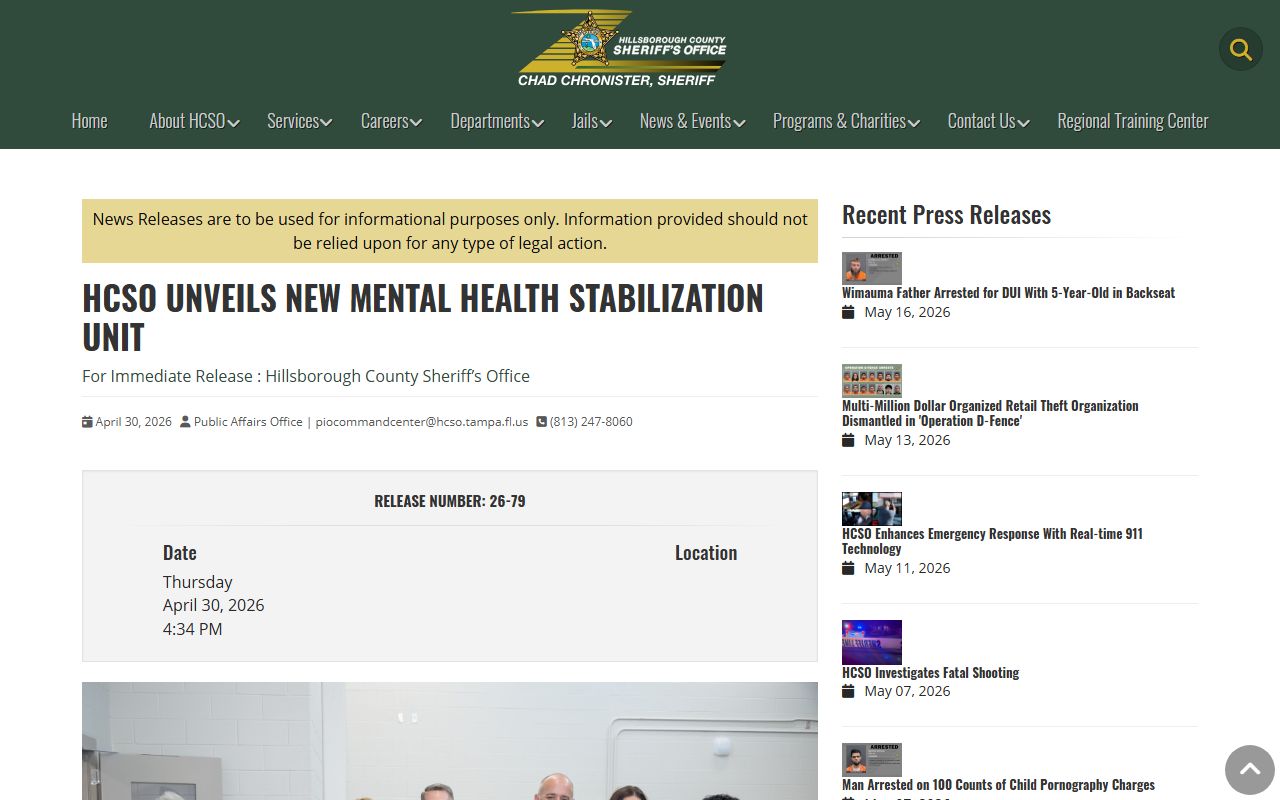
The stabilization program builds on a service line HCSO started in October 2017 for inmates diagnosed with schizophrenia, bipolar disorder, PTSD, and major depression. Those diagnoses cover a wide slice of the jail population in any urban county. HCSO has not posted a hard percent of inmates receiving mental-health care, but the existence of a dedicated unit at Falkenburg points to a daily caseload large enough to fill it.
On the medical and treatment side, the 2021 HCSO release noted that Falkenburg Road Jail and Orient Road Jail were the first correctional facilities in the nation to earn NCCHC accreditation for jail health services, mental health services, and opioid treatment programming. HCSO and partner NaphCare received the inaugural NCCHC Pinnacle Award for that work.
A view of the NCCHC Pinnacle Award announcement is shown below.
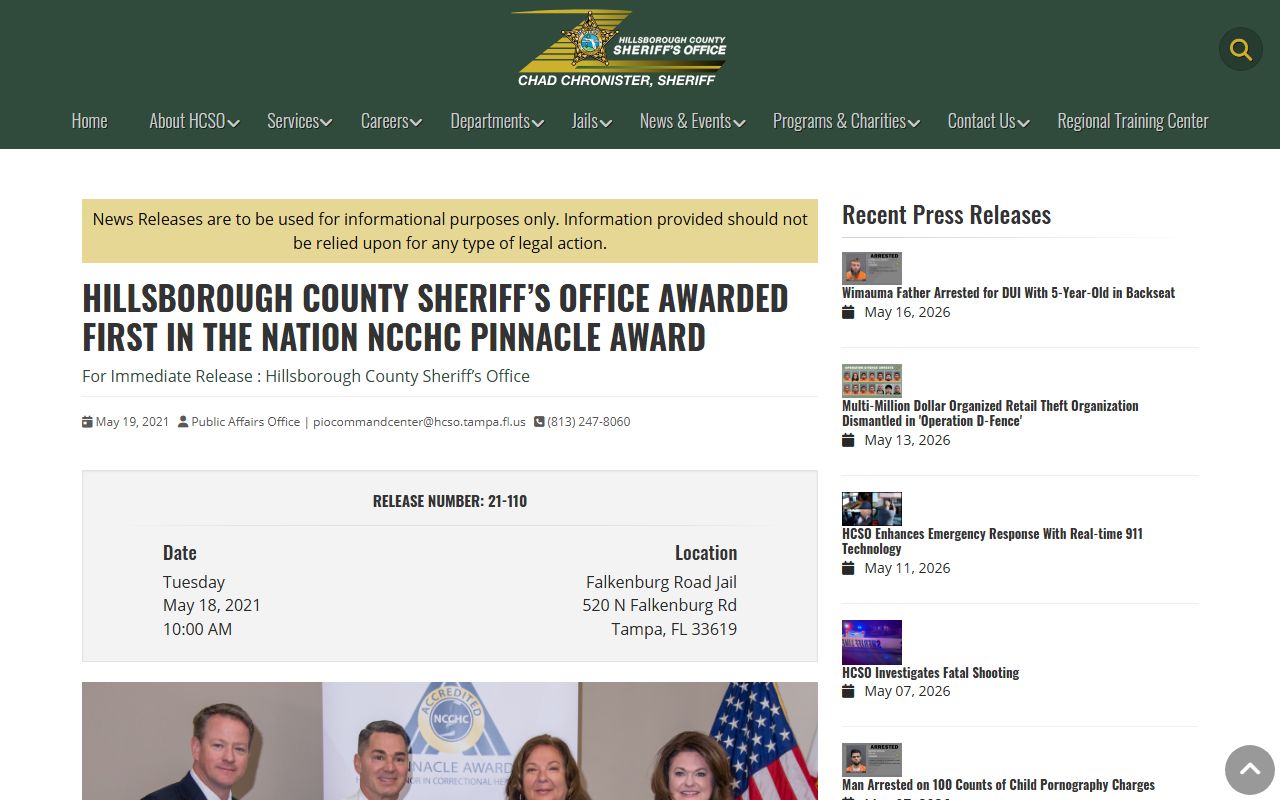
The Pinnacle Award put Hillsborough on the national map for jail-based health care. HCSO also operates what its public materials describe as the only state-certified drug treatment program inside a Florida jail.
National and State Context for Jail Population
To put Hillsborough's jail counts in scale, the standard yardstick is jail population per 100,000 residents. The Bureau of Justice Statistics tracks this rate at the state and national level through the Annual Survey of Jails. The Vera Institute also publishes county-level estimates derived from BJS data. A comparison below shows the standard rate frame.
| Level | Jail Population per 100k | Source |
|---|---|---|
| National (recent BJS) | ~210 | BJS Jail Inmates at Midyear |
| Florida statewide (BJS) | ~250 | BJS Annual Survey of Jails |
| Hillsborough County | Not published by HCSO | Estimate via records request |
The national rate has drifted down from its early-2000s peak. State rates vary widely. Florida tends to run higher than the national average. A county rate for Hillsborough can be derived if HCSO releases an ADP figure: divide that ADP by the most recent county population, multiply by 100,000. Without an official ADP, the rate is best left as an estimate. The state prison rate is a different figure and is driven by FDC, not the county jail.
The FDC homepage opens with the agency's standing scale: more than 80,000 inmates in state prisons and more than 146,000 people under community supervision. A lead-in below shows the FDC site.
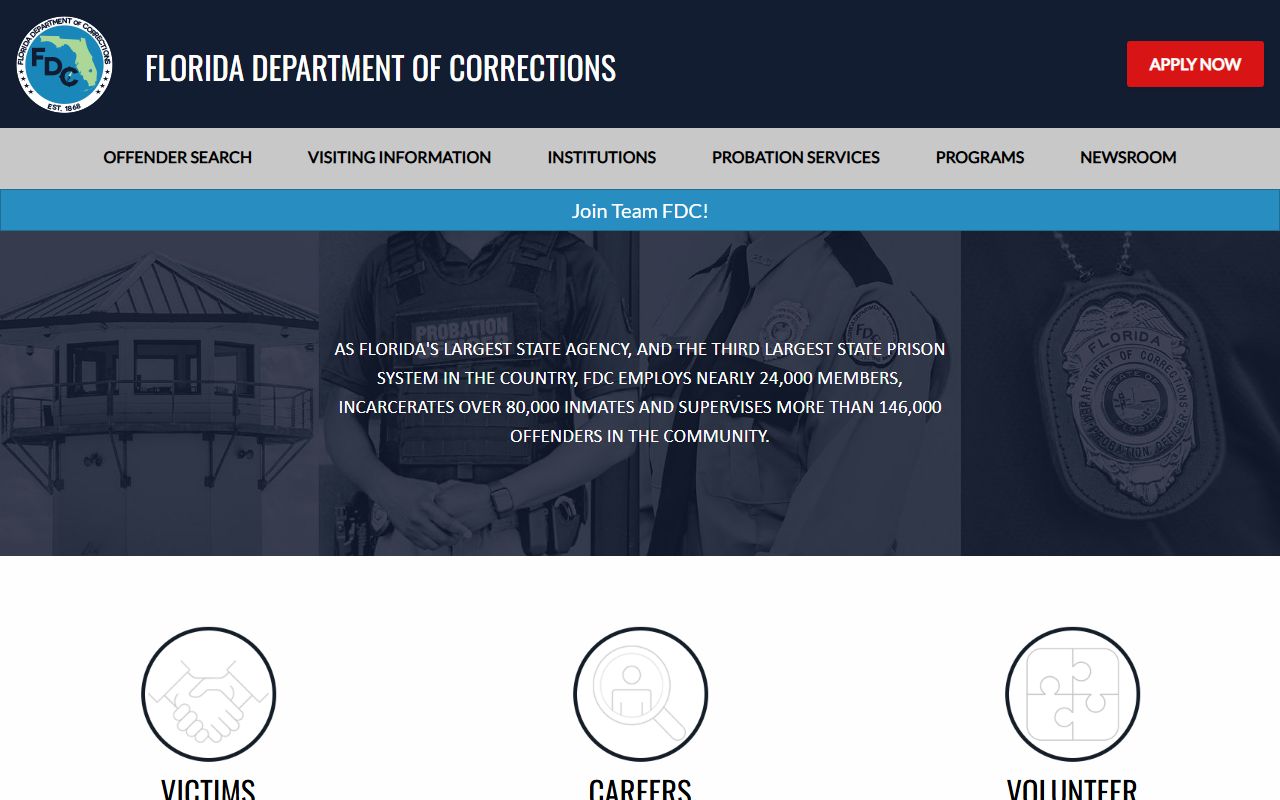
FDC's monthly statistical reports break out prison admissions, releases, and revocations by region. Hillsborough sits in FDC's Region III for supervision purposes, and a share of state admissions flow from Tampa-area cases.
Population Trends Over Time
The clearest published trend for the Hillsborough jail system is the buildout of behavioral-health capacity. HCSO has expanded its mental-health program from a single unit launched in October 2017 into a stand-alone Mental Health Stabilization Unit at Falkenburg announced in 2026. That arc shows a rising share of the daily population needing structured mental-health care, even without a public count attached to it.
Booking volume itself has held in a broad band over the past several years. National BJS data shows U.S. jail counts dipped sharply in 2020, climbed back through 2021 and 2022, and have run near pre-pandemic levels since. Florida county jails followed the same general pattern. A five-year Hillsborough trend chart is not posted by HCSO, which is the main gap in the local data picture. Note: the best place to file for a multi-year trend is HCSO via a Florida public records request citing chapter 119.
Searching for Hillsborough County Inmate Records by Name
This page covers aggregate jail population data. For a name-based search of the live county roster, including booking number, charges, bond, and mugshot, use the Hillsborough County inmate records page. To find people who have already been released, see released inmates.
Where the Data Comes From
Hillsborough County jail population figures pull from three official streams. The first is HCSO itself, which runs the live Arrest Inquiry tool, the booking system at Orient Road, and the housing assignments at Falkenburg. Its locations page at teamhcso.com/Home/Locations lists every division and is the right starting point for a records request. The second is the Florida Department of Corrections, which publishes monthly statistical reports on the state prison and community-supervision population. The third is the federal Bureau of Justice Statistics at bjs.ojp.gov, which runs the national jail census.
An additional layer comes from HCSO's communications vendor SmartInmate, which handles inmate phone and tablet messaging at the two jails. The vendor relationship is documented at smartinmate.com. A lead-in image below shows the vendor service page.
Communications vendor records do not contain population counts directly, but procurement files filed with HCSO during vendor selection include ADP attachments. That is one practical path to a recent ADP figure. The most reliable path remains a written Florida public records request to HCSO citing chapter 119 and naming the specific data fields needed.