
Probate Division of the Thirteenth Circuit
Florida does not run a separate elected probate court. In Hillsborough County, probate is a division inside the Thirteenth Judicial Circuit, the general jurisdiction trial court. That means probate judges are circuit judges assigned to estate, guardianship, trust, and mental health matters. Case files are opened, stamped, and held by the Clerk of the Circuit Court rather than by a stand alone probate clerk. The same Clerk handles civil, family, and other circuit business, which keeps filing and records access in one office.
The Probate Division hears decedent estates, summary administration, formal administration, ancillary administration, foreign wills, adult and minor guardianships, and trust proceedings. Filings include petitions, orders, letters of administration, inventories, accountings, creditor notices, waivers, and final discharge papers. Most hearings tied to these cases sit at the George Edgecomb Courthouse in downtown Tampa. The Thirteenth Circuit covers all of Hillsborough County, so Tampa, Plant City, Brandon, Temple Terrace, and the rest of the county all funnel into the same probate division.
Searchers should treat probate as a circuit court case. The case number format, the docket layout, and the access controls match other circuit files. The big difference is the privacy overlay. Probate files often hold medical details, financial accountings, and protected person information, so the Clerk and the courts apply tighter rules to what loads on a public screen.
Probate Division, Thirteenth Judicial Circuit
George Edgecomb Courthouse
800 E Twiggs Street
Tampa, FL 33602
Probate Division
Hours vary by division and judge
HOVER Probate Search and Access Restrictions
The Clerk's public court record portal is HOVER, short for Hillsborough Online Viewing of Electronic Records. Probate cases live inside HOVER, and a basic search returns the case number, party names, filing date, and the progress docket. The portal supports lookup by case number, Uniform Case Number, party or business name, and a date range plus court type and case type filter. For probate, users usually search by the decedent's name, the personal representative's name, or the case number if one is already known.
Image access is the tricky part. HOVER applies the Standards for Access to Electronic Court Records and the Access Security Matrix, so probate and guardianship images are restricted. Probate document images are limited to attorney of record, pro se parties, and registered users. Guardianship goes further and limits image access to attorney of record or pro se users only. An anonymous searcher can still see the docket and basic case data, but the actual will, inventory, or accounting pages may not load. A "Case Not Found" result can mean the case is sealed, the number was typed wrong, or the user role does not allow viewing.
Why the lock down? State law on probate, mental health, juvenile, and family records keeps medical, financial, and protected person details off the open internet. The Clerk follows those rules at the portal level. For records that cannot be viewed online, an in person visit to the Clerk's records office or a formal records request fills the gap. Older estate files may also sit in archive and require a staff retrieval.
The Clerk's Records and Reports hub ties together HOVER, the Official Records index, and eCertify for certified copies. Probate searchers usually move between HOVER for the case file and Official Records for any recorded judgment or notice.
Probate Filing Fees and Costs
The Clerk sets probate filing fees under state statute and the official fee schedule. The chart below pulls the core probate items. The Clerk also charges separate copy and certification fees on top of the case opening fee, and other add ons can apply once letters issue or extra petitions are filed. Always check the Clerk fee schedule for the current number before sending a check.
| Probate Item | Fee |
|---|---|
| Summary Administration: estate less than $1,000 | $235.00 |
| Summary Administration: estate $1,000 or more | $345.00 |
| Formal Administration | $400.00 |
| Ancillary Administration | $400.00 |
| Opening estate or guardianship of one or more documents, excluding letters or orders of summary | $231.00 |
| Petition to admit foreign wills or authenticated transcripts | $231.00 |
| Certified copies and per page copies | See Clerk fee schedule |
Estate size, the number of beneficiaries, and the type of administration all push the total cost up or down. A small bank account left behind by a deceased spouse may move through summary administration. A larger estate with real property, creditors, and a personal representative will sit in formal administration for months. Counsel often pull from estate funds to cover these fees, but a petitioner who opens the case usually pays at filing.
Note: Probate filing fees are set by Florida statute and the Clerk's published schedule, and they can change without notice, so confirm the current amount before filing.
Summary vs Formal Administration
Florida law gives families two main paths through probate. Summary administration is a faster, simpler track for smaller or older estates. Formal administration is the standard process with a personal representative, full creditor notice, and an inventory. Each comes with its own paperwork and timeline.
| Feature | Summary vs Formal |
|---|---|
| Who uses it | Summary: small estates that meet statutory limits or where the death is older. Formal: estates that do not qualify for summary, or where a personal representative is needed. |
| Personal representative | Summary: typically not appointed. Formal: a personal representative is appointed and receives letters of administration. |
| Letters of administration | Summary: usually not issued. Formal: issued so the representative can act on behalf of the estate. |
| Creditor process | Summary: shorter notice and limited claims. Formal: full notice to creditors and a statutory claim period. |
| Inventory and accounting | Summary: simplified or limited. Formal: full inventory, accounting, and final discharge. |
| Clerk filing fee | Summary: $235 or $345 by estate size. Formal: $400 at opening. |
| Typical timeline | Summary: weeks to a few months. Formal: several months and often longer with real property or contested claims. |
Picking the right track matters. Filing summary when an estate does not qualify can force a refile under formal administration. A probate attorney can read the will, list the assets, and match the case to the right Florida statute.
Probate Terms Defined
Probate paperwork is full of legal shorthand. A quick glossary helps when reading a docket or a court order.
- Testator
- The person who signed the will. Once the testator dies, the will is offered for probate and the court tests its validity.
- Executor
- The person named in a will to handle the estate. In Florida the more common label on the court file is personal representative.
- Intestate
- Dying without a valid will. Florida's intestacy statute then sets the order of heirs.
- Personal Representative
- The court appointed person who administers the estate, gathers assets, pays debts, and distributes what is left.
- Beneficiary
- A person or entity who is set to receive property under a will, a trust, or by Florida intestate law.
- Guardianship
- A court process where a guardian is appointed to manage the person, the property, or both of a minor or an incapacitated adult.
- Conservatorship
- A related arrangement used in some states for property management of an adult who cannot handle their own affairs. Florida mostly uses guardianship language for both.
Guardianship and Conservatorship Records
Guardianship files are housed in the same Probate Division of the Thirteenth Circuit. A guardianship case is opened when a court is asked to appoint someone to manage the person and property of a minor or an incapacitated adult. Florida statute uses the word guardianship for most of these cases. Other states call a similar arrangement a conservatorship, especially when the focus is on property management. The two words show up often in news coverage, but the Hillsborough case file will read "guardianship" on the docket.
Records held in a guardianship case can include the petition to determine incapacity, examining committee reports, the order appointing a guardian, letters of guardianship, annual accountings, annual plans, and any motions tied to the ward's care. The financial and medical detail is sensitive, which is why HOVER limits document images to attorney of record or pro se users. Index data, docket entries, and case status can still be searched by anonymous users.
Family members tracking a relative's case usually need to register with the Clerk or work through counsel to see the actual filings. The Clerk's office can also pull paper files on request, but staff redact protected information before release.
Mental Health Records Confidentiality
Mental health proceedings, including Baker Act commitments, route through the Probate Division on the civil side. The clinical records tied to these cases are confidential under Florida Statutes section 394.4615. That statute keeps mental health treatment records out of the general public record except in narrow situations spelled out by law. The Clerk follows the same rule on HOVER, so mental health case documents sit behind attorney of record or pro se user access.
The Clerk's portal will return an index entry for a mental health filing. Case party names, the case number, and docket text such as "petition for involuntary placement" or "order of release" may be visible. The clinical record itself, including any psychiatric evaluation or hospital report, is not posted online.
An open records request sent to the Clerk will not unlock mental health treatment files. Disclosure has to follow the statute, which usually means a court order, written consent from the patient, or one of the listed statutory uses such as continuity of care between providers.
For the full text of Florida's mental health confidentiality rule, see the official Senate statute page, captured below.
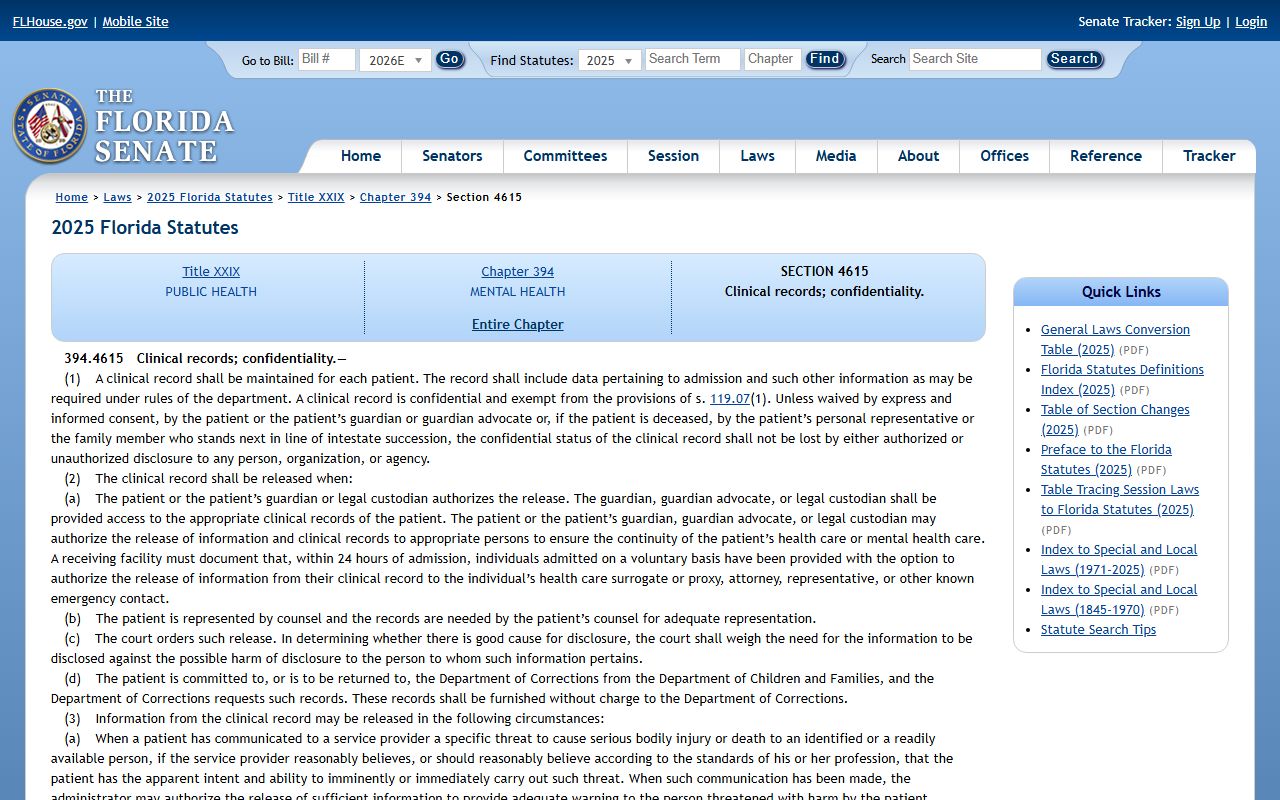
The screenshot shows the statute heading and the framework that drives the Clerk's lock down on mental health case images in Hillsborough County probate records.
Adoption Records Confidentiality
Adoption files are also handled inside the Thirteenth Circuit, with stricter confidentiality. Florida Statutes section 63.162 makes adoption papers and records confidential. Inspection is allowed only by court order, except for a short list of statutory exceptions. HOVER and eCertify treat adoption as an attorney of record or pro se access category, which mirrors the statute.
What does this mean for a researcher? The index may not surface adoption cases the same way it surfaces a regular civil filing. Even when an entry appears, the petition, the home study, and the final judgment of adoption will not load for an anonymous user. People searching for their own adoption file usually need to file a court petition and meet the narrow statutory test.
The full statute on adoption record confidentiality is available on the Florida Senate site, captured here.
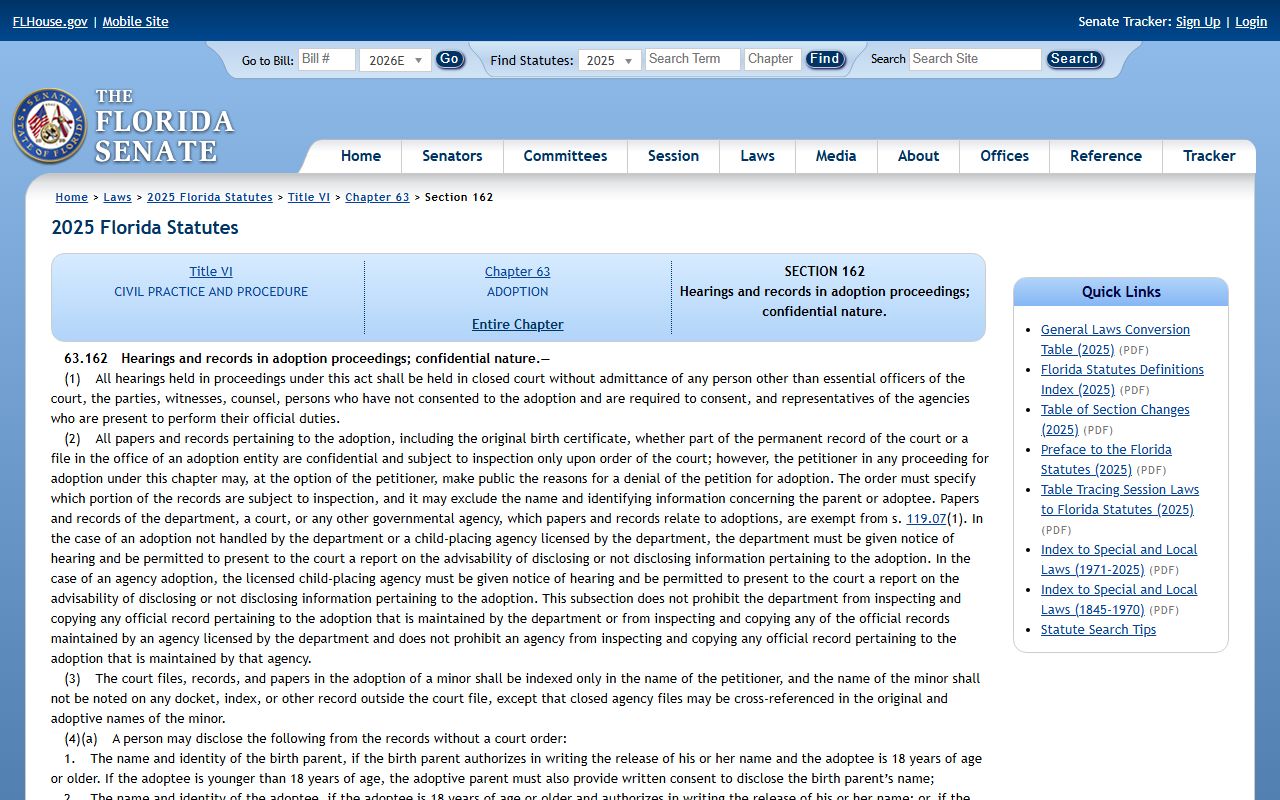
The capture confirms the legal basis for the tight access rules on adoption files inside the Thirteenth Circuit's probate and family divisions.
Official Records and Probate Judgments
Probate touches both the court file and the Official Records index. The court file holds the petition, orders, and accounting. Official Records, which the Clerk also keeps, holds the recorded version of certain judgments, deeds passing under probate, and creditor notices. The two indexes are searched in different portals, so a full probate search often hits both. An order of summary administration that distributes real property, for example, is typically recorded in Official Records so it shows in a title search.
Online image limits on Official Records come from Florida Statutes section 119.071 and related rules. The statute lays out general exemptions, including protected personal information that has to be removed from public internet display. That is why some recorded probate documents show only the index entry online, with the image available in person or through a subscription account.
Court access to probate filings also follows Florida Rule of General Practice and Judicial Administration 2.420. The rule treats public access to court records as the default and lists confidential categories such as adoption, mental health, and certain probate filings as exceptions. Both the Clerk and the courts cite Rule 2.420 when explaining why a document is hidden.
The Clerk also publishes the official statute on general exemptions, which drives a lot of probate redaction practice, on the Senate statutes page.
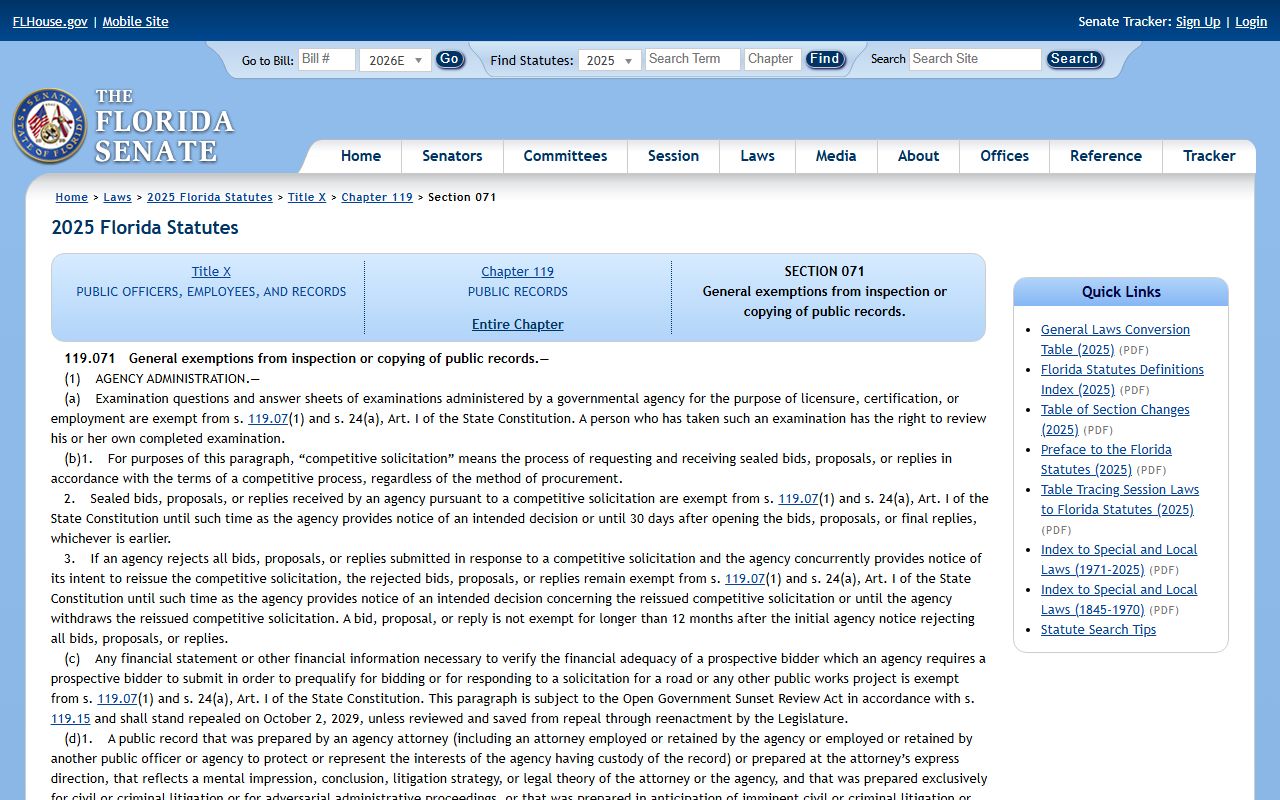
This page explains why so much identifying detail is missing from online probate and Official Records images in Hillsborough County.
Probate Document Types
A typical probate file collects a long list of documents over the life of the case. Knowing what each one does helps when reading a docket entry or pulling a copy.
- Will: The signed and witnessed statement by which the testator gives directions for the estate. The original is filed with the Clerk.
- Petition for administration: The opening pleading that asks the court to admit the will and appoint a personal representative.
- Inventory: The list of estate assets and values prepared by the personal representative.
- Notice to creditors: Published and served notice that triggers the creditor claim period.
- Order of summary administration: The court order that distributes a qualifying estate without a full formal process.
- Letters of administration: The court issued document that proves a personal representative's authority to act for the estate.
- Final accounting and discharge: The wrap up documents that close the estate after assets are distributed.
Each of these documents shows up on the progress docket inside HOVER. Whether the image loads depends on case type, user role, and any sealing or confidentiality flag tied to the filing.