
Clerk Victor D. Crist
Victor D. Crist is the elected Hillsborough County Clerk of the Circuit Court and Comptroller. His official bio on the Meet Clerk Crist page says he came into the role with prior service as a state senator and as a Hillsborough County Commissioner. He took the oath in January 2025 and named goals that include better support to judges so they can reduce case backlogs, tech upgrades, leaner processes, and standardized training across the office.
The Clerk is a constitutional officer under Article V and Article VIII of the Florida Constitution. The job is countywide and is filled by election. The Clerk is not appointed by the courts or by the county board. That structure keeps the records office separate from the judges who decide cases and from the commissioners who set the county budget. The Clerk reports to the public through the ballot box.
A look at the Meet Clerk Crist page gives the short bio plus the priorities Crist laid out at his swearing-in.
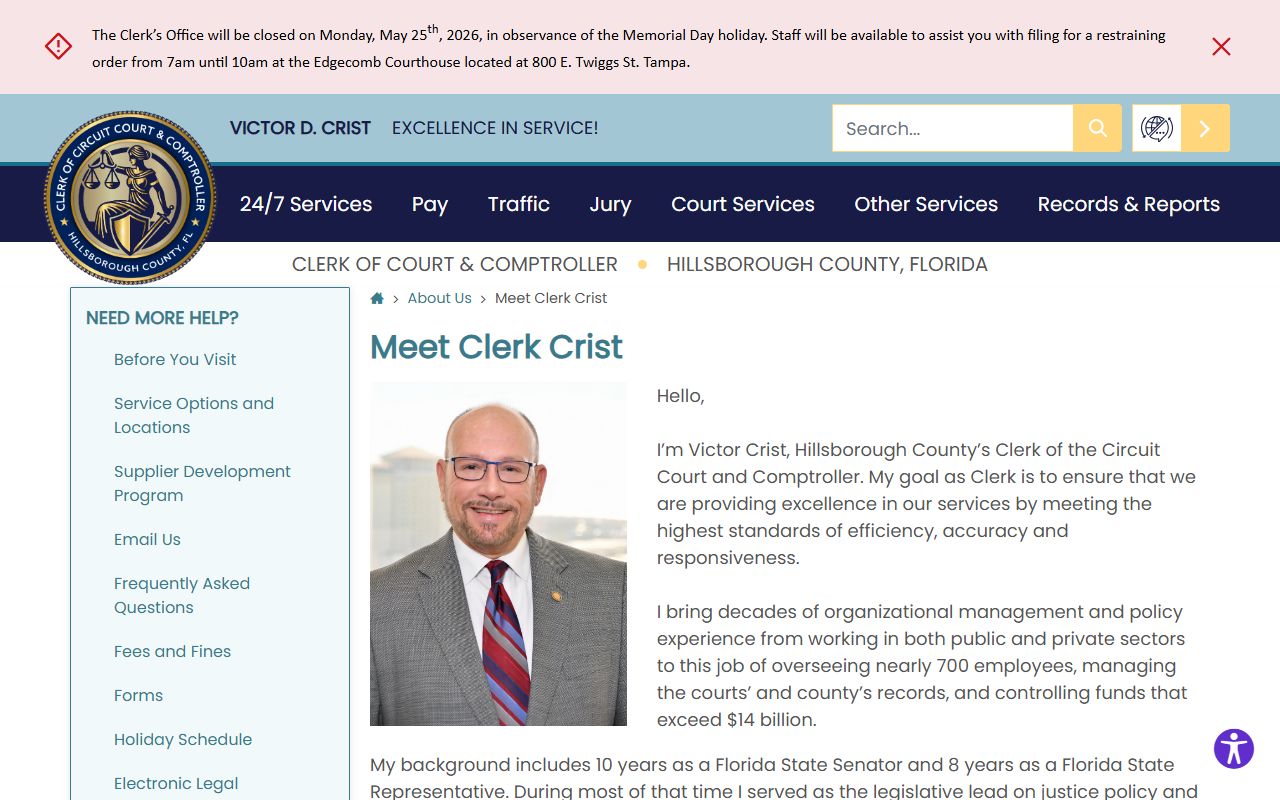
The bio frames the office around backlog work, tech changes, and cost control, which shapes the day-to-day pace inside the Hillsborough County Clerk of the Circuit Court office.
Unified Clerk Structure in Hillsborough County
Florida does not split trial-court records the way Texas splits district clerk and county clerk work. Hillsborough has one Clerk for all of it. The same office is custodian of Circuit Court files, County Court files, the Board of County Commissioners records, the official records book, marriage licenses, and the comptroller side of the county books. That keeps things simple for the public. One office, one set of phone numbers, one main website at hillsclerk.com.
The Clerk's custodian page is helpful because it also tells the public what the Clerk does not hold. Crash reports come from the investigating law-enforcement agency. Fire and arson reports come from the fire agency. Medical examiner records come from the county medical examiner. Birth and death records come from Florida Health. Statewide criminal-history info comes from FDLE. Knowing the right keeper of a record saves time before the first request goes out.
A quick scan of the Clerk's custodian table shows the split.
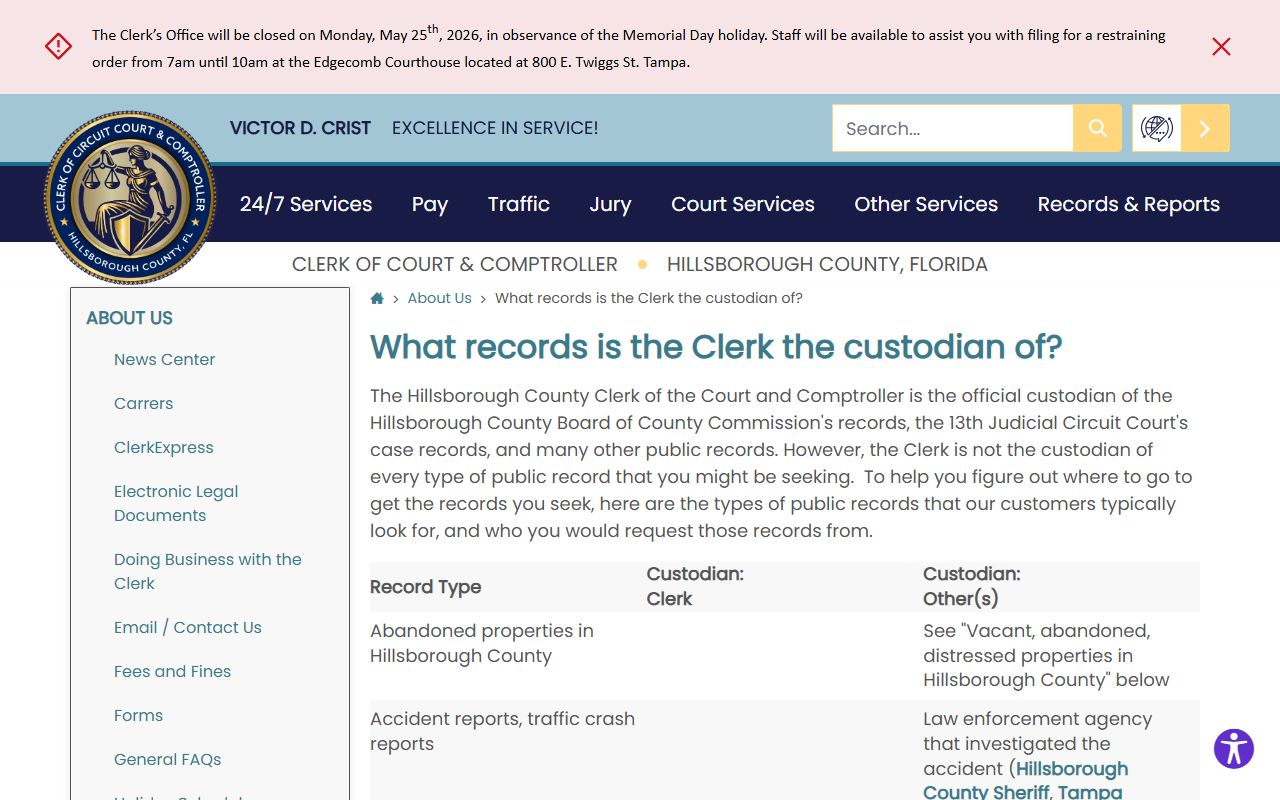
That table is the fastest way to confirm whether the Clerk holds a record before paying a search fee or making a trip downtown.
Court Records the Clerk Maintains
The Clerk holds case files for the entire Circuit Court and the County Court in Hillsborough County. That covers felonies, family, probate, guardianship, juvenile, circuit civil cases over the county threshold, real-property disputes, and injunctions on the circuit side. On the county side it covers misdemeanors, traffic, small claims, evictions, and lower-value civil cases. The full set of online court files lives in HOVER, the Clerk's portal.
HOVER stands for Hillsborough Online Viewing of Electronic Records. It is hosted at hover.hillsclerk.com. The Florida Supreme Court authorized the Clerk to provide electronic viewing of many court records, indexes, dockets, and non-confidential document images through HOVER. Access is set by the Standards for Access to Electronic Court Records and the Access Security Matrix. Some files are open to anyone. Others are open only to parties or attorneys of record. A few are blocked from online view and must be viewed in person under clerk supervision.
For more on the searchable case set, see the court records overview and the court dockets page. Probate files have their own access rules and a separate path under the probate records guide.
The Clerk's Records and Reports hub is the start point for nearly every records task.
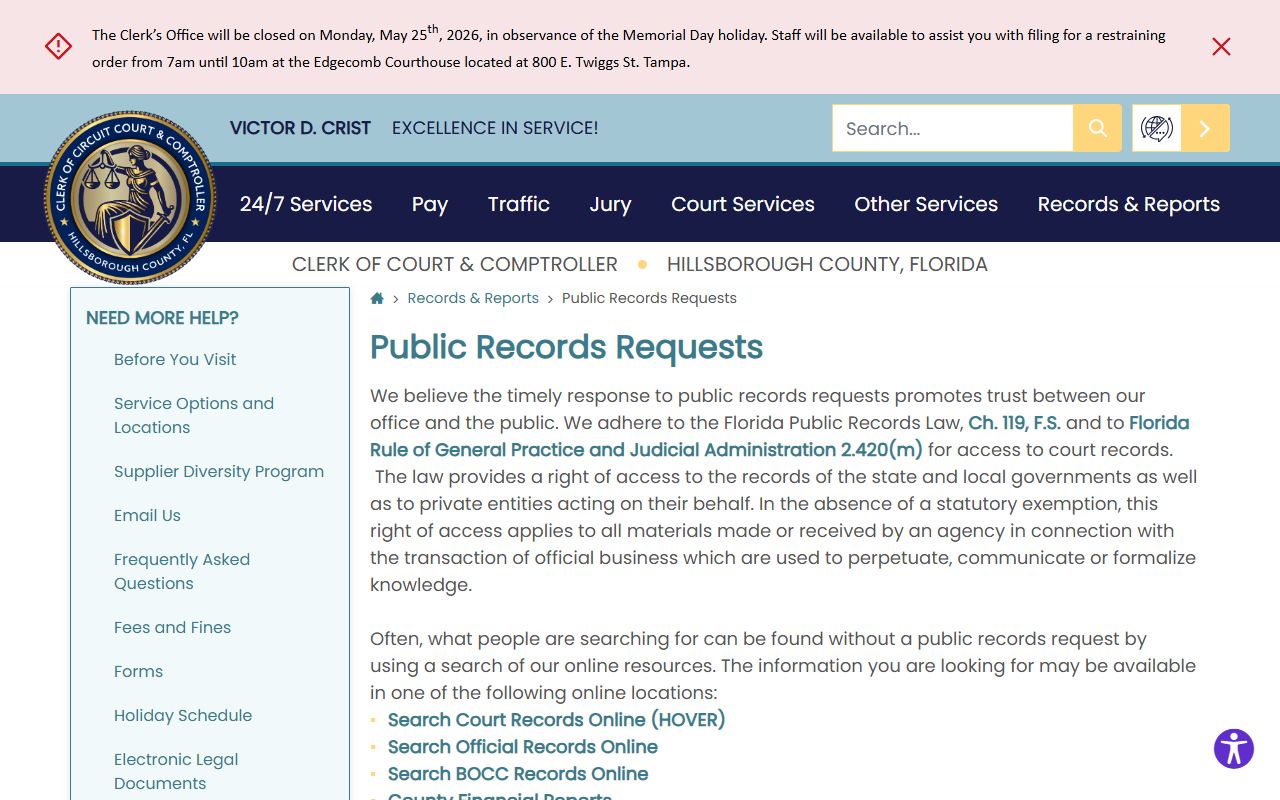
That page links the public records request form, the records library, and the rules that govern what can be removed from an online image.
Official Records, Deeds, and Judgments
The Recording Department records, indexes, and archives the documents that make up the Official Records of Hillsborough County. The Official Records page says about 25 million documents have been recorded since 1846 and around 2,000 new documents are recorded each day. The set includes deeds, mortgages, satisfactions, liens, judgments, and similar instruments that affect title or create a public claim.
The Records Library on the same page lists more than the deed book. Subdivision plats, tax rolls from 1883 to present, marriage license records from 1831 to present, circuit civil judgments from 1972 to present, county civil judgments from 1986 to present, and probate judgments from 1986 to present are all there. The Official Records Index from 1965 to present is free online when a certified copy is not needed. Older archived records like marriage licenses from 1846 to 1972 and deed indexes from 1948 to 1957 need an email request to recordslibrary@hillsclerk.com for certified archived copies.
The Official Records service page walks through the search options.
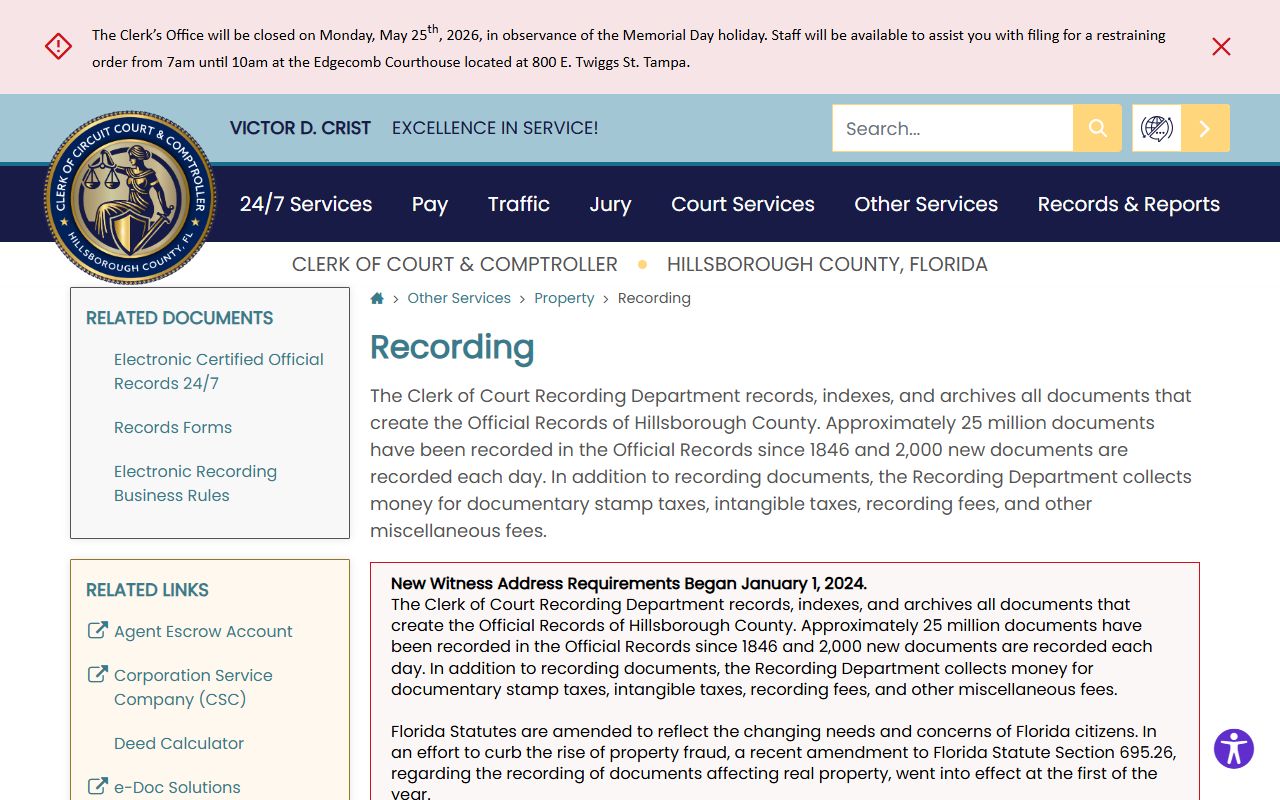
A name search there returns the document type, book and page, and the date of record for title and lien work.
Marriage Licenses
Marriage licenses are issued by the Clerk as agent for the State of Florida under Chapter 741 of the Florida Statutes. Couples can apply at Tampa, Brandon, or Plant City service locations. Brandon seats about 6 guests for a ceremony. Downtown Tampa and Plant City seat about 10. Appointments are recommended but walk-ins are welcome. Online license issuance by Zoom appointment is also offered. The Marriage page on the Clerk's site has the current forms, ID list, and ceremony rules.
Divorce is filed in the Circuit Court family division, not at the marriage license counter. The Clerk keeps the divorce case file once the petition is filed. For the full path on both sides see the marriage and divorce records page on this site.
eCertify Electronic Certification
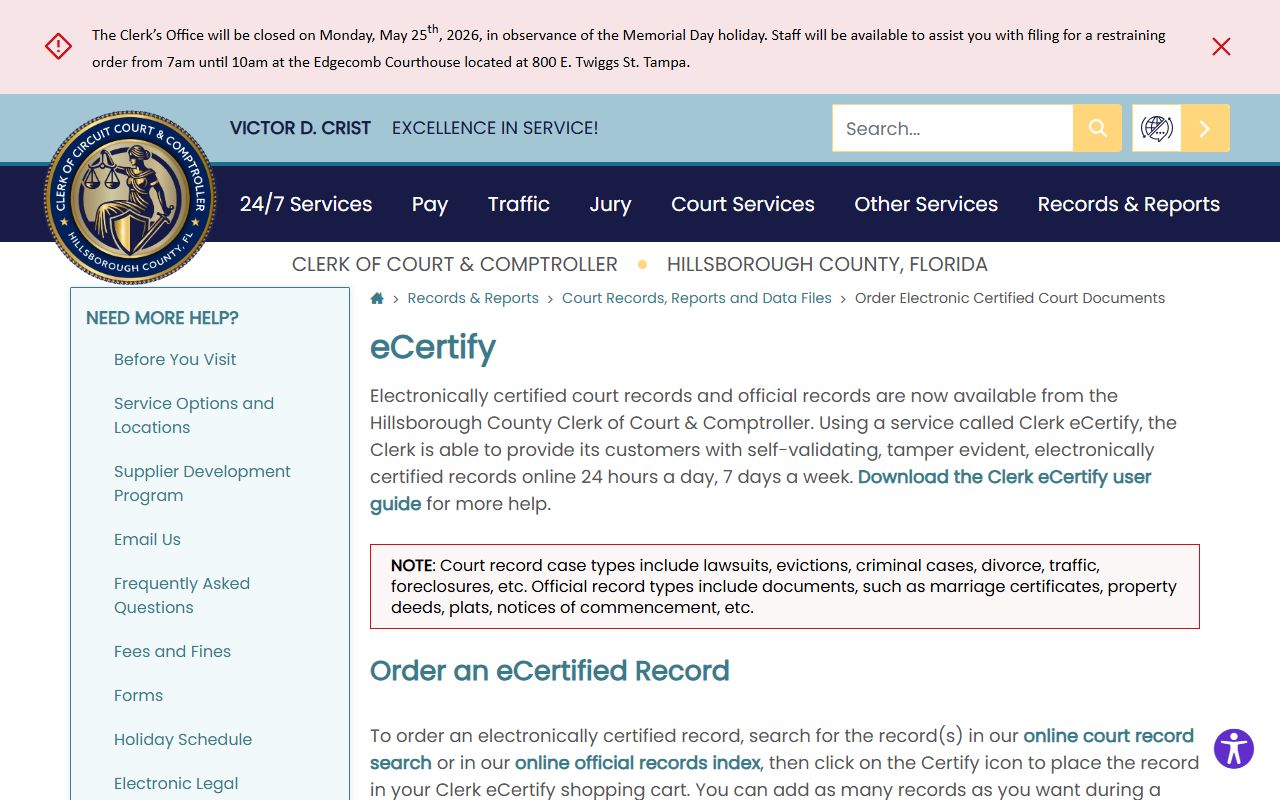
eCertify is the Clerk's tool for ordering electronically certified copies of court records and official records. The eCertify page explains the workflow. The user searches HOVER for court records or the Official Records index for recorded documents, then clicks the Certify icon to add documents to the Clerk eCertify shopping cart. After paying with a card, the user gets a payment email and a second email with secure download links.
Fees on eCertify stack. The vendor fee is $6 per electronically certified document. The Clerk fee is $2 per document plus $1 per page. A card processor fee of about 3.5% is added. All pages of a multi-page event document must be bought together through eCertify. Single-page purchases of a multi-page event have to be made in person or by mail. Exempt-fee users do not order through eCertify and instead request exempt court records with the listed form, or request exempt official records by email to recording@hillsclerk.com.
The eCertify page also lists the file format and validation steps for the digital certificate.
Most title companies and out-of-state courts now accept the eCertify digital cert in place of a paper raised seal.
BOCC and Comptroller Records
The Clerk is also Comptroller for the county and Clerk to the Board of County Commissioners. That means the office keeps the minutes, resolutions, contracts, and ordinances of the BOCC, plus the county's check register, audit reports, and finance records. These are not court records. They are local government records held by the same constitutional officer who keeps court files. The Clerk's main site links the BOCC records section from the top nav.
For broader open-government requests outside of court files, see the public records page. It covers Chapter 119 of the Florida Statutes, the state public records law that governs most BOCC and comptroller record requests.
Fees and Fines
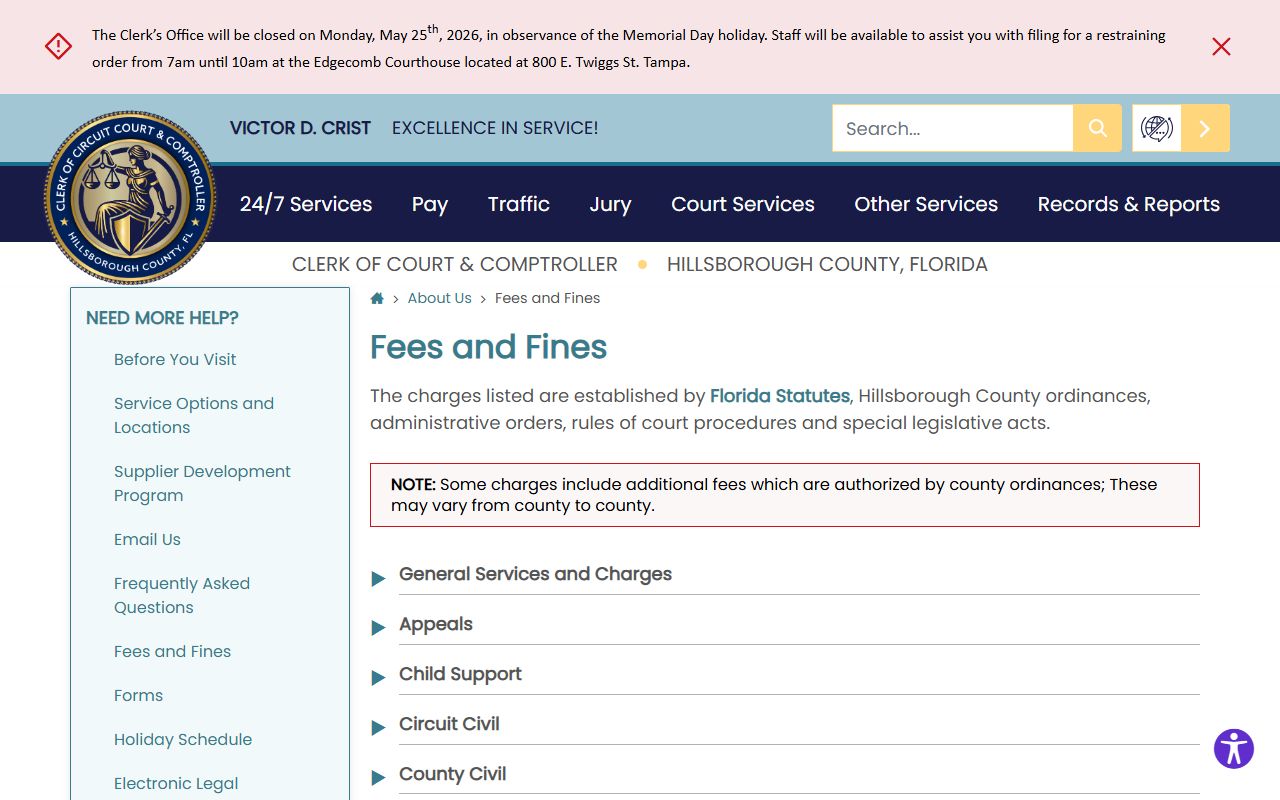
The Clerk's Fees and Fines page sets out copy fees, certification fees, search fees, civil filing fees, marriage fees, probate fees, and sealing/expunction fees. Most of these flow from Florida statutes and from administrative orders of the Thirteenth Judicial Circuit. A few of the most-asked items are listed below.
| Item | Amount |
|---|---|
| Photocopy up to 8.5 x 14 inches | $1.00 per page |
| Larger photocopy | $5.00 per page |
| Certifying a copy of a public record | $2.00 |
| Exemplified certificate | $7.00 |
| Search fee (per name, per year, when staff search is needed) | $2.00 |
| Circuit civil action over $50,000 | $400.00 |
| County civil $2,500.01 to $15,000 | $300.00 |
| Eviction of tenant | $185.00 |
| Marriage license including certified copy | $86.00 |
| Sealing a court file or expungement of a record | $42.00 plus copy and cert costs |
The Fees and Fines page is the source of truth and the place to check for any change.
Note: Sealing and expunction also need an FDLE eligibility certificate before a Hillsborough judge will rule on the petition, per Florida Statutes 943.0585 and 943.059.
Locations and Contact
The main Clerk office for court records is in downtown Tampa at the George Edgecomb Courthouse. The Clerk also runs a service counter for records viewing and public-record services on Pierce Street. Hours and counter rules can change, so call ahead for any in-person trip that needs a same-day certified copy.
Edgecomb Courthouse Clerk's Office
Clerk: Victor D. Crist
George Edgecomb Courthouse
800 E Twiggs St
Tampa, FL 33602
813-307-7000
HOVER support: 813-307-7180
Mon to Fri, 8 a.m. to 5 p.m.
Note: New felony arrest cases route through the Criminal Courthouse Annex at 401 N Jefferson Street, Tampa, FL 33602, but the case file is still kept by the same Clerk.
Records Request Form Fields
The Public Records Request page walks the public through what to include with a request. The fields below are the ones the Clerk asks for most. Some are required for any search. Others speed up the work and cut down on staff search fees.
| Field | Required | Notes |
|---|---|---|
| Case Number | No, but helpful | If known, this is the fastest path. Format is year then division then sequence. |
| Party Names | Yes | Last and first name of at least one party. Add aliases if known. |
| Document Type | Yes | Final judgment, petition, order, deed, marriage license, and so on. |
| Date Range | Yes if no case number | Helps narrow a name search and limit per-year search fees. |
| Number of Copies | Yes | Set the page count and whether certified or plain copies are needed. |
| Requester Contact | Yes | Name, mailing address, email, and phone for status updates and pickup. |
| Statutory Basis for Removal | Only for confidential redaction | Needed when asking the Clerk to remove information from an online image under Florida law. |
How to Request a Certified Copy
A certified copy carries the Clerk's seal and a signed certification that the copy is a true copy of the record on file. Courts, embassies, title insurers, schools, and many state agencies require a certified copy and will reject a plain printout. The steps below cover both the online eCertify path and the in-person path.
- Find the record. Search HOVER for a court file or the Official Records index for a recorded document. Note the case number, book and page, or instrument number.
- Pick the format. For a digital certified copy use eCertify and click the Certify icon on the document image. For a paper certified copy with raised seal, plan a counter visit or a mail-in request.
- Fill out the request. For mail or counter, complete the Clerk's public records request form with party names, document type, date, and copy count. For eCertify, the shopping cart captures the same info.
- Pay the fee. Online, the cart charges the $2 cert fee, $1 per page, the $6 vendor fee per document, and a 3.5% card fee. In person or by mail, pay $1 per page plus $2 to certify, by cash, check, or money order.
- Receive the copy. eCertify sends two emails with secure download links. Mail orders ship to the address on the request form. Counter orders are handed across the window the same day when staff time allows.
For broader open-government questions, see the public records page. For court file basics, see the court records overview.