
What County Court Is in Florida
Florida runs a four-tier court system. The Supreme Court of Florida sits at the top. Below it are the District Courts of Appeal. Then come the two trial courts in every county. Circuit Court is the general-jurisdiction trial court. County Court is the limited-jurisdiction trial court. Hillsborough is part of the Thirteenth Judicial Circuit, and the same circuit administers both Circuit and County Court in the county.
County Court handles smaller and less complex matters. By statute the civil jurisdiction limit is $50,000, so any money claim at or under that ceiling is filed as a county civil case. Criminal jurisdiction covers misdemeanors and county ordinance violations, but not felonies. Traffic citations, small claims under $8,000, evictions, and most landlord-tenant matters also land in County Court. Felony cases, divorce, probate, guardianship, juvenile, and lawsuits over $50,000 go to Circuit Court instead.
The case-type split is what matters for a Hillsborough County Court records search. Searchers do not pick a separate clerk or portal for County Court. The Clerk of the Circuit Court and Comptroller keeps both sets of files. The Hillsborough Online Viewing of Electronic Records (HOVER) portal indexes both. A user just needs to know what kind of case it is so they pick the right court type or case type filter.
Misdemeanor Criminal Cases in County Court
Misdemeanors are the criminal cases County Court hears. A misdemeanor in Florida is a crime that carries up to one year in jail. Common examples include first-offense DUI, petit theft, driving on a suspended license, disorderly conduct, simple battery, trespass, possession of small amounts of cannabis, and many drug-paraphernalia charges. Domestic battery starts as a misdemeanor in most cases. Violation of injunction matters are also handled at the County Court level when charged as a misdemeanor.
The Clerk's County Criminal department is the office that files, processes, and maintains the records for misdemeanor cases in Hillsborough. According to the Clerk, the Misdemeanor Department files and processes records for misdemeanor offenses, prepares the official court file, and keeps the original arrest document and release forms. If a person was detained and then released without being booked into the Hillsborough jail, they may receive an arraignment date on a Notice to Appear instead of a bond paper. For broader arrest details, see criminal records.
A useful look at the Clerk's County Criminal page is below.
The Clerk's County Criminal Court Services page outlines how misdemeanor files move through the system.
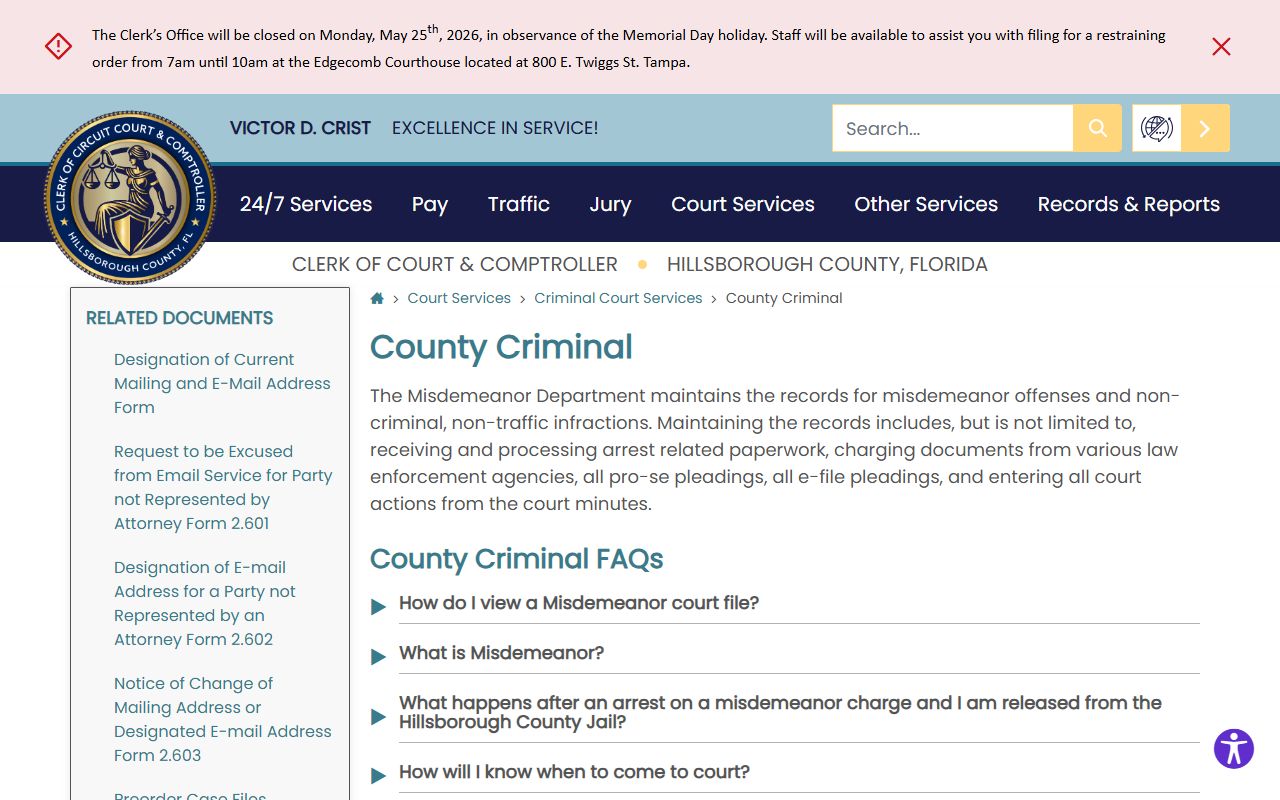
That page is the entry point for people who want to know how the Misdemeanor Department handles County Court paperwork from arrest through disposition.
Traffic Cases in County Court
Traffic cases make up the largest share of County Court filings in Hillsborough. The Civil Traffic Court is located at 419 N. Pierce Street in Tampa. Non-criminal moving violations, speeding tickets, red-light camera cases, and most infraction-only citations are handled there. Criminal traffic, such as DUI, driving while license suspended with knowledge, and reckless driving, routes through County Court's criminal traffic side. For citation lookups, fines, and traffic-school questions, see the dedicated traffic court records page.
HOVER allows a direct Citation Number search, which is the fastest way to find a Hillsborough traffic case. A Party or Business Name search also works when the citation number is not on hand. Fines, points, and school election options are usually visible on the case detail. If the case is criminal traffic, expect arrest documents, plea papers, and any conditions of release in the file. The same Clerk handles the records and the payments.
- Civil infractions: speeding, no proof of insurance, expired tag, careless driving.
- Red-light camera cases: handled as civil traffic infractions in County Court.
- Criminal traffic: DUI first or second offense, leaving the scene, reckless driving.
- License-related: driving while license suspended with knowledge.
- School-zone and work-zone enhanced cases.
Small Claims in County Court
Small claims in Florida cover money disputes up to $8,000, not counting costs, interest, and attorney fees. Hillsborough small claims are filed in County Court and follow the Florida Small Claims Rules, which are designed to be quicker and less formal than full county civil practice. Parties often appear without lawyers. The first court date is a pretrial conference, where the judge asks if the parties want to mediate or set the case for trial.
Typical small claims cases include unpaid bills, security deposit disputes, broken contracts for small jobs, minor car-accident property damage, returned-check claims, and unpaid loans between individuals. The Clerk's fee schedule sets the filing fee by claim size, with brackets at under $100, $100 to $500, $500.01 to $2,500, and $2,500.01 to $15,000 (the upper bracket spills past small claims into county civil). Service of process, witness fees, and copies are billed separately.
A judgment from small claims can be searched the same way as any other Hillsborough County Court case. Indexing on HOVER includes case number, parties, filing date, and disposition. Once a judgment is entered, the Clerk may also record it in Official Records when the prevailing party submits it for recording, which is then searchable through the court records system.
County Civil Cases Above Small Claims
County civil covers money claims over $8,000 and up to $50,000. The same court hears these cases, but the rules are the regular Florida Rules of Civil Procedure rather than the small-claims rules. That means full discovery, formal pleadings, and motion practice. Filing fees rise with the claim size. The Clerk lists $300 for claims of $2,500.01 to $15,000 and $400 for claims of $15,000.01 to $50,000.
Common county civil filings include collection lawsuits, breach of contract, insurance subrogation, debt buyer cases, and homeowner-association lien actions under the cap. Evictions of residential tenants are handled in County Court too, with a separate $185 filing fee. The eviction calendar moves faster than ordinary civil because of statutory time limits for tenant answers and writs of possession.
Anything above $50,000 leaves County Court and is filed in Circuit Court. Foreclosure of real property follows its own fee ladder by amount in controversy. A searcher who is not sure whether a case is county civil or circuit civil should run the party name in HOVER without restricting to a court type. The result list shows the court type next to each hit, which makes the split obvious.
Local Ordinance Cases
County ordinance violations are part of County Court's criminal-side caseload. Hillsborough County and the City of Tampa adopt ordinances on things like noise, animal control, business licensing, zoning, sign rules, and code enforcement. When an ordinance violation carries a possible jail term or a criminal penalty, the case is charged in County Court. Civil code-enforcement matters, by contrast, are heard before a special magistrate or code board rather than the County Court bench.
Records for ordinance prosecutions follow the same Clerk filing path as other misdemeanors. The case will show in HOVER under County Criminal with the ordinance section cited in the charging document. Fines and court costs from ordinance cases are paid to the Clerk just like any other criminal case.
Searchers should know that a parking ticket or routine code-violation notice is not a court case until it is referred for prosecution. Most never reach that point. A search of County Court records will not return a parking citation on its own.
How to Search County Court Records on HOVER
HOVER is the public court-record portal that hosts both Circuit and County Court files for Hillsborough. The same login, the same search modes, and the same case-detail screens apply to County Court cases. The trick is to set the court type or case type filter when the goal is to limit results to County Court. Anonymous users can index-search and view progress dockets; registered users see more documents under the Access Security Matrix.
The basic search path runs from the HOVER home page through case detail and, if needed, into eCertify for certified copies. Use the step list below.
- Open HOVER and pick a search mode: Case Number, Citation Number, Party or Business Name, or Date Range / Court Type / Case Type.
- For a misdemeanor, choose Party Name or Case Number and set Court Type to County Criminal. For a traffic case, the Citation Number search is the fastest path.
- For small claims or county civil, set Court Type to County Civil and use a date range when the file is older.
- Enter the known values. Avoid overly broad date ranges that return too many results.
- Click the magnifying-glass control next to the case number to open case detail and the progress docket.
- If a document image is needed, view it on the case detail. Confidential or sealed images will not appear.
- To order a certified copy, add the document to the eCertify cart, pay the vendor and Clerk fees, and download from the secure link emailed by the system.
Browser support listed by HOVER includes recent versions of Chrome, Firefox, and Edge, with Java enabled. Sessions log out after 30 minutes of inactivity.
County Court vs Circuit Court
The split between Hillsborough County Court and Circuit Court is set by Florida statute, not by local rule. A quick comparison clears up which court holds which records.
| Feature | County Court | Circuit Court |
|---|---|---|
| Civil jurisdiction limit | Up to $50,000 (small claims up to $8,000) | Over $50,000 |
| Criminal jurisdiction | Misdemeanors and ordinance cases | Felonies |
| Family and probate | None | Divorce, probate, guardianship, mental health |
| Appeals route | Circuit Court appellate division | Second District Court of Appeal |
| Clerk of record | Hillsborough Clerk of the Circuit Court and Comptroller | Hillsborough Clerk of the Circuit Court and Comptroller |
The clerk is the same. The portal is the same. The judges, divisions, and case-number prefixes are different, and that is what changes how a search is set up. A County Court misdemeanor will not show up if a user filters only for Circuit Criminal, and the reverse is true as well.
Cases that Move from County Court to Circuit Court
A losing party in County Court who wants to appeal does not go straight to the District Court of Appeal. Instead, the appeal goes up to the Circuit Court's appellate division. The Clerk's fee schedule lists a $281 county appeal filing fee and a $100 circuit appeal filing fee, which reflects this two-step appellate path. The appellate panel of Circuit Judges reviews the County Court record and rules on legal error.
Cases can also move between levels when a charge changes. A misdemeanor that the State Attorney later refiles as a felony jumps from County Criminal to Circuit Criminal. A small claims plaintiff who amends a complaint to seek more than $50,000 moves the case from County Civil to Circuit Civil. The case number and case type will usually change with the move, which matters for HOVER searches.
Once an appeal is decided, further review may go to the Second District Court of Appeal under that court's discretionary or mandatory jurisdiction. The Clerk lists a $300 fee for second-tier appeals. Records of these appeals are not stored in HOVER; they live in the appellate court's docket system.
Where Hillsborough County Court Is Held
County Court hearings in Hillsborough are spread across several courthouse locations. The right building depends on whether the case is criminal, civil, traffic, or based outside Tampa proper.
George E. Edgecomb Courthouse
800 E. Twiggs Street
Tampa, FL 33602
Civil divisions including County Civil
Hillsborough County Criminal Courthouse Annex
401 N. Jefferson Street
Tampa, FL 33602
Criminal cases, first appearance
Plant City Courthouse
301 N. Michigan Avenue
Plant City, FL 33563
East-county hearings, mixed dockets
The Thirteenth Judicial Circuit's Court Locations page keeps the most current list of courtrooms, building hours, and division assignments. Searchers visiting in person should confirm the courtroom on the day of the hearing because divisions are reshuffled from time to time.
Note: First appearance for newly booked misdemeanor defendants is held daily at the Criminal Courthouse Annex regardless of where the underlying case will eventually be heard.
Public Access to County Court Records
Florida law presumes court records are open. The right to inspect and copy public records is set out in Florida Statutes Chapter 119, and judicial branch records are also governed by Florida Rule of General Practice and Judicial Administration 2.420. County Court records follow the same access rules as Circuit Court records. Confidentiality applies only where a statute or rule specifies it.
For inspection and copy fees, the controlling statute is Florida Statutes section 119.07. That section sets the custodian's duty to provide reasonable access and to charge only authorized fees. Hillsborough's Clerk fee schedule implements those statutory rates.
A snapshot of the controlling statute is below.
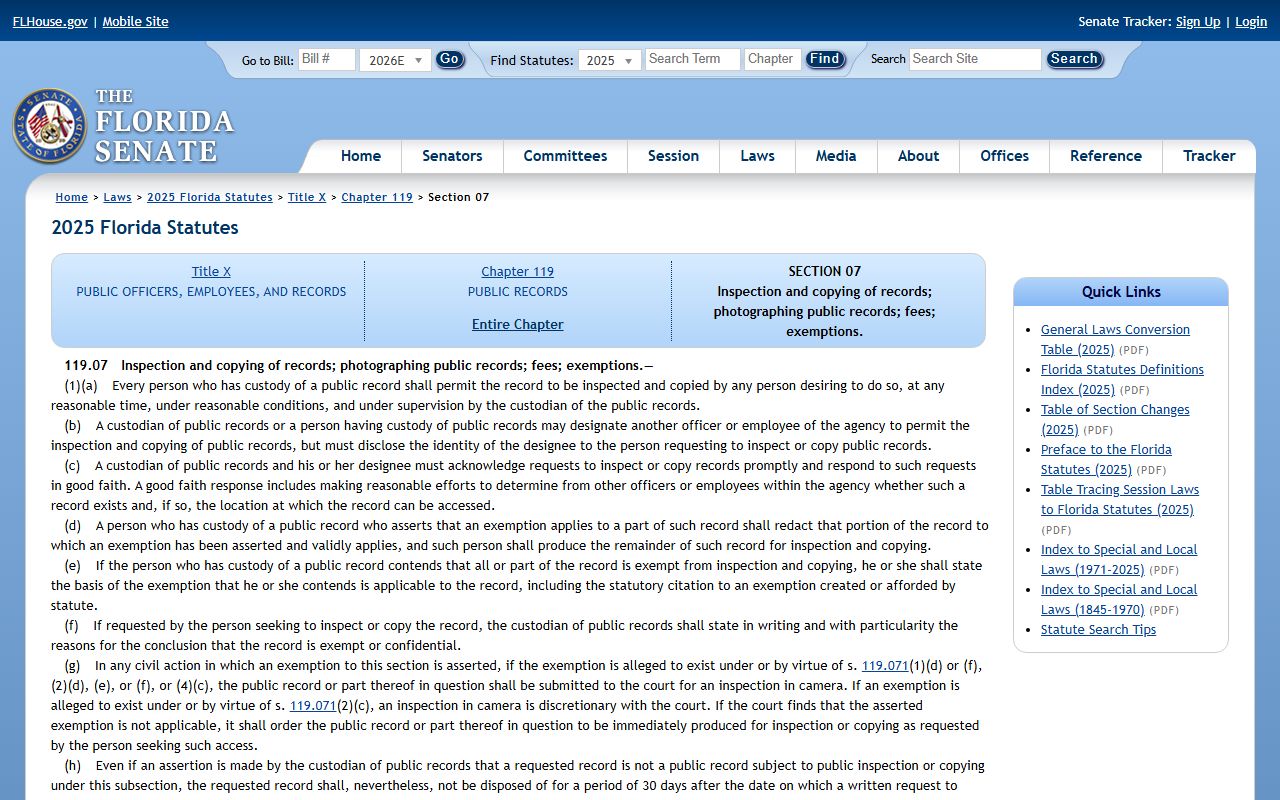
Section 119.07 sits behind every records request a member of the public makes to the Clerk's office, whether for a County Court file or any other county record. Fee specifics for the Clerk are listed on the Clerk's Fees and Fines page.
Clerk Service Charges for County Court Records
The Clerk's authority to collect service charges comes from Florida Statutes section 28.24. That law sets a baseline of charges for copies, certifications, record searches, seals, and many filing services. Hillsborough's fee page applies these charges and adds any county-level fees authorized by statute or administrative order.
The full statute is shown below.
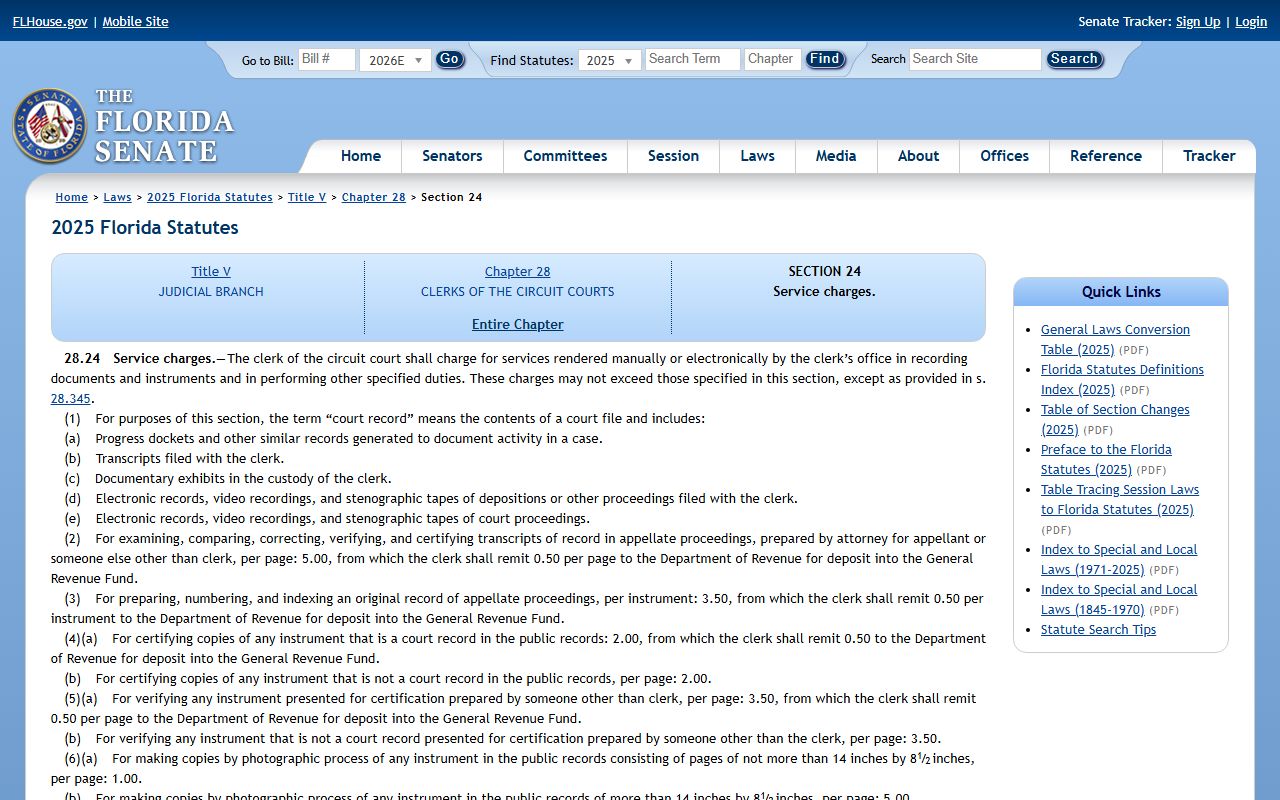
The fees that matter most to a typical County Court records searcher are the $1 per page photocopy charge, $2 certification per instrument, and the $42 charge for sealing a court file or expunging a record. Filing fees climb with claim size in civil cases, and appeal filing fees apply when a party seeks review.
The Clerk Handles County Court Records
One office keeps both Circuit and County Court records in Hillsborough. The Clerk of the Circuit Court and Comptroller, Victor D. Crist, is the custodian for County Court files. There is no separate County Court clerk in Florida, unlike some other states that split clerks by court level. The Clerk also keeps Official Records, marriage licenses, and Board of County Commissioners records. For full details on the office, see the Clerk of Court page.
Because the Clerk runs both record systems, the Records and Reports page is one stop for County Court access, Official Records lookups, certified copy ordering, and public-records requests. The Recording Department handles documents that move into Official Records. The County Criminal department handles misdemeanor files. The County Civil department handles small claims, evictions, and county civil cases. Each has its own counter at the Clerk's service locations.
Other useful internal pages include the main court records overview, court dockets, and the Circuit Court page for cases above the County Court limits.