
Criminal Records in Hillsborough County
A Hillsborough County criminal record is the paper trail that starts when a deputy or officer takes someone into custody and continues through every court event that follows. The Hillsborough County Sheriff's Office, led by Sheriff Chad Chronister, books arrestees at the Orient Road Jail and the Falkenburg Road Jail. HCSO generates the arrest affidavit, the booking sheet, the mugshot, and the initial bond paperwork. Once the State Attorney for the Thirteenth Judicial Circuit files formal charges, the file moves to the Clerk of the Circuit Court and gains a case number, a judge, and a docket.
Arrest data and criminal court data are kept in different systems. The Sheriff runs the jail roster. The Clerk runs the case index. For the full court file with pleadings, motions, and the final judgment, see Hillsborough County court records. This page focuses on the arrest side and the criminal case shortcuts that come with it.
County Criminal vs Circuit Criminal
Florida splits criminal cases by severity. Misdemeanors go to County Court. Felonies go to the Circuit Court. Both share the same clerk and the same downtown courthouse complex, but the divisions, judges, and rules differ. The Clerk's County Criminal page explains that the Misdemeanor Department files, processes, and maintains records for misdemeanor offenses and prepares the official court file, including the original arrest document and release forms.
| County Criminal | Circuit Criminal | |
|---|---|---|
| Court | County Court | Circuit Court, Thirteenth Judicial Circuit |
| Charge level | Misdemeanors and criminal traffic | Felonies |
| Max jail term | Up to one year in county jail | More than one year, up to life or death |
| Typical cases | DUI, petit theft, simple battery, trespass | Burglary, grand theft, drug trafficking, violent felonies |
| Clerk page | County Criminal | Felony / Circuit Criminal |
A criminal traffic charge like DUI sits with the misdemeanor side rather than civil traffic. The civil traffic counter at 419 N. Pierce Street handles ordinary infractions. Anything criminal in nature, even at the misdemeanor level, ends up in the criminal divisions. Cases that begin with a Notice to Appear instead of a jail booking still receive an arraignment date through the misdemeanor department.
HCSO Arrest Inquiry: Who's in Jail
The fastest way to confirm a recent booking is the HCSO Arrest Inquiry portal. HCSO states the database lists individuals currently in jail and includes charges, bond amounts, and booking photos. Adult arrest data goes back to January 1, 1995 where an electronic record exists. The portal updates every 30 minutes. New bookings do not show up in the general listing for the first 24 hours, but a search by full first and last name can still surface them during that window. Released inmates stay visible for 90 days, then drop off the public view unless the requester is an authorized member.
- Open the HCSO Arrest Inquiry page and accept the public-use notice.
- Pick a search field. Use Name when looking for a person, Booking Number when handed a paper receipt, or Booking Date when scanning a short window.
- Add filters if needed: Date of Birth, Race, Sex, or a date range. For the first 24 hours after arrest, enter both first and last name.
- Under More Options, check Current Inmates Only to hide released bookings, or check Include Arrest Details to expand the result rows.
- Sort by Booking Date, Booking Number, or Name. Hit Search.
- Click into a record for the mugshot, charges, bond amount, and arrest details. Print or save the page if needed.
Full access to the back end is reserved for law enforcement, accredited media, the bond industry, and members of any recognized State Bar association. HCSO requires an email from an official account to publicaffairs@teamhcso.com and grants final approval at its discretion. Everyone else uses the public side, which still returns charges, bond, and booking photo on each visible record. For a deeper look at currently booked inmates, see the Hillsborough inmate records page; for people who have just left custody, see released inmates.
HOVER Criminal Case Search
Once the State Attorney files charges, the case lands in the Clerk's HOVER system. HOVER stands for Hillsborough Online Viewing of Electronic Records and is the Clerk's public court-record portal for case indexes, progress dockets, and non-confidential document images. The Florida Supreme Court authorized the Hillsborough County Clerk of Court and Comptroller to provide this electronic access under the Standards for Access to Electronic Court Records and the Access Security Matrix.
Search a criminal case on HOVER by Case Number, Uniform Case Number, Party Name, or Citation Number. The Date Range, Court Type, and Case Type filters help narrow felony or misdemeanor searches. A "Case Not Found" result may mean the case is sealed or that the number was typed wrong. Anonymous users see indexes and progress dockets. Attorneys of record and pro se parties see most images. Sexual abuse and certain juvenile or family items may not appear remotely and require an in-person visit to the Clerk's office.
A criminal HOVER record usually shows the case number, the filing date, the judge, the division, the parties (the State of Florida vs the defendant), each docket event, hearing dates, the bond amount, and the disposition. Document images carry the charging Information, motions, plea forms, sentencing orders, and the final judgment when available. For the broader court records workflow, see Hillsborough County court records.
Arrest Does Not Mean Conviction
An arrest is an accusation, not a finding of guilt. HCSO repeats this point at the top of the Arrest Inquiry. A booking sheet is created on probable cause, which is a much lower bar than the beyond-a-reasonable-doubt standard a judge or jury applies at trial. Many people booked into the Orient Road or Falkenburg Road jails are released without ever being formally charged, are charged but later cleared, or accept a plea to a reduced count. Using a raw arrest record as proof of guilt is both inaccurate and risky.
| Charge | Conviction | |
|---|---|---|
| Stage of case | Accusation at or after arrest | Verdict, plea, or adjudication |
| Burden of proof | Probable cause | Beyond a reasonable doubt |
| Decision maker | Officer, prosecutor, or grand jury | Judge or jury |
| Possible outcomes | Dropped, reduced, dismissed, or filed | Sentence, probation, withhold, acquittal on appeal |
| Public record | Yes, unless sealed or expunged | Yes, unless sealed or expunged |
Florida also has the "withhold of adjudication" outcome. The defendant pleads, the court accepts the plea, but no formal conviction is entered. The case still appears in the court file and on background checks. A clean arrest record does not always mean an empty criminal history, and a busy arrest record does not always mean a long list of convictions. Read the disposition line, not just the charge.
Bond and First Appearance
Every person arrested in Hillsborough County is entitled to a first appearance hearing within 24 hours. A judge reviews the arrest affidavit, sets or reviews bond, and decides whether counsel should be appointed. Many misdemeanors carry a standard bond schedule and a release is possible before first appearance. Felonies often need a judge's order.
Bond can be paid as a cash bond, a money order, or a surety bond through a registered bail bond agent. Cash bonds and purges must be the exact amount. HCSO does not take credit or debit cards. The payment counter is at the Orient Road Jail, 1201 Orient Road, Tampa, FL 33619, and the Inmate Records line is 813-247-8400. The person posting bail needs the inmate's name with correct spelling, date of birth, and a valid ID.
HCSO collects cash bonds for Hillsborough cases but transmits the money to the Clerk. The Clerk processes the distribution once the case is over. Under Florida Statutes section 903.286, the Clerk can withhold enough from a cash bond to pay unpaid prosecution costs, representation costs, court fees, costs, and penalties. Any remainder goes to the bond depositor of record. For warrant-related bond questions, see Hillsborough warrant records.
FDLE Statewide Criminal History
The Florida Department of Law Enforcement keeps the statewide criminal history repository. Where HCSO Arrest Inquiry shows only Hillsborough bookings and HOVER shows only Hillsborough court files, the FDLE database pulls together arrests, charges, and dispositions reported by every Florida law enforcement agency and clerk. The public side runs through the Criminal History Information request portal.
Look up a name on the FDLE Computerized Criminal History portal. This is the official statute citation page that supports the system. The portal returns Florida arrest events tied to a person, the charges, and the available disposition. FDLE notes that name-based checks are not the same as a fingerprint check and can return false matches or miss people who use aliases. Anyone needing a certified background check for employment, licensing, or court should request a fingerprint-based search through FDLE rather than relying on the public name search.
A lead-in screenshot of the FDLE criminal history portal is below, sourced from the FDLE search application landing page.
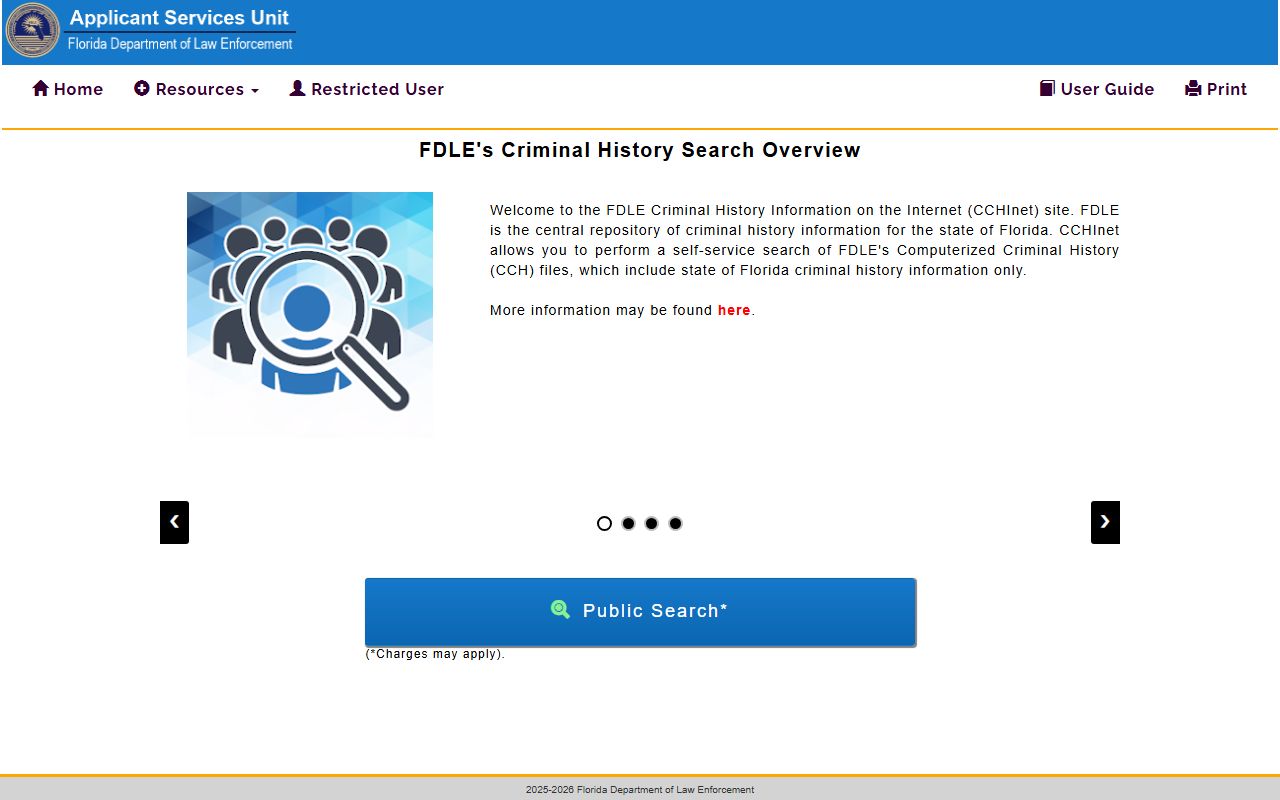
The FDLE record will not include sealed or expunged cases. If a court has granted relief, the arrest may still appear on an HCSO Arrest Inquiry list for a short time but should drop from FDLE once agencies process the order.
Sealed vs Expunged Records
Florida treats sealing and expunction as two separate remedies. Sealing limits public access but the record still exists in restricted form. Expunction goes further: the record is destroyed or made unavailable except as specifically allowed by law. Both processes usually start with an FDLE Certificate of Eligibility and end with a petition in the court that handled the case. The Clerk's fee schedule lists $42 for sealing any court file or for expungement of any record, plus the usual copy and certification costs.
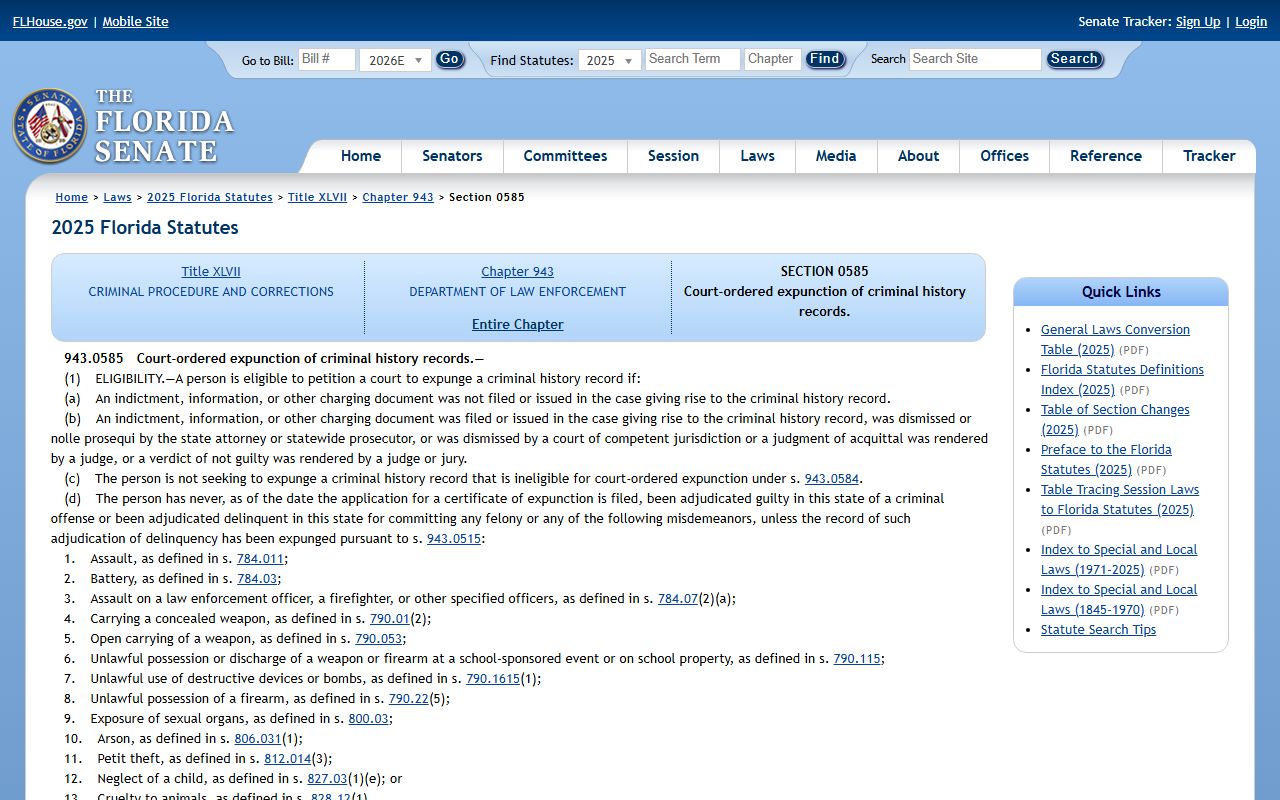
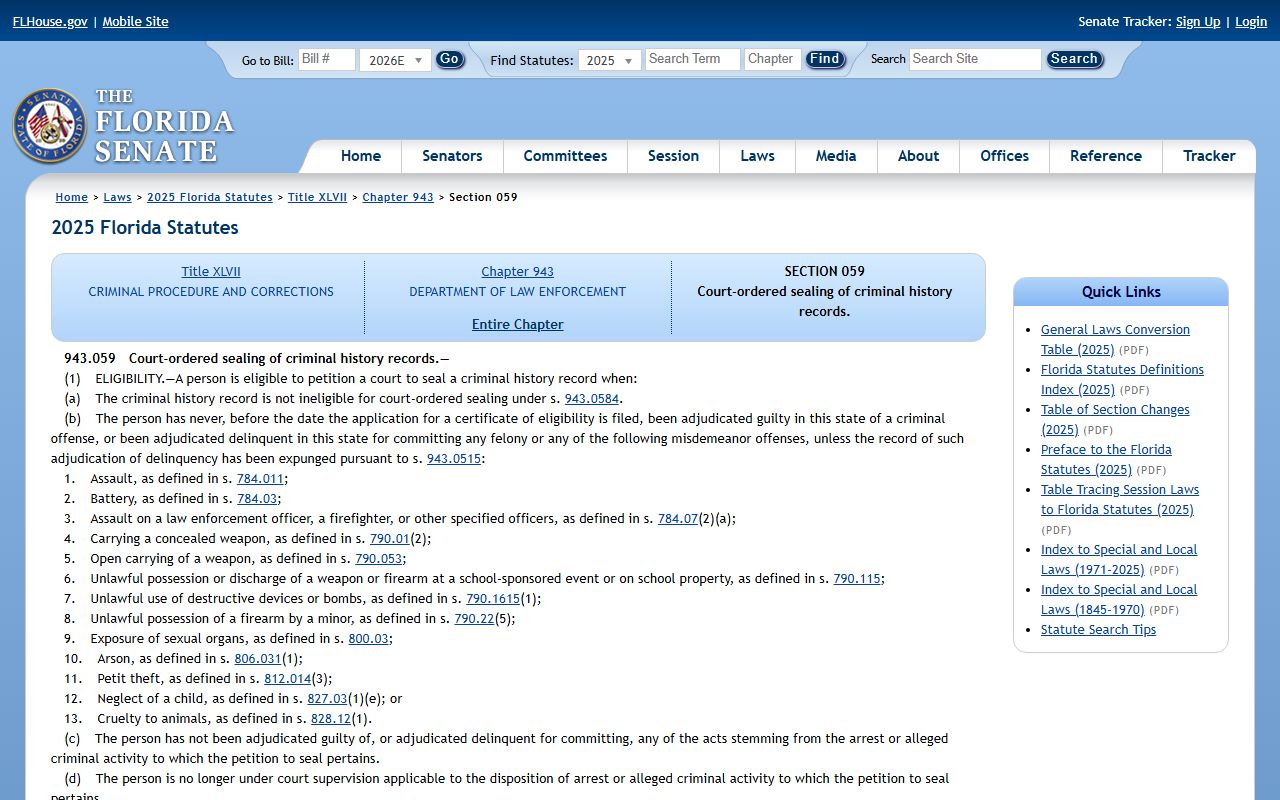
The expunction statute is set out in Florida Statutes section 943.0585. The sealing statute is at Florida Statutes section 943.059. Both spell out who qualifies, what charges are excluded, and how a granted order is processed by the Clerk, the arresting agency, FDLE, and other criminal-justice repositories.
A look at the official expunction statute page is below, captured from the Florida Senate statute page for section 943.0585.
The sealing statute reads in parallel and is shown next, from the Florida Senate statute page for section 943.059.
The two paths compare like this:
| Sealed (§943.059) | Expunged (§943.0585) | |
|---|---|---|
| Public access | Hidden from public view | Destroyed or treated as if it never existed |
| Law enforcement | Limited access for criminal-justice purposes | Very limited access; usually a court order or statutory listing |
| Eligibility | Generally no prior conviction; case disposed without adjudication | Same disqualifiers, plus charge must have been dropped, dismissed, acquitted, or sealed for 10 years |
| FDLE step | Certificate of Eligibility from FDLE | Certificate of Eligibility from FDLE |
| Court filing | Petition in the court of disposition | Petition in the court of disposition |
| Fee at Clerk | $42 | $42 |
Common reasons a petition fails include a disqualifying prior conviction, a disqualifying charge, an incomplete disposition, a missing FDLE certificate, the wrong venue, or failure to serve a required agency. After a granted order, online portals sometimes display a generic "no record" or "restricted" message rather than spelling out what happened.
Florida Sexual Offender Registry
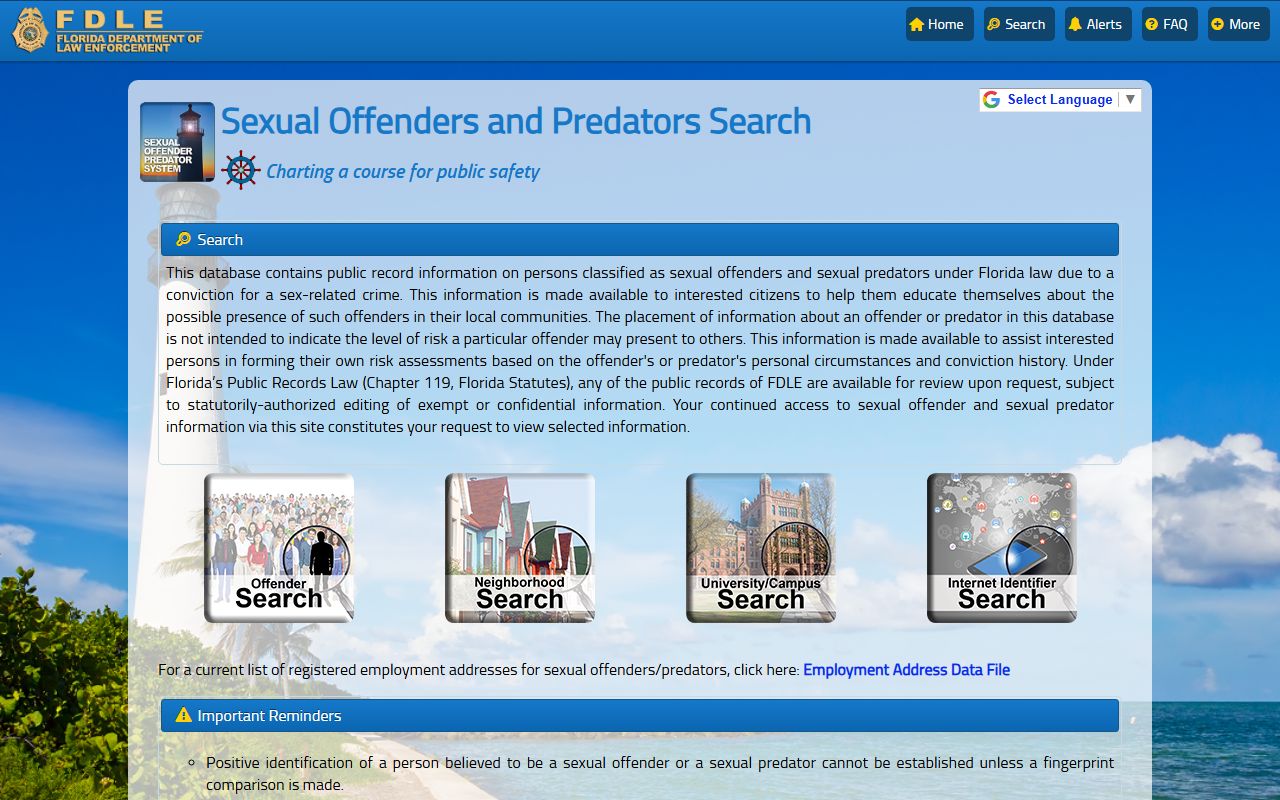
Florida runs a public sexual offender and predator registry under Florida Statutes section 943.0435. FDLE hosts the public search at offender.fdle.state.fl.us. The registry is searchable by name, address, ZIP code, county, neighborhood, or school. Hillsborough residents can pull a county-level list, an address-radius list, or a single name lookup.
The registry covers people required to register because of qualifying convictions. FDLE warns that the registry assists with risk assessment but positive identification requires fingerprints. A picture, charge, address, and registration status appear with each record. The screenshot below is from the FDLE sexual offender and predator search.
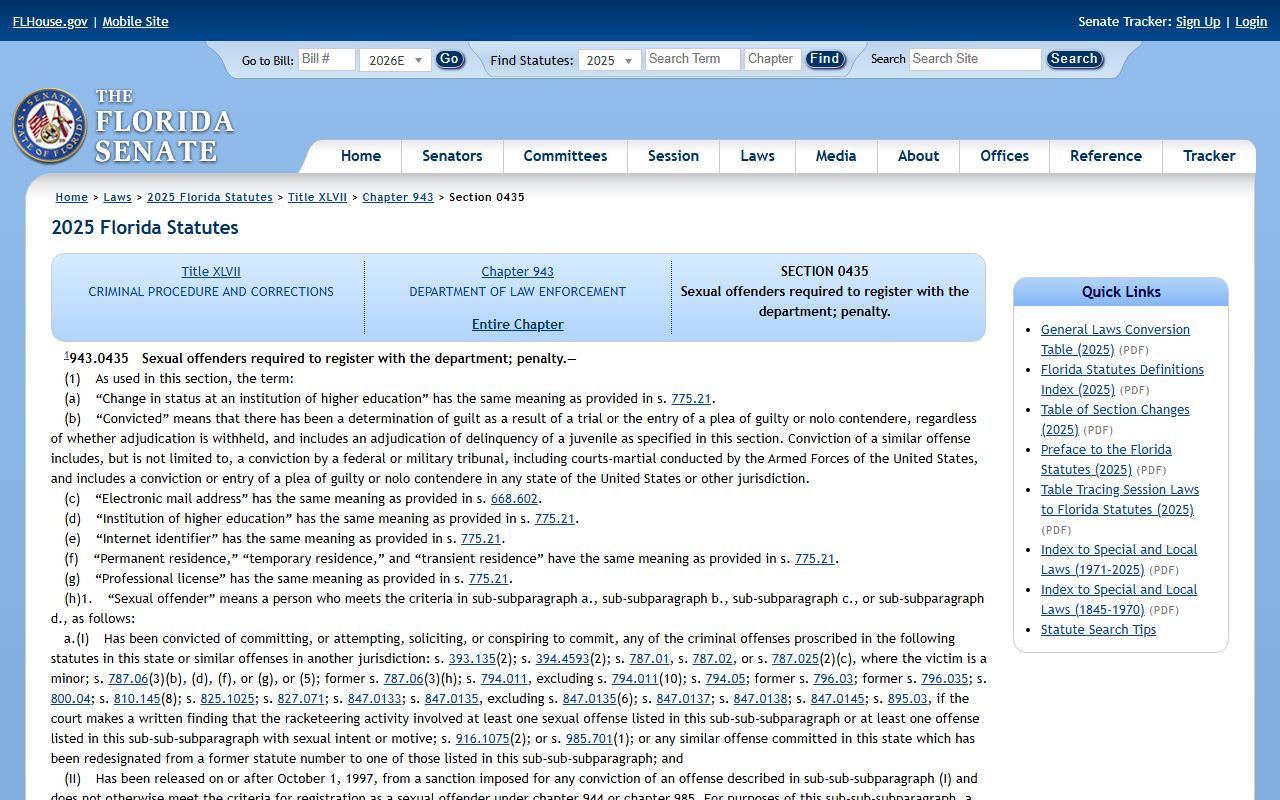
The underlying registration statute is shown next, from the Florida Senate page for section 943.0435.
Hillsborough's Re-Entry Center and Offender Registration Unit at 1201 Orient Road, Tampa, FL 33619 (phone 813-247-8460) handles in-person registration and updates for the county. Anyone with a change of address, employment, or vehicle on a registered file should contact that office.
Juvenile Records Are Confidential
Records of juveniles taken into custody for delinquency get a far tighter access rule than adult arrests. The governing law is Florida Statutes section 985.04. The statute restricts release of names, photos, and case detail and lists the narrow circumstances when disclosure is allowed. HOVER treats juvenile delinquency and dependency as restricted remote-access categories, which means most images require attorney-of-record or pro se access.
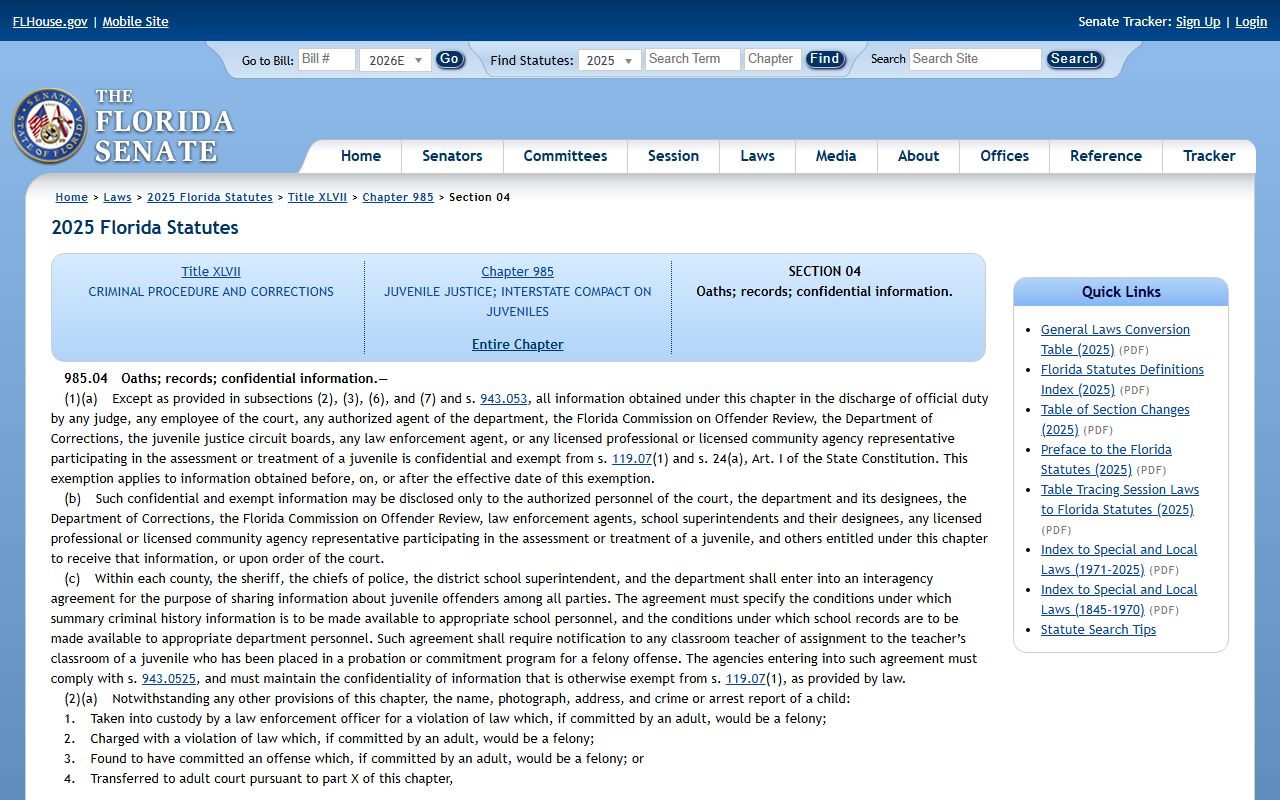
The juvenile confidentiality statute is below, from the Florida Senate page for section 985.04.
A juvenile case that is transferred to adult court loses the special protection for the transferred charges. A juvenile arrested for a serious felony where the State Attorney files in adult court will appear in HCSO and HOVER like any other adult defendant. Sealed and expunged remedies under sections 943.0585 and 943.059 are also available for many juvenile dispositions, with their own eligibility track. Confidentiality also extends to general exemption rules under Florida Statutes section 119.071, which shields victim information, security details, and other protected fields from public copies of criminal records.
Warrants and the Criminal Record
Active warrants are a major reason a person ends up with a fresh Hillsborough criminal record. The Sheriff posts an HCSO Warrant Inquiry portal at webapps.hcso.tampa.fl.us/WarrantInquiry. The portal lists active arrest warrants and capiases. Bench warrants and failure-to-appear warrants are the most common types after a missed court date. A capias often follows a probation violation or a missed compliance deadline.
Anyone with a possible warrant should not just walk into the courthouse. The safer path is to call an attorney, confirm bond and issuing judge through HOVER, and plan a surrender that limits jail time. HCSO has also warned about warrant scams: a March 2025 release noted that scammers have stolen more than one million dollars from residents through jury and warrant scam calls. A real deputy will not demand payment by gift card, Bitcoin, or wire. For deeper warrant detail, see Hillsborough warrant records.
Background Check Considerations
A name search on HCSO, HOVER, or FDLE is not a Fair Credit Reporting Act background check. Employers, landlords, insurers, and licensing boards that rely on consumer reports have to use an FCRA-compliant provider. Using a raw public-record lookup for those decisions can break federal law.
Important: This site is not a consumer reporting agency under the FCRA and the records linked here may not be used for employment, credit, housing, or insurance decisions.
A name-based check can also pull the wrong person. Two people with the same name and a close date of birth can blur into a single result. The fix is a fingerprint-based check through FDLE or the FBI, which uses biometric matching rather than a typed name.